Home > Press > Measuring progress in nanotech design
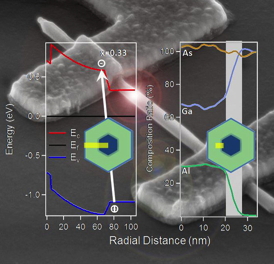 |
| Tracking a nanowire device's photocurrent responses, created by varying the wavelengths of a laser, will allow Drexel researchers to make measurements and adjustments that could help them design more efficient and smaller components for smartphones, laptops and even solar panels. |
Abstract:
Engineers working in the nanoscale will have a new tool at their disposal thanks to an international group of researchers led by Drexel University's College of Engineering. This innovative procedure could alleviate the persistent challenge of measuring key features of electron behavior while designing the ever-shrinking components that allow cell phones, laptops and tablets to get increasingly thinner and more energy efficient.
Measuring progress in nanotech design
Philadelphia, PA | Posted on September 4th, 2013"The interface between two semiconductor materials enables most of the electronic gadgets we use each day, from computers to mobile phones, displays and solar cells," said Guannan Chen, a graduate student in Drexel's Materials Science and Engineering department and the lead author of the group's report, which was recently published in Nano Letters. "One of the most important features of the interface is the height of the energy step required for the electron to climb over, known as band offset. Current methods for measuring this step height in planar devices are not practical for nanoscale devices, however, so we set off to find a better way to make this measurement."
Measuring the band offset faced by electrons jumping from one material to another is a key component of the design process because it guides the redesign and prototyping of nanoscale components in order to make them as efficient and effective as possible.
Using laser-induced current in a nanowire device and its dependence on the wavelength of the laser, the team devised a new method to derive the band offset. As they continuously change the wavelength of the laser, they measure the photocurrent responses. From this data they are able to determine the band offset.
"Using the interface within a co-axial core-shell semiconductor nanowire as a model system, we made direct measurements of the band offset for the first time in nanowire electronics," Chen said. "This is a significant cornerstone to freely design new nanowire devices such as solar cells, LEDs, and high speed electronics for wireless communications. This work can also extend to broader material systems which can be tailored for specific application."
The study, which was funded primarily by the National Science Foundation, also included researchers from Lehigh University, National Research Council - Institute for Microelectronics and Microsystems (IMM-CNR) and the University of Salento in Italy, Weizmann Institute of Science and Negev Nuclear Research Center in Israel and the University of Alabama. Each group added a key component to the project.
"Teamwork and close collaborations are essential in this work," said Guan Sun, the lead researcher from Lehigh. "The smooth channel of sharing ideas and experiment resources is valuable within the team because the quality and variety of the material system is vital to achieving accurate results."
While Drexel's members designed the experiments, processed the materials, made the nanowire device and conducted spectroscopic experiments, Sun and Yujie Ding, from Lehigh, supported the research with complementary optical experiments.
The collaborators from the IMM-CNR, Paola Prete, and the University of Salento, Ilio Miccoli and Nico Lovergine joined forces with Hadas Shtrikman, from Weizmann Institute of Science to produce the high quality nanowire used in the testing. Patrick Kung, from the University of Alabama, analyzed the composition of the nanowire at the atomic level, and Tsachi Livneh, of Negev Nuclear Research Center, contributed to the analyses.
"This remarkably simple approach to obtaining a key characteristic in individual nanowires is an exciting advance," said Dr. Jonathan Spanier, a professor in Drexel's College of Engineering who is the lead investigator of the project. "We anticipate it will be a valuable method as we develop nanoscale electronic devices having completely new and important functionalities."
With a better understanding of the material and electron behavior, the team will continue to pursue novel nanoscale optoelectronic devices such as new-concept transistors, electron-transfer devices and photovoltaic devices.
####
For more information, please click here
Contacts:
Britt Faulstick
215-895-5161
Mobile: 215-796-5161
Copyright © Drexel University
If you have a comment, please Contact us.Issuers of news releases, not 7th Wave, Inc. or Nanotechnology Now, are solely responsible for the accuracy of the content.
Bookmark:


| Related Links |
| Related News Press |
News and information
 Quantum computer improves AI predictions April 17th, 2026
Flexible sensor gains sensitivity under pressure April 17th, 2026
A reusable chip for particulate matter sensing April 17th, 2026
Detecting vibrational quantum beating in the predissociation dynamics of SF6 using time-resolved photoelectron spectroscopy April 17th, 2026
Imaging
Simple algorithm paired with standard imaging tool could predict failure in lithium metal batteries August 8th, 2025
Chip Technology
A reusable chip for particulate matter sensing April 17th, 2026
Metasurfaces smooth light to boost magnetic sensing precision January 30th, 2026
Optical computing/Photonic computing
ICFO researchers overcome long-standing bottleneck in single photon detection with twisted 2D materials August 8th, 2025
Programmable electron-induced color router array May 14th, 2025
Nanoelectronics
Lab to industry: InSe wafer-scale breakthrough for future electronics August 8th, 2025
Interdisciplinary: Rice team tackles the future of semiconductors Multiferroics could be the key to ultralow-energy computing October 6th, 2023
Key element for a scalable quantum computer: Physicists from Forschungszentrum Jülich and RWTH Aachen University demonstrate electron transport on a quantum chip September 23rd, 2022
Reduced power consumption in semiconductor devices September 23rd, 2022
Discoveries
Quantum computer improves AI predictions April 17th, 2026
Flexible sensor gains sensitivity under pressure April 17th, 2026
A reusable chip for particulate matter sensing April 17th, 2026
Detecting vibrational quantum beating in the predissociation dynamics of SF6 using time-resolved photoelectron spectroscopy April 17th, 2026
Announcements
A fundamentally new therapeutic approach to cystic fibrosis: Nanobody repairs cellular defect April 17th, 2026
UC Irvine physicists discover method to reverse ‘quantum scrambling’ : The work addresses the problem of information loss in quantum computing system April 17th, 2026
Interviews/Book Reviews/Essays/Reports/Podcasts/Journals/White papers/Posters
A fundamentally new therapeutic approach to cystic fibrosis: Nanobody repairs cellular defect April 17th, 2026
UC Irvine physicists discover method to reverse ‘quantum scrambling’ : The work addresses the problem of information loss in quantum computing system April 17th, 2026
Tools
Metasurfaces smooth light to boost magnetic sensing precision January 30th, 2026
From sensors to smart systems: the rise of AI-driven photonic noses January 30th, 2026
Japan launches fully domestically produced quantum computer: Expo visitors to experience quantum computing firsthand August 8th, 2025
Energy
Sensors innovations for smart lithium-based batteries: advancements, opportunities, and potential challenges August 8th, 2025
Simple algorithm paired with standard imaging tool could predict failure in lithium metal batteries August 8th, 2025
Photonics/Optics/Lasers
Metasurfaces smooth light to boost magnetic sensing precision January 30th, 2026
From sensors to smart systems: the rise of AI-driven photonic noses January 30th, 2026
Solar/Photovoltaic
Spinel-type sulfide semiconductors to operate the next-generation LEDs and solar cells For solar-cell absorbers and green-LED source October 3rd, 2025
KAIST researchers introduce new and improved, next-generation perovskite solar cell November 8th, 2024
Groundbreaking precision in single-molecule optoelectronics August 16th, 2024
Development of zinc oxide nanopagoda array photoelectrode: photoelectrochemical water-splitting hydrogen production January 12th, 2024
 |
||
 |
||
| The latest news from around the world, FREE | ||
 |
||
|
|
||
| Premium Products | ||
 |
||
|
Only the news you want to read!
Learn More |
||
 |
||
|
Full-service, expert consulting
Learn More |
||
|
|
||