Home > Press > New NIST nanoscale indenter takes novel approach to measuring surface properties
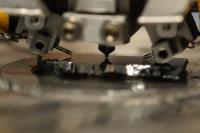 |
| Good vibrations: Close-up image shows the tip of the new NIST nanoscale indenter flanked by two tuning forks that provide a stable, noncontact reference relative to the specimen, a piece of single-crystal silicon. Using a piar of tuning forks allows the system to compensate for any tilt.
Credit: Nowakowski/NIST |
Abstract:
Researchers from the National Institute of Standards and Technology (NIST) and the University of North Carolina have demonstrated a new design for an instrument, a "instrumented nanoscale indenter," that makes sensitive measurements of the mechanical properties of thin films -- ranging from auto body coatings to microelectronic devices -- and biomaterials. The NIST instrument uses a unique technique for precisely measuring the depth of the indentation in a test surface with no contact of the surface other than the probe tip itself.*
New NIST nanoscale indenter takes novel approach to measuring surface properties
Gaithersburg, MD | Posted on July 24th, 2013Nanoindenter head
Indenters have a long history in materials research. Johan August Brinell devised one of the first versions in 1900. The concept is to drop or ram something hard onto the test material and gauge the material's hardness by the depth of the dent. This is fine for railway steel, but modern technology has brought more challenging measurements: the stiffness of micromechanical sensors used in auto airbags, the hardness of thin coatings on tool bits, the elasticity of thin biological membranes. These require precision measurements of depth in terms of nanometers and force in terms of micronewtons.
Instead of dents in metal, says NIST's Douglas Smith, "We are trying to get the most accurate measurement possible of how far the indenter tip penetrates into the surface of the specimen, and how much force it took to push it in that far. We record this continuously. It's called 'instrumented indentation testing'."
A major challenge, Smith says, is that at the nanoscale you need to know exactly where the surface of the test specimen is relative to the indenter's tip. Some commercial instruments do this by touching the surface with a reference part of the instrument that is a known distance from the tip, but this introduces additional problems. "For example, if you want to look at creep in polymer -- which is one thing that our instrument is particularly good at—that reference point itself is going to be creeping into the polymer just under its own contact force. That's an error you don't know and can't correct for," says Smith.
The NIST solution is a touchless surface detector that uses a pair of tiny quartz tuning forks -- the sort used to keep time in most wrist watches. When the tuning forks get close to the test surface, the influence of the nearby mass changes their frequency -- not much, but enough. The nanoindenter uses that frequency shift to "lock" the position of the indenter mechanism at a fixed distance from the test surface, but without exerting any detectable force on the surface itself.
"The only significant interaction we want is between the indenter and the specimen," says Smith, "or at least, to be constant and not deforming the surface. This is a significant improvement over the commercial instruments."
The NIST nanoindenter can apply forces up to 150 millinewtons, taking readings a thousand times a second, with an uncertainty lower than 2 micronewtons, and while measuring tip penetration up to 10 micrometers to within about 0.4 nanometers. All of this in done in a way that can be traceably calibrated against basic SI units for force and displacement in a routine manner.
The instrument is well suited for high-precision measurements of hardness, elasticity and creep and similar properties for a wide range of materials, including often difficult to measure soft materials such as polymer films, says Smith, but one of its primary uses will be in the development of reference materials that can be used to calibrate other instrumented indenters. "There still are no NIST standard reference materials for this class of instruments because we wanted to have an instrument that was better than the commercial instruments for doing that," Smith explains.
*B.K. Nowakowski, D.T. Smith, S.T. Smith, L.F. Correa and R F. Cook. Development of a precision nanoindentation platform. Review of Scientific Instruments, 84(7), 075110, DOI: 10-1063/1.4811195, (2013). Published online July 18, 2013.
####
For more information, please click here
Contacts:
Michael Baum
301-975-2763
Copyright © National Institute of Standards and Technology (NIST)
If you have a comment, please Contact us.Issuers of news releases, not 7th Wave, Inc. or Nanotechnology Now, are solely responsible for the accuracy of the content.
Bookmark:


| Related News Press |
News and information
 Quantum computer improves AI predictions April 17th, 2026
Flexible sensor gains sensitivity under pressure April 17th, 2026
A reusable chip for particulate matter sensing April 17th, 2026
Detecting vibrational quantum beating in the predissociation dynamics of SF6 using time-resolved photoelectron spectroscopy April 17th, 2026
Thin films
Tiny nanosheets, big leap: A new sensor detects ethanol at ultra-low levels January 30th, 2026
Utilizing palladium for addressing contact issues of buried oxide thin film transistors April 5th, 2024
Laboratories
Researchers develop molecular qubits that communicate at telecom frequencies October 3rd, 2025
Govt.-Legislation/Regulation/Funding/Policy
Quantum computer improves AI predictions April 17th, 2026
Metasurfaces smooth light to boost magnetic sensing precision January 30th, 2026
New imaging approach transforms study of bacterial biofilms August 8th, 2025
Discoveries
Quantum computer improves AI predictions April 17th, 2026
Flexible sensor gains sensitivity under pressure April 17th, 2026
A reusable chip for particulate matter sensing April 17th, 2026
Detecting vibrational quantum beating in the predissociation dynamics of SF6 using time-resolved photoelectron spectroscopy April 17th, 2026
Announcements
A fundamentally new therapeutic approach to cystic fibrosis: Nanobody repairs cellular defect April 17th, 2026
UC Irvine physicists discover method to reverse ‘quantum scrambling’ : The work addresses the problem of information loss in quantum computing system April 17th, 2026
Interviews/Book Reviews/Essays/Reports/Podcasts/Journals/White papers/Posters
A fundamentally new therapeutic approach to cystic fibrosis: Nanobody repairs cellular defect April 17th, 2026
UC Irvine physicists discover method to reverse ‘quantum scrambling’ : The work addresses the problem of information loss in quantum computing system April 17th, 2026
Tools
Metasurfaces smooth light to boost magnetic sensing precision January 30th, 2026
From sensors to smart systems: the rise of AI-driven photonic noses January 30th, 2026
Japan launches fully domestically produced quantum computer: Expo visitors to experience quantum computing firsthand August 8th, 2025
Research partnerships
Lab to industry: InSe wafer-scale breakthrough for future electronics August 8th, 2025
HKU physicists uncover hidden order in the quantum world through deconfined quantum critical points April 25th, 2025
 |
||
 |
||
| The latest news from around the world, FREE | ||
 |
||
|
|
||
| Premium Products | ||
 |
||
|
Only the news you want to read!
Learn More |
||
 |
||
|
Full-service, expert consulting
Learn More |
||
|
|
||