Home > Press > New iron catalyst promises green future for hydrogenation
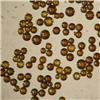 |
| Iron nanoparticles (diameter: 90 micrometers) |
Abstract:
A new iron nanoparticle catalyst developed by researchers in Japan and Canada promises to drastically improve the efficiency of hydrogenation, a key chemical process used in a wide array of industrial applications. Cleaner, safer and cheaper than traditional rare metal-based catalysts, the new, more environmentally friendly technique marks a breakthrough for the emerging field of green chemistry.
New iron catalyst promises green future for hydrogenation
Wako, Japan | Posted on June 28th, 2013Hydrogenation, the reaction of molecular hydrogen with another compound or element, is one of the world's most highly studied chemical reactions, with industrial applications ranging from petrochemistry, to food production, to pharmaceuticals.
Most such applications of hydrogenation use rare metal catalysts such as palladium or platinum to speed up chemical reactions. While highly efficient, these metals are expensive and limited in supply, posing environmental and economic challenges.
To get around these problems, researchers at McGill University, the RIKEN Center for Sustainable Resource Science and the Institute for Molecular Science developed their new technique using iron, a much less expensive and far more abundant element. Iron has been ruled out in the past due to the fact that it rusts in the presence of oxygen and water, negating its catalytic effect.
The new technique, described in a paper published in the journal Green Chemistry, produces iron nanoparticles directly inside a polymer matrix, which protects the iron surface from rusting while allowing the reactants to reach it and react. The resulting system of polymer-stabilized iron nanoparticles in water is the first of its kind: a safe, cheap and environmentally friendly catalyst system for hydrogenation reactions.
"Our aim is to develop iron-based catalysts not only for hydrogenation but also a variety of organic transformations that can be used in future industrial applications," explains RIKEN researcher Dr. Yoichi M. A. Yamada, one of the authors of the paper. "If rare metal-based catalysts can be replaced by iron-based ones, then we can overcome our costly and dangerous dependency on rare metals."
Full bibliographic information
Reuben Hudson, Go Hamasaka, Takao Osako, Yochi M. A. Yamada, Chao-Jun Li, Yasuhiro Uozumi, and Audrey Moores. Highly Efficient Iron(0) Nanoparticle-Catalyzed Hydrogenation in Water in Flow, Green Chemistry. doi:10.1039/C3GC40789F
####
About RIKEN
RIKEN is Japan’s flagship research institute devoted to basic and applied research. Over 2500 papers by RIKEN researchers are published every year in reputable scientific and technical journals, covering topics ranging across a broad spectrum of disciplines including physics, chemistry, biology, medical science and engineering. RIKEN’s advanced research environment and strong emphasis on interdisciplinary collaboration has earned itself an unparalleled reputation for scientific excellence in Japan and around the world.
Reach us on Twitter: @rikenresearch
For more information, please click here
Contacts:
Juliette Savin
RIKEN
Global Relations and Research Coordination Office
Copyright © AlphaGalileo
If you have a comment, please Contact us.Issuers of news releases, not 7th Wave, Inc. or Nanotechnology Now, are solely responsible for the accuracy of the content.
Bookmark:


| Related News Press |
News and information
 Quantum computer improves AI predictions April 17th, 2026
Flexible sensor gains sensitivity under pressure April 17th, 2026
A reusable chip for particulate matter sensing April 17th, 2026
Detecting vibrational quantum beating in the predissociation dynamics of SF6 using time-resolved photoelectron spectroscopy April 17th, 2026
Chemistry
Projecting light to dispense liquids: A new route to ultra-precise microdroplets January 30th, 2026
From sensors to smart systems: the rise of AI-driven photonic noses January 30th, 2026
"Nanoreactor" cage uses visible light for catalytic and ultra-selective cross-cycloadditions October 3rd, 2025
Cambridge chemists discover simple way to build bigger molecules – one carbon at a time June 6th, 2025
Discoveries
Quantum computer improves AI predictions April 17th, 2026
Flexible sensor gains sensitivity under pressure April 17th, 2026
A reusable chip for particulate matter sensing April 17th, 2026
Detecting vibrational quantum beating in the predissociation dynamics of SF6 using time-resolved photoelectron spectroscopy April 17th, 2026
Announcements
A fundamentally new therapeutic approach to cystic fibrosis: Nanobody repairs cellular defect April 17th, 2026
UC Irvine physicists discover method to reverse ‘quantum scrambling’ : The work addresses the problem of information loss in quantum computing system April 17th, 2026
Industrial
Tiny nanosheets, big leap: A new sensor detects ethanol at ultra-low levels January 30th, 2026
Quantum interference in molecule-surface collisions February 28th, 2025
Boron nitride nanotube fibers get real: Rice lab creates first heat-tolerant, stable fibers from wet-spinning process June 24th, 2022
Research partnerships
Lab to industry: InSe wafer-scale breakthrough for future electronics August 8th, 2025
HKU physicists uncover hidden order in the quantum world through deconfined quantum critical points April 25th, 2025
 |
||
 |
||
| The latest news from around the world, FREE | ||
 |
||
|
|
||
| Premium Products | ||
 |
||
|
Only the news you want to read!
Learn More |
||
 |
||
|
Full-service, expert consulting
Learn More |
||
|
|
||