Home > Press > Next-generation transistor outperforms other carbon-based designs
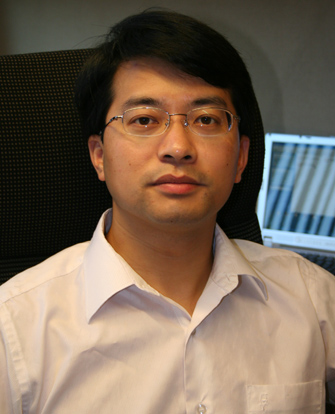 |
| Chongwu Zhou, corresponding author of a paper about the transistor that was published online by ACS Nano |
Abstract:
A team of engineers from USC has constructed the highest-performing carbon nanotube transistor to date.
Next-generation transistor outperforms other carbon-based designs
Los Angeles, CA | Posted on May 7th, 2013Next-generation transistor outperforms other carbon-based designs
By Robert Perkins
May 7, 2013
A team of engineers from USC has constructed the highest-performing carbon nanotube transistor to date.
Transistors are semiconductor switches and amplifiers that are key components of almost all electronic devices, from radios to cellphones to computers.
The new carbon nanotube transistor has an extrinsic performance — the limit of its practical, usable operating frequency — of 25 Gigahertz (GHz). By comparison, its closest competitor, built by the Institut d'Électronique de Microélectronique et de Nanotechnologie, peaks at 15 GHz.
"Carbon nanotubes have unique properties and great potential in advanced electronic application," said Chongwu Zhou, professor at the USC Viterbi School of Engineering and corresponding author of a paper about the transistor that was published online by ACS Nano on April 16. "This is the very first report of analog circuits based on self-aligned nanotube array transistors operated in the gigahertz regime.
"The characterization of nanotube transistor-based analog circuits is of great importance for further exploring the potential of nanotubes in high-frequency applications with fast speed and low-power consumption requirement," he added.
Zhou led a team that included USC PhD students Yuchi Che, Yuncheng Lin and Pyo Jae Kim.
The new transistor takes advantage of a new T-shaped design that is a mere 200 nanometers wide. The design helps reduce parasitic effects on the transistor's performance and boosts the speed of the transistor's response by scaling down its channel length. Zhou and his team recently patented the design.
Scientists have long eyed carbon nanotubes as a replacement for silicon semiconductors in commercial electronics because carbon has superior electrical properties and can be used to build smaller transistors.
Though current carbon nanotube-based designs come nowhere near the older silicon technology — which can perform at around 500 GHz — they have the potential, theoretically, to reach 1,000 GHz frequency performance.
"It is a significant step toward the practical application of carbon nanotube RF transistor as a promising candidate for next-generation electronics," said Che, lead author of the ACS Nano paper.
Zhou and his research group continue to work on optimizing carbon nanotube-based analog electronics. Their final goal is to generate carbon nanotube transistors and circuits that offer superior performance to traditional industrial technology.
This research as funded by the Joint KACST/California Center of Excellence and the Office of Naval Research (ONR).
####
For more information, please click here
Contacts:
Robert Perkins
(213) 740-9226
Copyright © University of Southern California
If you have a comment, please Contact us.Issuers of news releases, not 7th Wave, Inc. or Nanotechnology Now, are solely responsible for the accuracy of the content.
Bookmark:


| Related News Press |
News and information
 Quantum computer improves AI predictions April 17th, 2026
Flexible sensor gains sensitivity under pressure April 17th, 2026
A reusable chip for particulate matter sensing April 17th, 2026
Detecting vibrational quantum beating in the predissociation dynamics of SF6 using time-resolved photoelectron spectroscopy April 17th, 2026
Govt.-Legislation/Regulation/Funding/Policy
Quantum computer improves AI predictions April 17th, 2026
Metasurfaces smooth light to boost magnetic sensing precision January 30th, 2026
New imaging approach transforms study of bacterial biofilms August 8th, 2025
Chip Technology
A reusable chip for particulate matter sensing April 17th, 2026
Metasurfaces smooth light to boost magnetic sensing precision January 30th, 2026
Nanotubes/Buckyballs/Fullerenes/Nanorods/Nanostrings/Nanosheets
Tiny nanosheets, big leap: A new sensor detects ethanol at ultra-low levels January 30th, 2026
Enhancing power factor of p- and n-type single-walled carbon nanotubes April 25th, 2025
Chainmail-like material could be the future of armor: First 2D mechanically interlocked polymer exhibits exceptional flexibility and strength January 17th, 2025
Innovative biomimetic superhydrophobic coating combines repair and buffering properties for superior anti-erosion December 13th, 2024
Discoveries
Quantum computer improves AI predictions April 17th, 2026
Flexible sensor gains sensitivity under pressure April 17th, 2026
A reusable chip for particulate matter sensing April 17th, 2026
Detecting vibrational quantum beating in the predissociation dynamics of SF6 using time-resolved photoelectron spectroscopy April 17th, 2026
Announcements
A fundamentally new therapeutic approach to cystic fibrosis: Nanobody repairs cellular defect April 17th, 2026
UC Irvine physicists discover method to reverse ‘quantum scrambling’ : The work addresses the problem of information loss in quantum computing system April 17th, 2026
Interviews/Book Reviews/Essays/Reports/Podcasts/Journals/White papers/Posters
A fundamentally new therapeutic approach to cystic fibrosis: Nanobody repairs cellular defect April 17th, 2026
UC Irvine physicists discover method to reverse ‘quantum scrambling’ : The work addresses the problem of information loss in quantum computing system April 17th, 2026
Military
Quantum engineers ‘squeeze’ laser frequency combs to make more sensitive gas sensors January 17th, 2025
Chainmail-like material could be the future of armor: First 2D mechanically interlocked polymer exhibits exceptional flexibility and strength January 17th, 2025
Single atoms show their true color July 5th, 2024
NRL charters Navy’s quantum inertial navigation path to reduce drift April 5th, 2024
 |
||
 |
||
| The latest news from around the world, FREE | ||
 |
||
|
|
||
| Premium Products | ||
 |
||
|
Only the news you want to read!
Learn More |
||
 |
||
|
Full-service, expert consulting
Learn More |
||
|
|
||