Home > Press > Scientists image nanoparticles in action
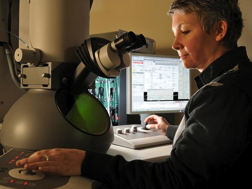 |
| Deborah Kelly |
Abstract:
The macroscopic effects of certain nanoparticles on human health have long been clear to the naked eye. What scientists have lacked is the ability to see the detailed movements of individual particles that give rise to those effects.
For the first time, researchers at the Virginia Tech Carilion Research Institute have imaged nanoparticles in action in a liquid environment.
Scientists image nanoparticles in action
Roanoke, VA | Posted on April 25th, 2013In a recently published study, scientists at the Virginia Tech Carilion Research Institute invented a technique for imaging nanoparticle dynamics with atomic resolution as these dynamics occur in a liquid environment. The results will allow, for the first time, the imaging of nanoscale processes, such as the engulfment of nanoparticles into cells.
"We were stunned to see the large-ranged mobility in such small objects," said Deborah Kelly, an assistant professor at the Virginia Tech Carilion Research Institute. "We now have a system to watch the behaviors of therapeutic nanoparticles at atomic resolution."
Nanoparticles are made of many materials and come in different shapes and sizes. In the new study, Kelly and her colleagues chose to make rod-shaped gold nanoparticles the stars of their new molecular movies. These nanoparticles, roughly the size of a virus, are used to treat various forms of cancer. Once injected, they accumulate in solid tumors. Infrared radiation is then used to heat them and destroy nearby cancerous cells.
To take an up-close look at the gold nanoparticles in action, the researchers made a vacuum-tight microfluidic chamber by pressing two silicon-nitride semiconductor chips together with a 150-nanometer spacer in between. The microchips contained transparent windows so the beam from a transmission electron microscope could pass through to create an atomic-scale image.
Using the new technique, the scientists created two types of visualizations. The first included pictures of individual nanoparticles' atomic structures at 100,000-times magnification - the highest resolution images ever taken of nanoparticles in a liquid environment.
The second visualization was a movie captured at 23,000-times magnification that revealed the movements of a group of nanoparticles reacting to an electron beam, which mimics the effects of the infrared radiation used in cancer therapies.
In the movie, the gold nanoparticles can be seen surfing nanoscale tidal waves.
"The nanoparticles behaved like grains of sand being concentrated on a beach by crashing waves," said Kelly. "We think this behavior may be related to why the nanoparticles become concentrated in tumors. Our next experiment will be to insert a cancer cell to study the nanoparticles' therapeutic effects on tumors."
The team is also testing the resolution of the microfluidic system with other reagents and materials, bringing researchers one step closer to viewing live biological mechanisms in action at the highest levels of resolution possible.
The study appeared in Chemical Communications in the article "Visualizing Nanoparticle Mobility in Liquid at Atomic Resolution," by Madeline Dukes, an applications scientist at Protochips Inc. in Raleigh, N.C.; Benjamin Jacobs, an applications scientist at Protochips; David Morgan, assistant manager of the Cryo-Transmission Electron Microscopy Facility at Indiana University Bloomington; Harshad Hegde, a computer scientist at the Virginia Tech Carilion Research Institute; and Kelly, who is also an assistant professor of biological sciences in the College of Science at Virginia Tech.
The Virginia Tech Carilion School of Medicine and Research Institute joins the basic science, life science, bioinformatics, and engineering strengths of Virginia Tech with the medical practice and medical education experience of Carilion Clinic. Virginia Tech Carilion is located in a new biomedical health sciences campus in Roanoke at 2 Riverside Circle.
Written by Ken Kingery.
####
For more information, please click here
Contacts:
Paula Byron
540-526-2027
Copyright © Virginia Tech
If you have a comment, please Contact us.Issuers of news releases, not 7th Wave, Inc. or Nanotechnology Now, are solely responsible for the accuracy of the content.
Bookmark:


| Related Links |
 Article - “Visualizing Nanoparticle Mobility in Liquid at Atomic Resolution,” by Madeline Duke:
| Related News Press |
News and information
Quantum computer improves AI predictions April 17th, 2026
Flexible sensor gains sensitivity under pressure April 17th, 2026
A reusable chip for particulate matter sensing April 17th, 2026
Detecting vibrational quantum beating in the predissociation dynamics of SF6 using time-resolved photoelectron spectroscopy April 17th, 2026
Imaging
Simple algorithm paired with standard imaging tool could predict failure in lithium metal batteries August 8th, 2025
First real-time observation of two-dimensional melting process: Researchers at Mainz University unveil new insights into magnetic vortex structures August 8th, 2025
Microfluidics/Nanofluidics
Projecting light to dispense liquids: A new route to ultra-precise microdroplets January 30th, 2026
Nanomedicine
A fundamentally new therapeutic approach to cystic fibrosis: Nanobody repairs cellular defect April 17th, 2026
New molecular technology targets tumors and simultaneously silences two ‘undruggable’ cancer genes August 8th, 2025
New imaging approach transforms study of bacterial biofilms August 8th, 2025
Electrifying results shed light on graphene foam as a potential material for lab grown cartilage June 6th, 2025
Discoveries
Quantum computer improves AI predictions April 17th, 2026
Flexible sensor gains sensitivity under pressure April 17th, 2026
A reusable chip for particulate matter sensing April 17th, 2026
Detecting vibrational quantum beating in the predissociation dynamics of SF6 using time-resolved photoelectron spectroscopy April 17th, 2026
Announcements
A fundamentally new therapeutic approach to cystic fibrosis: Nanobody repairs cellular defect April 17th, 2026
UC Irvine physicists discover method to reverse ‘quantum scrambling’ : The work addresses the problem of information loss in quantum computing system April 17th, 2026
Tools
Metasurfaces smooth light to boost magnetic sensing precision January 30th, 2026
From sensors to smart systems: the rise of AI-driven photonic noses January 30th, 2026
Japan launches fully domestically produced quantum computer: Expo visitors to experience quantum computing firsthand August 8th, 2025
 |
||
 |
||
| The latest news from around the world, FREE | ||
 |
||
|
|
||
| Premium Products | ||
 |
||
|
Only the news you want to read!
Learn More |
||
 |
||
|
Full-service, expert consulting
Learn More |
||
|
|
||