Home > Press > Super-nanotubes: 'Remarkable' spray-on coating combines carbon nanotubes with ceramic
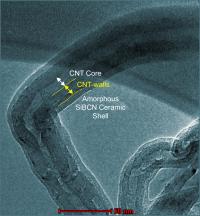 |
| This is a micrograph of one strand of a new spray-on super-nanotube composite developed by the National Institute of Standards and Technology (NIST) and Kansas State University. The multi-wall nanotube core is surrounded by a ceramic shell. The composite is a promising coating for laser power detectors. (Color added for clarity.)
Credit: Kansas State University |
Abstract:
Researchers from the National Institute of Standards and Technology (NIST) and Kansas State University have demonstrated a spray-on mixture of carbon nanotubes and ceramic that has unprecedented ability to resist damage while absorbing laser light.*
Super-nanotubes: 'Remarkable' spray-on coating combines carbon nanotubes with ceramic
Boulder, CO | Posted on April 17th, 2013Coatings that absorb as much of the energy of high-powered lasers as possible without breaking down are essential for optical power detectors that measure the output of such lasers, which are used, for example, in military equipment for defusing unexploded mines. The new material improves on NIST's earlier version of a spray-on nanotube coating for optical power detectors** and has already attracted industry interest.
"It really is remarkable material," NIST co-author John Lehman says. "It's a way to make super-nanotubes. It has the optical, thermal and electrical properties of nanotubes with the robustness of the high-temperature ceramic."
The composite was developed by Kansas State. NIST researchers suggested using toluene to uniformly coat individual nanotubes with a ceramic shell. They also performed damage studies showing how well the composite tolerates exposure to laser light.
NIST has developed and maintained optical power standards for decades. In recent years, NIST researchers have coated optical detectors with nanotubes because of their unusual combination of desirable properties, including intense black color for maximum light absorption.
The new composite consists of multiwall carbon nanotubes and a ceramic made of silicon, boron, carbon and nitrogen. Boron boosts the temperature at which the material breaks down. The nanotubes were dispersed in toluene, to which a clear liquid polymer containing boron was added drop by drop, and the mixture was heated to 1,100 degrees C. The resulting composite was then crushed into a fine powder, dispersed in toluene, and sprayed in a thin coat on copper surfaces. Researchers baked the test specimens and then exposed them to a far-infrared laser beam of the type used to cut hard materials.
Analysis revealed that the coating absorbed 97.5 percent of the light and tolerated 15 kilowatts of laser power per square centimeter for 10 seconds. This is about 50 percent higher damage tolerance than other research groups have reported for similar coatings—such as nanotubes alone and carbon paint—tested with the same wavelength of light, according to the paper. The nanotubes and graphene-like carbon absorb light uniformly and transmit heat well, while the oxidation-resistant ceramic boosts damage resistance. The spray-on material also adheres well to the copper surface. As an added bonus, the composite can be produced easily in large quantities.
After light exposure, the coatings were analyzed using several different techniques. Electron microscopy revealed no major destruction such as burning or deformation. Other tests showed the coating to be adaptable, with the ceramic shell partially oxidizing into a stable layer of silicon dioxide (quartz).
* R. Bhandavat, A. Feldman, C. Cromer, J. Lehman and G. Singh. 2013. Very high laser-damage threshold of polymer-derived Si(B)CNCarbon nanotube composite coatings. ACS Applied Materials & Interfaces. ASAP Publication Date March 19. DOI: 10.1021/am302755x.
####
About National Institute of Standards and Technology (NIST)
The National Institute of Standards and Technology (NIST) is an agency of the U.S. Department of Commerce.
For more information, please click here
Contacts:
Laura Ost
303-497-4880
Copyright © National Institute of Standards and Technology (NIST)
If you have a comment, please Contact us.Issuers of news releases, not 7th Wave, Inc. or Nanotechnology Now, are solely responsible for the accuracy of the content.
Bookmark:


| Related Links |
| Related News Press |
News and information
 Quantum computer improves AI predictions April 17th, 2026
Flexible sensor gains sensitivity under pressure April 17th, 2026
A reusable chip for particulate matter sensing April 17th, 2026
Detecting vibrational quantum beating in the predissociation dynamics of SF6 using time-resolved photoelectron spectroscopy April 17th, 2026
Laboratories
Researchers develop molecular qubits that communicate at telecom frequencies October 3rd, 2025
A battery’s hopping ions remember where they’ve been: Seen in atomic detail, the seemingly smooth flow of ions through a battery’s electrolyte is surprisingly complicated February 16th, 2024
Govt.-Legislation/Regulation/Funding/Policy
Quantum computer improves AI predictions April 17th, 2026
Metasurfaces smooth light to boost magnetic sensing precision January 30th, 2026
New imaging approach transforms study of bacterial biofilms August 8th, 2025
Nanotubes/Buckyballs/Fullerenes/Nanorods/Nanostrings/Nanosheets
Tiny nanosheets, big leap: A new sensor detects ethanol at ultra-low levels January 30th, 2026
Enhancing power factor of p- and n-type single-walled carbon nanotubes April 25th, 2025
Chainmail-like material could be the future of armor: First 2D mechanically interlocked polymer exhibits exceptional flexibility and strength January 17th, 2025
Innovative biomimetic superhydrophobic coating combines repair and buffering properties for superior anti-erosion December 13th, 2024
Discoveries
Quantum computer improves AI predictions April 17th, 2026
Flexible sensor gains sensitivity under pressure April 17th, 2026
A reusable chip for particulate matter sensing April 17th, 2026
Detecting vibrational quantum beating in the predissociation dynamics of SF6 using time-resolved photoelectron spectroscopy April 17th, 2026
Announcements
A fundamentally new therapeutic approach to cystic fibrosis: Nanobody repairs cellular defect April 17th, 2026
UC Irvine physicists discover method to reverse ‘quantum scrambling’ : The work addresses the problem of information loss in quantum computing system April 17th, 2026
Military
Quantum engineers ‘squeeze’ laser frequency combs to make more sensitive gas sensors January 17th, 2025
Chainmail-like material could be the future of armor: First 2D mechanically interlocked polymer exhibits exceptional flexibility and strength January 17th, 2025
Single atoms show their true color July 5th, 2024
NRL charters Navy’s quantum inertial navigation path to reduce drift April 5th, 2024
Industrial
Tiny nanosheets, big leap: A new sensor detects ethanol at ultra-low levels January 30th, 2026
Quantum interference in molecule-surface collisions February 28th, 2025
Boron nitride nanotube fibers get real: Rice lab creates first heat-tolerant, stable fibers from wet-spinning process June 24th, 2022
Photonics/Optics/Lasers
Metasurfaces smooth light to boost magnetic sensing precision January 30th, 2026
From sensors to smart systems: the rise of AI-driven photonic noses January 30th, 2026
 |
||
 |
||
| The latest news from around the world, FREE | ||
 |
||
|
|
||
| Premium Products | ||
 |
||
|
Only the news you want to read!
Learn More |
||
 |
||
|
Full-service, expert consulting
Learn More |
||
|
|
||