Home > Press > ORNL research paves way for larger, safer lithium ion batteries
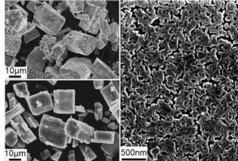 |
| ORNL researchers developed a nanoporous solid electrolyte (bottom left and in detail on right) from a solvated precursor (top left). The material conducts ions 1,000 times faster than its natural bulk form and enables more energy-dense lithium ion batteries. |
Abstract:
Looking toward improved batteries for charging electric cars and storing energy from renewable but intermittent solar and wind, scientists at Oak Ridge National Laboratory have developed the first high-performance, nanostructured solid electrolyte for more energy-dense lithium ion batteries.
ORNL research paves way for larger, safer lithium ion batteries
Oak Ridge, TN | Posted on January 25th, 2013 Today's lithium-ion batteries rely on a liquid electrolyte, the material that conducts ions between the negatively charged anode and positive cathode. But liquid electrolytes often entail safety issues because of their flammability, especially as researchers try to pack more energy in a smaller battery volume. Building batteries with a solid electrolyte, as ORNL researchers have demonstrated, could overcome these safety concerns and size constraints.
"To make a safer, lightweight battery, we need the design at the beginning to have safety in mind," said ORNL's Chengdu Liang, who led the newly published study in the Journal of the American Chemical Society. "We started with a conventional material that is highly stable in a battery system - in particular one that is compatible with a lithium metal anode."
The ability to use pure lithium metal as an anode could ultimately yield batteries five to 10 times more powerful than current versions, which employ carbon based anodes.
"Cycling highly reactive lithium metal in flammable organic electrolytes causes serious safety concerns," Liang said. "A solid electrolyte enables the lithium metal to cycle well, with highly enhanced safety."
The ORNL team developed its solid electrolyte by manipulating a material called lithium thiophosphate so that it could conduct ions 1,000 times faster than its natural bulk form. The researchers used a chemical process called nanostructuring, which alters the structure of the crystals that make up the material.
"Think about it in terms of a big crystal of quartz vs. very fine beach sand," said coauthor Adam Rondinone. "You can have the same total volume of material, but it's broken up into very small particles that are packed together. It's made of the same atoms in roughly the same proportions, but at the nanoscale the structure is different. And now this solid material conducts lithium ions at a much greater rate than the original large crystal."
The researchers are continuing to test lab scale battery cells, and a patent on the team's invention is pending.
"We use a room-temperature, solution-based reaction that we believe can be easily scaled up," Rondinone said. "It's an energy-efficient way to make large amounts of this material."
For information about industry collaboration opportunities, please visit the ORNL Partnerships website at www.ornl.gov/adm/partnerships/index.shtml.
The study is published as "Anomalous High Ionic Conductivity of Nanoporous ß-Li3PS4," and its ORNL coauthors are Zengcai Liu, Wujun Fu, Andrew Payzant, Xiang Yu, Zili Wu, Nancy Dudney, Jim Kiggans, Kunlun Hong, Adam Rondinone and Chengdu Liang. The work was sponsored by the Division of Materials Sciences and Engineering in DOE's Office of Science.
The materials synthesis and characterization were supported by the Center for Nanophase Materials Sciences at ORNL. CNMS is one of the five DOE Nanoscale Science Research Centers supported by the DOE Office of Science, premier national user facilities for interdisciplinary research at the nanoscale. Together the NSRCs comprise a suite of complementary facilities that provide researchers with state-of-the-art capabilities to fabricate, process, characterize and model nanoscale materials, and constitute the largest infrastructure investment of the National Nanotechnology Initiative. The NSRCs are located at DOE's Argonne, Brookhaven, Lawrence Berkeley, Oak Ridge and Sandia and Los Alamos national laboratories. For more information about the DOE NSRCs, please visit science.energy.gov/bes/suf/user-facilities/nanoscale-science-research-centers/. ORNL is managed by UT-Battelle for the Department of Energy's Office of Science.
DOE's Office of Science is the single largest supporter of basic research in the physical sciences in the United States, and is working to address some of the most pressing challenges of our time. For more information, please visit science.energy.gov.
####
About Oak Ridge National Laboratory
ORNL is a multiprogram science and technology laboratory managed for the U.S. Department of Energy by UT-Battelle, LLC. ORNL's mission is to deliver scientific discoveries and technical breakthroughs that will accelerate the development and deployment of solutions in clean energy and global security, and in doing so create economic opportunity for the nation.
For more information, please click here
Contacts:
Morgan McCorkle
865-574-7308
Copyright © Oak Ridge National Laboratory
If you have a comment, please Contact us.Issuers of news releases, not 7th Wave, Inc. or Nanotechnology Now, are solely responsible for the accuracy of the content.
Bookmark:


| Related News Press |
News and information
 Quantum computer improves AI predictions April 17th, 2026
Flexible sensor gains sensitivity under pressure April 17th, 2026
A reusable chip for particulate matter sensing April 17th, 2026
Detecting vibrational quantum beating in the predissociation dynamics of SF6 using time-resolved photoelectron spectroscopy April 17th, 2026
Laboratories
Researchers develop molecular qubits that communicate at telecom frequencies October 3rd, 2025
A battery’s hopping ions remember where they’ve been: Seen in atomic detail, the seemingly smooth flow of ions through a battery’s electrolyte is surprisingly complicated February 16th, 2024
Govt.-Legislation/Regulation/Funding/Policy
Quantum computer improves AI predictions April 17th, 2026
Metasurfaces smooth light to boost magnetic sensing precision January 30th, 2026
New imaging approach transforms study of bacterial biofilms August 8th, 2025
Discoveries
Quantum computer improves AI predictions April 17th, 2026
Flexible sensor gains sensitivity under pressure April 17th, 2026
A reusable chip for particulate matter sensing April 17th, 2026
Detecting vibrational quantum beating in the predissociation dynamics of SF6 using time-resolved photoelectron spectroscopy April 17th, 2026
Announcements
A fundamentally new therapeutic approach to cystic fibrosis: Nanobody repairs cellular defect April 17th, 2026
UC Irvine physicists discover method to reverse ‘quantum scrambling’ : The work addresses the problem of information loss in quantum computing system April 17th, 2026
Energy
Sensors innovations for smart lithium-based batteries: advancements, opportunities, and potential challenges August 8th, 2025
Simple algorithm paired with standard imaging tool could predict failure in lithium metal batteries August 8th, 2025
Automotive/Transportation
Decoding hydrogen‑bond network of electrolyte for cryogenic durable aqueous zinc‑ion batteries January 30th, 2026
Sensors innovations for smart lithium-based batteries: advancements, opportunities, and potential challenges August 8th, 2025
Simple algorithm paired with standard imaging tool could predict failure in lithium metal batteries August 8th, 2025
Battery Technology/Capacitors/Generators/Piezoelectrics/Thermoelectrics/Energy storage
Decoding hydrogen‑bond network of electrolyte for cryogenic durable aqueous zinc‑ion batteries January 30th, 2026
COF scaffold membrane with gate‑lane nanostructure for efficient Li+/Mg2+ separation January 30th, 2026
MXene nanomaterials enter a new dimension Multilayer nanomaterial: MXene flakes created at Drexel University show new promise as 1D scrolls January 30th, 2026
Solar/Photovoltaic
Spinel-type sulfide semiconductors to operate the next-generation LEDs and solar cells For solar-cell absorbers and green-LED source October 3rd, 2025
KAIST researchers introduce new and improved, next-generation perovskite solar cell November 8th, 2024
Groundbreaking precision in single-molecule optoelectronics August 16th, 2024
Development of zinc oxide nanopagoda array photoelectrode: photoelectrochemical water-splitting hydrogen production January 12th, 2024
 |
||
 |
||
| The latest news from around the world, FREE | ||
 |
||
|
|
||
| Premium Products | ||
 |
||
|
Only the news you want to read!
Learn More |
||
 |
||
|
Full-service, expert consulting
Learn More |
||
|
|
||