Home > Press > First synthesis of gold nanoparticles inside human hair for dyeing and much more
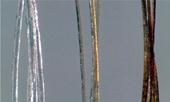 |
| Gold nanoparticles darken hair after treatment for one day, center, and 16 days, right (untreated hairs, left).
Credit: American Chemical Society |
Abstract:
In a discovery with applications ranging from hair dyeing to electronic sensors to development of materials with improved properties, scientists are reporting the first synthesis of gold nanoparticles inside human hairs. Their study appears in ACS' journal Nano Letters.
First synthesis of gold nanoparticles inside human hair for dyeing and much more
Washington, DC | Posted on December 5th, 2012Philippe Walter and colleagues explain that gold nanoparticles — 40,000-60,000 of which could fit across the width of a human hair — are a hot topic. Scientists are exploring uses, ranging from electronics and sensors to medical diagnostic tests and cancer treatments. Gold nanoparticles have been deposited on hair for use as electrodes, and gold nanoparticles had been used to dye wool. Walter's team looked at a new use — dyeing hair, inspired by the ancient Greeks' and Romans' use of another metal, lead, to color their hair.
They describe the first synthesis of fluorescent gold nanoparticles inside human hair. It involved soaking white hairs in a solution of a gold compound. The hairs turned pale yellow and then darkened to a deep brown. Using an electron microscope, the scientists confirmed that the particles were forming inside the hairs' central core cortex. The color remained even after repeated washings.
The authors acknowledge funding from the Agence Nationale de la Recherche.
####
About American Chemical Society (ACS)
The American Chemical Society is a nonprofit organization chartered by the U.S. Congress. With more than 164,000 members, ACS is the world's largest scientific society and a global leader in providing access to chemistry-related research through its multiple databases, peer-reviewed journals and scientific conferences. Its main offices are in Washington, D.C., and Columbus, Ohio.
To automatically receive news releases from the American Chemical Society, contact
For more information, please click here
Contacts:
Michael Bernstein
202-872-6042
Philippe Walter, Ph.D.
Université Pierre et Marie Curie-CNRS
Ivry-sur-Seine, Paris 94200
France
Phone : +33 1 44 27 82 22
Fax : +33 1 44 27 82 98
Email:
Copyright © American Chemical Society (ACS)
If you have a comment, please Contact us.Issuers of news releases, not 7th Wave, Inc. or Nanotechnology Now, are solely responsible for the accuracy of the content.
Bookmark:


| Related Links |
| Related News Press |
News and information
 Quantum computer improves AI predictions April 17th, 2026
Flexible sensor gains sensitivity under pressure April 17th, 2026
A reusable chip for particulate matter sensing April 17th, 2026
Detecting vibrational quantum beating in the predissociation dynamics of SF6 using time-resolved photoelectron spectroscopy April 17th, 2026
Govt.-Legislation/Regulation/Funding/Policy
Quantum computer improves AI predictions April 17th, 2026
Metasurfaces smooth light to boost magnetic sensing precision January 30th, 2026
New imaging approach transforms study of bacterial biofilms August 8th, 2025
Chip Technology
A reusable chip for particulate matter sensing April 17th, 2026
Metasurfaces smooth light to boost magnetic sensing precision January 30th, 2026
Nanomedicine
A fundamentally new therapeutic approach to cystic fibrosis: Nanobody repairs cellular defect April 17th, 2026
New molecular technology targets tumors and simultaneously silences two ‘undruggable’ cancer genes August 8th, 2025
New imaging approach transforms study of bacterial biofilms August 8th, 2025
Electrifying results shed light on graphene foam as a potential material for lab grown cartilage June 6th, 2025
Sensors
Flexible sensor gains sensitivity under pressure April 17th, 2026
Tiny nanosheets, big leap: A new sensor detects ethanol at ultra-low levels January 30th, 2026
From sensors to smart systems: the rise of AI-driven photonic noses January 30th, 2026
Sensors innovations for smart lithium-based batteries: advancements, opportunities, and potential challenges August 8th, 2025
Discoveries
Quantum computer improves AI predictions April 17th, 2026
Flexible sensor gains sensitivity under pressure April 17th, 2026
A reusable chip for particulate matter sensing April 17th, 2026
Detecting vibrational quantum beating in the predissociation dynamics of SF6 using time-resolved photoelectron spectroscopy April 17th, 2026
Announcements
A fundamentally new therapeutic approach to cystic fibrosis: Nanobody repairs cellular defect April 17th, 2026
UC Irvine physicists discover method to reverse ‘quantum scrambling’ : The work addresses the problem of information loss in quantum computing system April 17th, 2026
 |
||
 |
||
| The latest news from around the world, FREE | ||
 |
||
|
|
||
| Premium Products | ||
 |
||
|
Only the news you want to read!
Learn More |
||
 |
||
|
Full-service, expert consulting
Learn More |
||
|
|
||