Home > Press > Power generation technology based on piezoelectric nanocomposite materials developed by KAIST
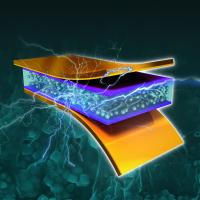 |
| Nanocomposite generator produces electricity.
Credit: KAIST |
Abstract:
The team of Professor Keon Jae Lee (fand.kaist.ac.kr/) from the Department of Materials Science and Engineering, KAIST, has developed new forms of low cost, large-area nanogenerator technology using the piezoelectric ceramic nanoparticles.
Power generation technology based on piezoelectric nanocomposite materials developed by KAIST
Seoul, South Korea | Posted on May 7th, 2012Piezoelectric effects-based nanogenerator technology that converts existing sources of nonpolluting energies, such as vibrational and mechanical energy from the nature of wind and waves, into infinite electrical energy is drawing immense interest in the next-generation energy harvesting technology. However, previous nanogenerator technologies have limitations such as complicated process, high-cost, and size-related restrictions.
Recently, Professor Lee's research team has developed a nanocomposite-based nanogenerator that successfully overcomes the critical restrictions existed in previous nanogenerators and builds a simple, low-cost, and large-scale self-powered energy system. The team produced a piezoelectric nanocomposite by mixing piezoelectric nanoparticles with carbon-based nanomaterials (carbon nanotubes and reduced graphene oxide) in a polydimethylsiloxane (PDMS) matrix and fabricated the nanocomposite generator by the simple process of spin-casting or bar-coating method.
Professor Zhong Lin Wang from Georgia Institute of Technology, who is the inventor of the nanogenerator, said,
"This exciting result first introduces a nanocomposite material into the self-powered energy system, and therefore it can expand the feasibility of nanogenerator in consumer electronics, ubiquitous sensor networks, and wearable clothes."
The research result was published in the May online issue of the Advanced Materials Wiley journal as a cover paper.
####
For more information, please click here
Contacts:
Lan Yoon
82-423-502-295
Copyright © The Korea Advanced Institute of Science and Technology
If you have a comment, please Contact us.Issuers of news releases, not 7th Wave, Inc. or Nanotechnology Now, are solely responsible for the accuracy of the content.
Bookmark:


| Related News Press |
News and information
 Quantum computer improves AI predictions April 17th, 2026
Flexible sensor gains sensitivity under pressure April 17th, 2026
A reusable chip for particulate matter sensing April 17th, 2026
Detecting vibrational quantum beating in the predissociation dynamics of SF6 using time-resolved photoelectron spectroscopy April 17th, 2026
Flexible Electronics
Flexible sensor gains sensitivity under pressure April 17th, 2026
Sensors
Flexible sensor gains sensitivity under pressure April 17th, 2026
Tiny nanosheets, big leap: A new sensor detects ethanol at ultra-low levels January 30th, 2026
From sensors to smart systems: the rise of AI-driven photonic noses January 30th, 2026
Sensors innovations for smart lithium-based batteries: advancements, opportunities, and potential challenges August 8th, 2025
Discoveries
Quantum computer improves AI predictions April 17th, 2026
Flexible sensor gains sensitivity under pressure April 17th, 2026
A reusable chip for particulate matter sensing April 17th, 2026
Detecting vibrational quantum beating in the predissociation dynamics of SF6 using time-resolved photoelectron spectroscopy April 17th, 2026
Materials/Metamaterials/Magnetoresistance
First real-time observation of two-dimensional melting process: Researchers at Mainz University unveil new insights into magnetic vortex structures August 8th, 2025
Researchers unveil a groundbreaking clay-based solution to capture carbon dioxide and combat climate change June 6th, 2025
A 1960s idea inspires NBI researchers to study hitherto inaccessible quantum states June 6th, 2025
Institute for Nanoscience hosts annual proposal planning meeting May 16th, 2025
Announcements
A fundamentally new therapeutic approach to cystic fibrosis: Nanobody repairs cellular defect April 17th, 2026
UC Irvine physicists discover method to reverse ‘quantum scrambling’ : The work addresses the problem of information loss in quantum computing system April 17th, 2026
Textiles/Clothing
Protective equipment with graphene nanotubes meets the strictest ESD safety standards March 25th, 2022
Polymer fibers with graphene nanotubes make it possible to heat hard-to-reach, complex-shaped items February 11th, 2022
Flexible material shows potential for use in fabrics to heat, cool July 3rd, 2020
Battery Technology/Capacitors/Generators/Piezoelectrics/Thermoelectrics/Energy storage
Decoding hydrogen‑bond network of electrolyte for cryogenic durable aqueous zinc‑ion batteries January 30th, 2026
COF scaffold membrane with gate‑lane nanostructure for efficient Li+/Mg2+ separation January 30th, 2026
MXene nanomaterials enter a new dimension Multilayer nanomaterial: MXene flakes created at Drexel University show new promise as 1D scrolls January 30th, 2026
 |
||
 |
||
| The latest news from around the world, FREE | ||
 |
||
|
|
||
| Premium Products | ||
 |
||
|
Only the news you want to read!
Learn More |
||
 |
||
|
Full-service, expert consulting
Learn More |
||
|
|
||