Home > Press > NIST Releases First Certified Reference Material for Single-Wall Carbon Nanotubes
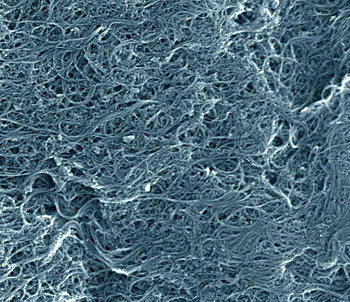 |
| Scanning electron microscope image of a typical sample of the NIST single-wall carbon nanotube soot standard reference material. The nanotubes tend to stick together and form smaller and larger bundles. Some of the impurities also are visible. The image shows an area just over a micrometer wide. (Color added for clarity.) Credit: Vladar, NIST |
Abstract:
The National Institute of Standards and Technology (NIST) has issued the world's first reference material for single-wall carbon nanotube soot. Distantly related to the soot in your fireplace or in a candle flame, nanotube-laden soot is the primary industrial source of single-wall carbon nanotubes, perhaps the archetype of all nanoscale materials. The new NIST material offers companies and researchers a badly needed source of uniform and well-characterized carbon nanotube soot for material comparisons, as well as chemical and toxicity analysis.
NIST Releases First Certified Reference Material for Single-Wall Carbon Nanotubes
Gaithersburg, MD | Posted on December 21st, 2011With walls of carbon only one atom thick and looking like a sheet of chicken wire curled into a cylinder, single-wall carbon nanotubes are one of several families of pure carbon materials that, because of their nanoscale size, have special properties. "Single-wall carbon nanotubes," says NIST chemical engineer Jeffery Fagan, "have exquisite optical, mechanical, thermal and electronic properties, and because of their small width but long lengths—think of something like a long piece of hair but 10,000 times thinner—full development of these materials should enable lighter, stronger materials, as well as improve many technologies from sensors to electronics and batteries."
Unfortunately, nanotubes are difficult to produce without significant impurities or in large quantities. Single-wall nanotubes, in particular, have been notorious for their relatively low quality and batch-to-batch variability. They typically are produced in complex processes using small particles of metal catalysts that promote the growth of the nanotubes. The resulting material—often a powder not unlike the soot you would find in your fireplace—has frequently contained large amounts of impurities, such as other forms of carbon, and sometimes significant levels of catalysts.
"One of the issues that this reference material addresses is that there's no homogeneous lot that people can buy to do comparative measurements," says Fagan. "Even batch-to-batch, raw carbon nanotube powder samples have varied so much that there is no interlaboratory consistency. And that's particularly a problem for comparisons such as toxicity measurements. If you bought carbon nanotubes, you were pretty much guaranteed that your sample could be so different from anyone else's samples that either your measurements could be specific to some flaw of your material, or that others might not be able to reproduce what you were doing."
To address these issues, a multidisciplinary research team at NIST has worked to develop the metrology necessary for quantitative single-wall carbon nanotube measurements through a three-prong approach: basic measurement and separation science, documentary protocols and standards through international standards organizations, and now certified reference materials.
The new NIST product, Standard Reference Material (SRM) 2483, "Single-Wall Carbon Nanotubes (Raw Soot)," will directly address the issue of comparability. It is possibly the world's single largest supply of homogeneous, chemically analyzed, carbon nanotube soot where the uniformity of the samples from unit to unit is assured. Each unit of SRM 2483, a glass vial containing 250 milligrams of soot, is certified by NIST for the mass fraction values of several common contaminants: barium, cerium, chlorine, cobalt, dysprosium, europium, gadolinium, lanthanum, molybdenum and samarium. Reference values (values believed to be accurate, but not rising to the level of confidence that NIST certifies) are provided for an additional seven elements.
NIST also provides additional reference data useful for nanotube analysis, including thermal gravimetric and Raman data, as well as informational values for ultraviolet-visible-near-infrared absorbance spectra, near-infrared fluorescence spectra, Raman scattering spectra and scanning electron microscopy images. With these sets of information, purchasers of the material should be able to compare their results against the NIST values and against those from suppliers or after processing, ensuring a consistent point of comparison.
Single units of SRM 2483, "Single-Wall Carbon Nanotubes (Raw Soot)," are available from the NIST Standard Reference Materials Program at www.nist.gov/srm/. See https://www-s.nist.gov/srmors/view_detail.cfm?srm=2483 for details.
Standard Reference Materials are among the most widely distributed and used products from NIST. The agency prepares, analyzes and distributes more than a thousand different materials that are used throughout the world to check the accuracy of instruments and test procedures used in manufacturing, clinical chemistry, environmental monitoring, electronics, criminal forensics and dozens of other fields.
####
About NIST
The National Institute of Standards and Technology (NIST) is an agency of the U.S. Department of Commerce.
For more information, please click here
Contacts:
Michael Baum
301-975-2763
Copyright © NIST
If you have a comment, please Contact us.Issuers of news releases, not 7th Wave, Inc. or Nanotechnology Now, are solely responsible for the accuracy of the content.
Bookmark:


| Related News Press |
News and information
 Quantum computer improves AI predictions April 17th, 2026
Flexible sensor gains sensitivity under pressure April 17th, 2026
A reusable chip for particulate matter sensing April 17th, 2026
Detecting vibrational quantum beating in the predissociation dynamics of SF6 using time-resolved photoelectron spectroscopy April 17th, 2026
Laboratories
Researchers develop molecular qubits that communicate at telecom frequencies October 3rd, 2025
A battery’s hopping ions remember where they’ve been: Seen in atomic detail, the seemingly smooth flow of ions through a battery’s electrolyte is surprisingly complicated February 16th, 2024
Govt.-Legislation/Regulation/Funding/Policy
Quantum computer improves AI predictions April 17th, 2026
Metasurfaces smooth light to boost magnetic sensing precision January 30th, 2026
New imaging approach transforms study of bacterial biofilms August 8th, 2025
Nanotubes/Buckyballs/Fullerenes/Nanorods/Nanostrings/Nanosheets
Tiny nanosheets, big leap: A new sensor detects ethanol at ultra-low levels January 30th, 2026
Enhancing power factor of p- and n-type single-walled carbon nanotubes April 25th, 2025
Chainmail-like material could be the future of armor: First 2D mechanically interlocked polymer exhibits exceptional flexibility and strength January 17th, 2025
Innovative biomimetic superhydrophobic coating combines repair and buffering properties for superior anti-erosion December 13th, 2024
Announcements
A fundamentally new therapeutic approach to cystic fibrosis: Nanobody repairs cellular defect April 17th, 2026
UC Irvine physicists discover method to reverse ‘quantum scrambling’ : The work addresses the problem of information loss in quantum computing system April 17th, 2026
 |
||
 |
||
| The latest news from around the world, FREE | ||
 |
||
|
|
||
| Premium Products | ||
 |
||
|
Only the news you want to read!
Learn More |
||
 |
||
|
Full-service, expert consulting
Learn More |
||
|
|
||