Home > Press > Scientists use laser imaging to assess safety of zinc oxide nanoparticles in sunscreen
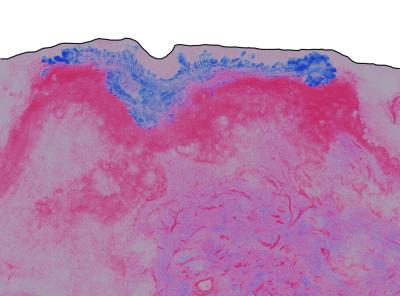 |
| Zinc oxide (ZnO) nanoparticle distribution in excised human skin. The black line represents the surface of the skin (top), blue represents ZnO nanoparticle distribution in the skin (stratum corneum), and pink represents skin.
Credit: Timothy Kelf, Macquarie University. |
Abstract:
Ultra-tiny zinc oxide (ZnO) particles with dimensions less than one-ten-millionth of a meter are among the ingredients list of some commercially available sunscreen products, raising concerns about whether the particles may be absorbed beneath the outer layer of skin. To help answer these safety questions, an international team of scientists from Australia and Switzerland have developed a way to optically test the concentration of ZnO nanoparticles at different skin depths. They found that the nanoparticles did not penetrate beneath the outermost layer of cells when applied to patches of excised skin. The results, which were published this month in the Optical Society's (OSA) open-access journal Biomedical Optics Express, lay the groundwork for future studies in live patients.
Scientists use laser imaging to assess safety of zinc oxide nanoparticles in sunscreen
Washington, DC | Posted on December 1st, 2011The high optical absorption of ZnO nanoparticles in the UVA and UVB range, along with their transparency in the visible spectrum when mixed into lotions, makes them appealing candidates for inclusion in sunscreen cosmetics. However, the particles have been shown to be toxic to certain types of cells within the body, making it important to study the nanoparticles' fate after being applied to the skin. By characterizing the optical properties of ZnO nanoparticles, the Australian and Swiss research team found a way to quantitatively assess how far the nanoparticles might migrate into skin.
The team used a technique called nonlinear optical microscopy, which illuminates the sample with short pulses of laser light and measures a return signal. Initial results show that ZnO nanoparticles from a formulation that had been rubbed into skin patches for 5 minutes, incubated at body temperature for 8 hours, and then washed off, did not penetrate beneath the stratum corneum, or topmost layer of the skin. The new optical characterization should be a useful tool for future non-invasive in vivo studies, the researchers write.
####
For more information, please click here
Contacts:
Angela Stark
202-416-1443
Copyright © Optical Society of America
If you have a comment, please Contact us.Issuers of news releases, not 7th Wave, Inc. or Nanotechnology Now, are solely responsible for the accuracy of the content.
Bookmark:


| Related Links |
| Related News Press |
News and information
 Quantum computer improves AI predictions April 17th, 2026
Flexible sensor gains sensitivity under pressure April 17th, 2026
A reusable chip for particulate matter sensing April 17th, 2026
Detecting vibrational quantum beating in the predissociation dynamics of SF6 using time-resolved photoelectron spectroscopy April 17th, 2026
Discoveries
Quantum computer improves AI predictions April 17th, 2026
Flexible sensor gains sensitivity under pressure April 17th, 2026
A reusable chip for particulate matter sensing April 17th, 2026
Detecting vibrational quantum beating in the predissociation dynamics of SF6 using time-resolved photoelectron spectroscopy April 17th, 2026
Announcements
A fundamentally new therapeutic approach to cystic fibrosis: Nanobody repairs cellular defect April 17th, 2026
UC Irvine physicists discover method to reverse ‘quantum scrambling’ : The work addresses the problem of information loss in quantum computing system April 17th, 2026
Personal Care/Cosmetics
DGIST and New Life Group launched a research project on "Functional beauty and health products using the latest nanotechnology" May 12th, 2023
A Comprehensive Guide: The Future of Nanotechnology September 13th, 2018
Graphene finds new application as anti-static hair dye: New formula works as well as commercial permanent dyes without chemically altering hairs March 22nd, 2018
Programmable materials find strength in molecular repetition May 23rd, 2016
Photonics/Optics/Lasers
Metasurfaces smooth light to boost magnetic sensing precision January 30th, 2026
From sensors to smart systems: the rise of AI-driven photonic noses January 30th, 2026
 |
||
 |
||
| The latest news from around the world, FREE | ||
 |
||
|
|
||
| Premium Products | ||
 |
||
|
Only the news you want to read!
Learn More |
||
 |
||
|
Full-service, expert consulting
Learn More |
||
|
|
||