Home > Press > Nature notices PKU's new solar battery in carbon nanotubes
 |
Abstract:
Peking University (PKU) Professor Peng Lianmao published Research Efficient Photovoltage Multiplication in Carbon Nanotubes on Nature Photonics (2011, 5, PP.672-676), with PhD candidates from PKU School of Electronics Engineering and Computer Science, Yang Leijing and Wang Shengfu, as co-writers.
Nature notices PKU's new solar battery in carbon nanotubes
Beijing, China | Posted on November 24th, 2011Nature Photonics is one of the periodicals belonging to the renowned journal Nature. The research paper contains major breakthrough in the study of nanoelectronic applications. It at the same time represents the new progress in the field of nanoelectronic applications made by Professor Peng Lianmao's team.
With the background that natural resource is more and more meager, solar power has many unsurpassable advantages as an alternative energy source. At present, global researches in solar photovoltage mainly focus on the study of photovoltaic devices based on new nanomaterials.
Carbon nanotubes are direct-bandgap materials that are not only useful for nanoelectronic applications, but also have the potential to make a significant impact on the next generation of photovoltaic technology. A semiconducting single-walled carbon nanotube (SWCNT) has an unusual band structure, as a result of which high-efficiency carrier multiplication effects have been predicted and observed, and films of SWCNTs with absorption close to 100% have been reported. Other important features for photovoltaic applications include high mobility and the availability of ohmic contacts for both electrons and holes. However, the photovoltage generated from a typical semiconducting SWCNT is less than 0.2V, which is too small for most practical photovoltaic applications. Given this background, the researchers successfully showed how this value was readily multiplied by using virtual contacts at the carbon nanotube, which turned to be an important and challenging job.
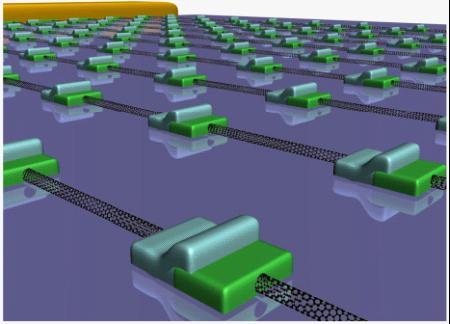
Professor Peng and his team worked out an approach, the key to which was the introduction of a local virtual contact to the CNT. This contact is virtual in the sense that it is not intended to be connected to the external circuit. In one example, more than 1.0V is generated from a 10-mm-long carbon nanotube with a single-cell photovoltage of 0.2V. This work was realized based on the forward researches conducted by the same team.
In 2008, the research group put forward a method to form carbon nanotube (CNT) diodes using asymmetrically contacts between electrodes. This research finding was published on Advanced Materials (2008, 20, 3258). On this basis, using almost the same but improved methods, the team invented the first carbon tube infrared light-emitting diode (LED), Nano Letters (2011, 11, 23) reported.
The study was supported by the China's National Basic Research Program, and funded by the National Natural Science Fund Committee (NNSFC).
Written by: Jiang Zhaohui
Edited by: Arthars
####
For more information, please click here
Copyright © Peking University
If you have a comment, please Contact us.Issuers of news releases, not 7th Wave, Inc. or Nanotechnology Now, are solely responsible for the accuracy of the content.
Bookmark:


| Related News Press |
News and information
 Quantum computer improves AI predictions April 17th, 2026
Flexible sensor gains sensitivity under pressure April 17th, 2026
A reusable chip for particulate matter sensing April 17th, 2026
Detecting vibrational quantum beating in the predissociation dynamics of SF6 using time-resolved photoelectron spectroscopy April 17th, 2026
Nanotubes/Buckyballs/Fullerenes/Nanorods/Nanostrings/Nanosheets
Tiny nanosheets, big leap: A new sensor detects ethanol at ultra-low levels January 30th, 2026
Enhancing power factor of p- and n-type single-walled carbon nanotubes April 25th, 2025
Chainmail-like material could be the future of armor: First 2D mechanically interlocked polymer exhibits exceptional flexibility and strength January 17th, 2025
Innovative biomimetic superhydrophobic coating combines repair and buffering properties for superior anti-erosion December 13th, 2024
Discoveries
Quantum computer improves AI predictions April 17th, 2026
Flexible sensor gains sensitivity under pressure April 17th, 2026
A reusable chip for particulate matter sensing April 17th, 2026
Detecting vibrational quantum beating in the predissociation dynamics of SF6 using time-resolved photoelectron spectroscopy April 17th, 2026
Announcements
A fundamentally new therapeutic approach to cystic fibrosis: Nanobody repairs cellular defect April 17th, 2026
UC Irvine physicists discover method to reverse ‘quantum scrambling’ : The work addresses the problem of information loss in quantum computing system April 17th, 2026
Energy
Sensors innovations for smart lithium-based batteries: advancements, opportunities, and potential challenges August 8th, 2025
Simple algorithm paired with standard imaging tool could predict failure in lithium metal batteries August 8th, 2025
Battery Technology/Capacitors/Generators/Piezoelectrics/Thermoelectrics/Energy storage
Decoding hydrogen‑bond network of electrolyte for cryogenic durable aqueous zinc‑ion batteries January 30th, 2026
COF scaffold membrane with gate‑lane nanostructure for efficient Li+/Mg2+ separation January 30th, 2026
MXene nanomaterials enter a new dimension Multilayer nanomaterial: MXene flakes created at Drexel University show new promise as 1D scrolls January 30th, 2026
Solar/Photovoltaic
Spinel-type sulfide semiconductors to operate the next-generation LEDs and solar cells For solar-cell absorbers and green-LED source October 3rd, 2025
KAIST researchers introduce new and improved, next-generation perovskite solar cell November 8th, 2024
Groundbreaking precision in single-molecule optoelectronics August 16th, 2024
Development of zinc oxide nanopagoda array photoelectrode: photoelectrochemical water-splitting hydrogen production January 12th, 2024
 |
||
 |
||
| The latest news from around the world, FREE | ||
 |
||
|
|
||
| Premium Products | ||
 |
||
|
Only the news you want to read!
Learn More |
||
 |
||
|
Full-service, expert consulting
Learn More |
||
|
|
||