Home > Press > The quest for the tiny carbon nanotube
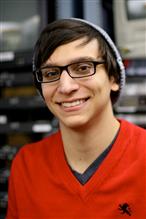 |
| Tom Flores |
Abstract:
As he tailors one of the world's finest imaging instruments to tackle one of science's most baffling challenges, Tom Flores feels like he's playing a microscopic game of Where's Waldo.
The quest for the tiny carbon nanotube
Bethlehem, PA | Posted on November 1st, 2011Flores, a junior majoring in physics, is on a quest for something more elusive—the tiny carbon nanotube.
Carbon nanotubes measure 1 to 5 nanometers in diameter. One nanometer is a billionth of a meter, or between one ten-thousandth and one hundred-thousandth the thickness of a human hair.
With unmatched strength, stiffness and hardness, and length-to-diameter ratios of as much as millions to one, CNTs have potential in medicine, energy and many other applications.
But their infinitesimal size makes it difficult to find and observe CNTs. While Waldo hides behind people, CNTs conceal themselves among bumps, nicks, specks of dust and other imperfections on a microscope slide. They reveal their presence by emitting infrared light when a light source is directed at them.
An ultrathin plane of focus
Flores began studying CNTs last spring with Slava Rotkin, associate professor of physics, and continued last summer in the physics department's Research Experience for Undergraduates program. Funded by the National Science Foundation, the program enables students to do a 10-week paid internship alongside a faculty member.
Lehigh's REU program, with more than two decades of NSF funding, is one of the nation's oldest. In the past five years, an average of 25 to 28 students, roughly one-third from Lehigh, have taken part in the internship.
Flores and two graduate students—Massooma Pirbhai and Tetyana Ignatova—study CNTs with a custom-made NTEGRA-Spectra recently acquired by Rotkin and Richard Vinci, professor of materials science and engineering. The instrument pairs an optical microscope with an atomic-force microscope (AFM), whose needle-like probe scans a surface and records its topographical features.
Flores and his colleagues combine AFM with an optical imaging technique called total internal reflection fluorescence.
"TIRF is a form of photoluminescence," says Flores. "You excite an object so that it gives off light, which provides information about the object and its properties.
"TIRF can excite an object in an extremely thin plane. We study single-walled CNTs, which are 1 nm in diameter. Our plane of focus has to be very thin; if not, we get luminescence from impurities near our sample."
A unique integration of microscopy techniques
Flores uses the AFM probe tip to locate the position of CNTs on a sample.
"We produce an AFM topographical image that shows us where we need to focus. The resolution of that image is limited only by the diameter of the tip. This is much better than you can do with an optics probe.
"Our project is like a game of Where's Waldo. We're trying to find a tiny object in a giant sample. We have to combine information from the AFM about physical characteristics—shape and size—with information supplied by TIRF about how light interacts with the sample."
Only one other research group in the U.S., says Flores, integrates AFM and TIRF in a setup exactly the same as Lehigh's. Combining the two techniques requires resourcefulness. To achieve optimum focus and illumination, Flores and his colleagues have had to modify the sample stage and lenses of the optical microscope.
"Our overall goal is to find and examine CNTs and characterize their properties so that engineers can find applications for them.
"We don't have images of CNTs yet, but we have produced images of polyethylene beads with dyes that emit light at various wavelengths.
"So we know our system is working."
####
For more information, please click here
Contacts:
Kurt Pfitzer
Copyright © Lehigh University
If you have a comment, please Contact us.Issuers of news releases, not 7th Wave, Inc. or Nanotechnology Now, are solely responsible for the accuracy of the content.
Bookmark:


| Related News Press |
News and information
 Quantum computer improves AI predictions April 17th, 2026
Flexible sensor gains sensitivity under pressure April 17th, 2026
A reusable chip for particulate matter sensing April 17th, 2026
Detecting vibrational quantum beating in the predissociation dynamics of SF6 using time-resolved photoelectron spectroscopy April 17th, 2026
Imaging
Simple algorithm paired with standard imaging tool could predict failure in lithium metal batteries August 8th, 2025
Nanotubes/Buckyballs/Fullerenes/Nanorods/Nanostrings/Nanosheets
Tiny nanosheets, big leap: A new sensor detects ethanol at ultra-low levels January 30th, 2026
Enhancing power factor of p- and n-type single-walled carbon nanotubes April 25th, 2025
Chainmail-like material could be the future of armor: First 2D mechanically interlocked polymer exhibits exceptional flexibility and strength January 17th, 2025
Innovative biomimetic superhydrophobic coating combines repair and buffering properties for superior anti-erosion December 13th, 2024
Discoveries
Quantum computer improves AI predictions April 17th, 2026
Flexible sensor gains sensitivity under pressure April 17th, 2026
A reusable chip for particulate matter sensing April 17th, 2026
Detecting vibrational quantum beating in the predissociation dynamics of SF6 using time-resolved photoelectron spectroscopy April 17th, 2026
Announcements
A fundamentally new therapeutic approach to cystic fibrosis: Nanobody repairs cellular defect April 17th, 2026
UC Irvine physicists discover method to reverse ‘quantum scrambling’ : The work addresses the problem of information loss in quantum computing system April 17th, 2026
Tools
Metasurfaces smooth light to boost magnetic sensing precision January 30th, 2026
From sensors to smart systems: the rise of AI-driven photonic noses January 30th, 2026
Japan launches fully domestically produced quantum computer: Expo visitors to experience quantum computing firsthand August 8th, 2025
 |
||
 |
||
| The latest news from around the world, FREE | ||
 |
||
|
|
||
| Premium Products | ||
 |
||
|
Only the news you want to read!
Learn More |
||
 |
||
|
Full-service, expert consulting
Learn More |
||
|
|
||