Home > Press > Improved characterization of nanoparticle clusters for EHS and biosensors research
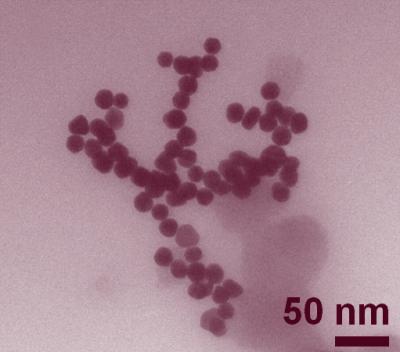 |
| Clusters of roughly 30-nanometer gold nanoparticles imaged by transmission electron microscopy. (Color added for clarity.)
Credit: Keene, FDA |
Abstract:
The tendency of nanoparticles to clump together in solution—"agglomeration"—is of great interest because the size of the clusters plays an important role in the behavior of the materials. Toxicity, the persistence of the nanomaterials in the environment, their efficacy as biosensors and, for that matter, the accuracy of experiments to measure these factors, are all known to be affected by agglomeration and cluster size. Recent work* at the National Institute of Standards and Technology (NIST) offers a way to measure accurately both the distribution of cluster sizes in a sample and the characteristic light absorption for each size. The latter is important for the application of nanoparticles in biosensors.
Improved characterization of nanoparticle clusters for EHS and biosensors research
Gaithersburg, MD | Posted on October 26th, 2011A good example of the potential application of the work, says NIST biomedical engineer Justin Zook, is in the development of nanoparticle biosensors for ultrasensitive pregnancy tests. Gold nanoparticles can be coated with antibodies to a hormone** produced by an embryo shortly after conception. Multiple gold nanoparticles can bind to each hormone, forming clusters that have a different color from unclustered gold nanoparticles. But only certain size clusters are optimal for this measurement, so knowing how light absorbance changes with cluster size makes it easier to design the biosensors to result in just the right sized clusters.
The NIST team first prepared samples of gold nanoparticles—a nanomaterial widely used in biology—in a standard cell culture solution, using their previously developed technique for creating samples with a controlled distribution of sizes***. The particles are allowed to agglomerate in gradually growing clusters and the clumping process is "turned off" after varying lengths of time by adding a stabilizing agent that prevents further agglomeration.
They then used a technique called analytical ultracentrifugation (AUC) to simultaneously sort the clusters by size and measure their light absorption. The centrifuge causes the nanoparticle clusters to separate by size, the smaller, lighter clusters moving more slowly than the larger ones. While this is happening, the sample containers are repeatedly scanned with light and the amount of light passing through the sample for each color or frequency is recorded. The larger the cluster, the more light is absorbed by lower frequencies. Measuring the absorption by frequency across the sample containers allows the researchers both to watch the gradual separation of cluster sizes and to correlate absorbed frequencies with specific cluster sizes.
Most previous measurements of absorption spectra for solutions of nanoparticles were able only to measure the bulk spectra—the absorption of all the different cluster sizes mixed together. AUC makes it possible to measure the quantity and distribution of each nanoparticle cluster without being confounded by other components in complex biological mixtures, such as proteins. The technique previously had been used only to make these measurements for single nanoparticles in solution. The NIST researchers are the first to show that the procedure also works for nanoparticle clusters.
* J.M. Zook, V. Rastogi, R.I. MacCuspie, A.M. Keene and J. Fagan. Measuring agglomerate size distribution and dependence of localized surface plasmon resonance absorbance on gold nanoparticle agglomerate size using analytical ultracentrifugation. ACS Nano, Articles ASAP (As Soon As Publishable). Publication Date (Web): Sept. 3, 2011 DOI: 10.1021/nn202645b.
** HCG: Human chorionic gonadotropin.
*** See J.M. Zook, R.I. MacCuspie, L.E. Locascio, M.D. Halter and J.T. Elliott. Stable nanoparticle aggregates/agglomerates of different sizes and the effect of their size on hemolytic cytotoxicity. Nanotoxicology, published online Dec. 13, 2010 (DOI: 10.3109/17435390.2010.536615) and the Feb. 2, 2011, NIST Tech Beat article, "NIST Technique Controls Sizes of Nanoparticle Clusters for EHS Studies," at www.nist.gov/public_affairs/tech-beat/tb20110202.cfm#nanoparticles.
####
For more information, please click here
Contacts:
Michael E. Newman
301-975-3025
Copyright © National Institute of Standards and Technology (NIST)
If you have a comment, please Contact us.Issuers of news releases, not 7th Wave, Inc. or Nanotechnology Now, are solely responsible for the accuracy of the content.
Bookmark:


| Related News Press |
News and information
 Quantum computer improves AI predictions April 17th, 2026
Flexible sensor gains sensitivity under pressure April 17th, 2026
A reusable chip for particulate matter sensing April 17th, 2026
Detecting vibrational quantum beating in the predissociation dynamics of SF6 using time-resolved photoelectron spectroscopy April 17th, 2026
Laboratories
Researchers develop molecular qubits that communicate at telecom frequencies October 3rd, 2025
A battery’s hopping ions remember where they’ve been: Seen in atomic detail, the seemingly smooth flow of ions through a battery’s electrolyte is surprisingly complicated February 16th, 2024
Govt.-Legislation/Regulation/Funding/Policy
Quantum computer improves AI predictions April 17th, 2026
Metasurfaces smooth light to boost magnetic sensing precision January 30th, 2026
New imaging approach transforms study of bacterial biofilms August 8th, 2025
Sensors
Flexible sensor gains sensitivity under pressure April 17th, 2026
Tiny nanosheets, big leap: A new sensor detects ethanol at ultra-low levels January 30th, 2026
From sensors to smart systems: the rise of AI-driven photonic noses January 30th, 2026
Sensors innovations for smart lithium-based batteries: advancements, opportunities, and potential challenges August 8th, 2025
Discoveries
Quantum computer improves AI predictions April 17th, 2026
Flexible sensor gains sensitivity under pressure April 17th, 2026
A reusable chip for particulate matter sensing April 17th, 2026
Detecting vibrational quantum beating in the predissociation dynamics of SF6 using time-resolved photoelectron spectroscopy April 17th, 2026
Announcements
A fundamentally new therapeutic approach to cystic fibrosis: Nanobody repairs cellular defect April 17th, 2026
UC Irvine physicists discover method to reverse ‘quantum scrambling’ : The work addresses the problem of information loss in quantum computing system April 17th, 2026
Environment
A reusable chip for particulate matter sensing April 17th, 2026
Researchers unveil a groundbreaking clay-based solution to capture carbon dioxide and combat climate change June 6th, 2025
Safety-Nanoparticles/Risk management
Tiny nanosheets, big leap: A new sensor detects ethanol at ultra-low levels January 30th, 2026
Onion-like nanoparticles found in aircraft exhaust May 14th, 2025
Closing the gaps — MXene-coating filters can enhance performance and reusability February 28th, 2025
 |
||
 |
||
| The latest news from around the world, FREE | ||
 |
||
|
|
||
| Premium Products | ||
 |
||
|
Only the news you want to read!
Learn More |
||
 |
||
|
Full-service, expert consulting
Learn More |
||
|
|
||