Home > Press > Rice's Zheng wins Packard Fellowship: Chemist will build spectrometer to analyze molecules in 3-D
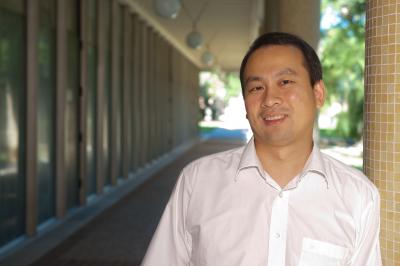 |
| Rice University chemist Junrong Zheng will use his Packard Foundation award to build a spectrometer that can determine the conformation of molecules in three dimensions.
Credit: Jeff Fitlow/Rice University |
Abstract:
Junrong Zheng's techniques to see the fine details of how molecules interact have earned the young Rice University scientist a highly prestigious Packard Fellowship.
Rice's Zheng wins Packard Fellowship: Chemist will build spectrometer to analyze molecules in 3-D
Houston, TX | Posted on October 20th, 2011Zheng and his team of postdoctoral researchers and graduate students will use the five-year grant that comes with the fellowship to build a laser-based spectroscopic device to easily see the conformation -- the shape and orientation -- of any molecule, no matter how complex.
Zheng, an assistant professor of chemistry who joined Rice in 2008, discovered a method to analyze the natural vibrations of the bonds that hold molecules together in a way that can tell him how far apart those molecules are. Further work led to a 2-D method for finding the angles at which the atoms within a molecule bond.
Now Zheng is preparing to leap into real-time, three-dimensional analysis of molecular conformations. Doing so will take some time and effort -- and money -- to build a machine capable of looking at molecular details in a way nobody has before. A successful effort could mean a quantum leap in the study of chemical reactions, protein folding, drug/protein interactions, doped nanomaterials and molecular recognition.
Zheng anticipates it will take five years to build the machine, a full-spectrum, multidimensional spectrometer that can read a wide range of frequencies from the high infrared to the low terahertz. It will allow researchers to take snapshots of molecules that could provide in seconds data that now takes days to acquire.
He knows firsthand about that process; he published a paper this year that detailed his technique for acquiring 3-D data from a specific molecule.
The paper in the Journal of Physical Chemistry described how Zheng and his team analyzed the conformations of a small molecule, 1-cyanovinyl acetate, known to contain a wide range of vibrational energy.
Theoretical calculations of the five possible conformations of the molecule let them compare what they saw through physical analysis with a two-dimensional infrared spectrometer designed by Zheng and his team. The comparison showed theory and experimental results in virtually perfect alignment.
Zheng believed results for molecules bigger than the fast-moving 1-cyanovinyl acetate would be just as good because their rotations are slower.
Zheng said the machine, when finished, will probably be the only one of its kind in the world. The goal is the development of a sophisticated yet routine analytic tool for determining molecular structure for chemists and researchers who are not laser specialists.
"Hopefully, we can make it very easy to use, so everybody can go buy one," he said.
The David and Lucille Packard Foundation names 16 award winners every year from among 100 nominees who represent 50 American research universities. Zheng is the fifth Rice researcher to win. He joins Rice physicists Thomas Killian and Douglas Natelson and Earth scientists Cin-Ty Lee and Rajdeep Dasgupta.
"I didn't anticipate this award, because I know some very important people in our field have won it," Zheng said. "I know it's very competitive, so it means people appreciate my work."
####
For more information, please click here
Contacts:
Mike Williams
713-348-6728
Copyright © Rice University
If you have a comment, please Contact us.Issuers of news releases, not 7th Wave, Inc. or Nanotechnology Now, are solely responsible for the accuracy of the content.
Bookmark:


| Related News Press |
News and information
 Quantum computer improves AI predictions April 17th, 2026
Flexible sensor gains sensitivity under pressure April 17th, 2026
A reusable chip for particulate matter sensing April 17th, 2026
Detecting vibrational quantum beating in the predissociation dynamics of SF6 using time-resolved photoelectron spectroscopy April 17th, 2026
Chemistry
Projecting light to dispense liquids: A new route to ultra-precise microdroplets January 30th, 2026
From sensors to smart systems: the rise of AI-driven photonic noses January 30th, 2026
"Nanoreactor" cage uses visible light for catalytic and ultra-selective cross-cycloadditions October 3rd, 2025
Cambridge chemists discover simple way to build bigger molecules – one carbon at a time June 6th, 2025
Announcements
A fundamentally new therapeutic approach to cystic fibrosis: Nanobody repairs cellular defect April 17th, 2026
UC Irvine physicists discover method to reverse ‘quantum scrambling’ : The work addresses the problem of information loss in quantum computing system April 17th, 2026
Tools
Metasurfaces smooth light to boost magnetic sensing precision January 30th, 2026
From sensors to smart systems: the rise of AI-driven photonic noses January 30th, 2026
Japan launches fully domestically produced quantum computer: Expo visitors to experience quantum computing firsthand August 8th, 2025
Grants/Sponsored Research/Awards/Scholarships/Gifts/Contests/Honors/Records
Quantum computer improves AI predictions April 17th, 2026
Detecting vibrational quantum beating in the predissociation dynamics of SF6 using time-resolved photoelectron spectroscopy April 17th, 2026
Metasurfaces smooth light to boost magnetic sensing precision January 30th, 2026
Photonics/Optics/Lasers
Metasurfaces smooth light to boost magnetic sensing precision January 30th, 2026
From sensors to smart systems: the rise of AI-driven photonic noses January 30th, 2026
 |
||
 |
||
| The latest news from around the world, FREE | ||
 |
||
|
|
||
| Premium Products | ||
 |
||
|
Only the news you want to read!
Learn More |
||
 |
||
|
Full-service, expert consulting
Learn More |
||
|
|
||