Home > Press > Small, Quick, and Multitasking: Optimized Nanostructure Synthesis and Morphology
 |
Abstract:
Making exactly the noble metal nanostructure you want is now much simpler, thanks to a microfluidic array developed by US and Chinese researchers.
Nanostructures made up of noble metals such as gold and palladium are vitally important to further our progress in electronics, photonics, plasmonics, information storage, catalysis, and biomedicine, to name but a few. Most of these structures are made using solution synthesis procedures which can be difficult to optimize; often commonly used and published procedures do not use the optimal conditions. In particular, the morphology (shape and form) can be greatly affected by variables such as temperature, pH, and concentration of reactants. An approach that identifies optimal parameters for each morphology at a glance would help many researchers.
Small, Quick, and Multitasking: Optimized Nanostructure Synthesis and Morphology
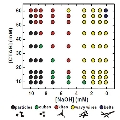
USA and China | Posted on September 22nd, 2011Microfluidics, an emerging technology that works with very small volumes of reagents and allows multiple reactions to be run in parallel, is an ideal way to screen many variables at once. By taking advantage of this technology, Younan Xia and co-workers at Washington University, USA, and the Hong Kong University of Science and Technology, China, have developed an on-chip way of rapidly screening the experimental conditions for synthesis of noble metal nanostructures and their morphologies. The scientists used an array of microfluidic reactors containing solutions with gradients in reagent concentration, pH value, or reaction temperature. They were able to quickly identify the parameters needed for the production of Au and Pd nanostructures with various morphologies, including some morphologies that had not previously been made.
The scientists expect that their approach will be extended to other systems for rapid screening and optimization of synthesis conditions for different types of nanostructure. This approach should mean that nanostructures can be made purer and in larger quantities than before, which should benefit virtually everyone working with nanotechnology.
####
For more information, please click here
Copyright © Wiley-VCH Materials Science Journals
If you have a comment, please Contact us.Issuers of news releases, not 7th Wave, Inc. or Nanotechnology Now, are solely responsible for the accuracy of the content.
Bookmark:


| Related Links |
 J. Zhou et al., Small, ; DOI: 10.1002/smll.201101299
| Related News Press |
News and information
Quantum computer improves AI predictions April 17th, 2026
Flexible sensor gains sensitivity under pressure April 17th, 2026
A reusable chip for particulate matter sensing April 17th, 2026
Detecting vibrational quantum beating in the predissociation dynamics of SF6 using time-resolved photoelectron spectroscopy April 17th, 2026
Microfluidics/Nanofluidics
Projecting light to dispense liquids: A new route to ultra-precise microdroplets January 30th, 2026
Chemistry
Projecting light to dispense liquids: A new route to ultra-precise microdroplets January 30th, 2026
From sensors to smart systems: the rise of AI-driven photonic noses January 30th, 2026
"Nanoreactor" cage uses visible light for catalytic and ultra-selective cross-cycloadditions October 3rd, 2025
Cambridge chemists discover simple way to build bigger molecules – one carbon at a time June 6th, 2025
Chip Technology
A reusable chip for particulate matter sensing April 17th, 2026
Metasurfaces smooth light to boost magnetic sensing precision January 30th, 2026
Memory Technology
Researchers tackle the memory bottleneck stalling quantum computing October 3rd, 2025
First real-time observation of two-dimensional melting process: Researchers at Mainz University unveil new insights into magnetic vortex structures August 8th, 2025
Utilizing palladium for addressing contact issues of buried oxide thin film transistors April 5th, 2024
Nanomedicine
A fundamentally new therapeutic approach to cystic fibrosis: Nanobody repairs cellular defect April 17th, 2026
New molecular technology targets tumors and simultaneously silences two ‘undruggable’ cancer genes August 8th, 2025
New imaging approach transforms study of bacterial biofilms August 8th, 2025
Electrifying results shed light on graphene foam as a potential material for lab grown cartilage June 6th, 2025
Discoveries
Quantum computer improves AI predictions April 17th, 2026
Flexible sensor gains sensitivity under pressure April 17th, 2026
A reusable chip for particulate matter sensing April 17th, 2026
Detecting vibrational quantum beating in the predissociation dynamics of SF6 using time-resolved photoelectron spectroscopy April 17th, 2026
Announcements
A fundamentally new therapeutic approach to cystic fibrosis: Nanobody repairs cellular defect April 17th, 2026
UC Irvine physicists discover method to reverse ‘quantum scrambling’ : The work addresses the problem of information loss in quantum computing system April 17th, 2026
Photonics/Optics/Lasers
Metasurfaces smooth light to boost magnetic sensing precision January 30th, 2026
From sensors to smart systems: the rise of AI-driven photonic noses January 30th, 2026
 |
||
 |
||
| The latest news from around the world, FREE | ||
 |
||
|
|
||
| Premium Products | ||
 |
||
|
Only the news you want to read!
Learn More |
||
 |
||
|
Full-service, expert consulting
Learn More |
||
|
|
||