Home > Press > Researchers Link DNA to Nanostructures
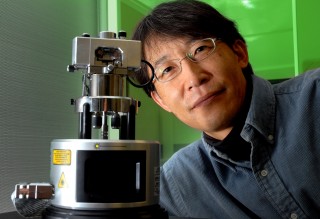 |
| Jin-Woo Kim, University of Arkansas |
Abstract:
Assembly of nanostructures using DNA may lead to the production of new materials with a wide range of applications from electronics to tissue engineering. Researchers in the Institute for Nanoscience and Engineering at the University of Arkansas have produced building blocks for such material by controlling the number, placement and orientation of DNA linkers on the surface of colloidal nanoparticles.
Researchers Link DNA to Nanostructures
Fayetteville, AR | Posted on September 20th, 2011Their work is featured as the "hot paper" in the current issue of Angewandte Chemie International Edition, the weekly scientific journal of the German Chemical Society.
"We have demonstrated a strategy to place ‘DNA linkers' on a nanoparticle at specific angles relative to each other so that we may produce building blocks with well-defined arrangements of DNA in all dimensions," said Jin-Woo Kim, professor of biological engineering. "The specific number and orientation of DNA strands on the nanoparticles allow greater control over the ultimate shape of nanostructures."
DNA linkers are areas on the nanoparticles that functionally allow connection with other nanoparticles. In this case, connection is achieved through a type of DNA hybridization reaction.
The simple and sustainable strategy involves attaching strands of DNA to functionalized nanoparticles one strand after the other rather than all at the same time. The nanoparticle with the first strand serves as the starting material for the second strand. The nanoparticle with these two strands together serves as the starting material for the third, and so on. In addition to facilitating greater control over the shape of the structure, assembling in this sequential manner renders the process more reproducible and scalable, which helps with the assembly of complex, hybrid nanoscale architectures at all scales and in all dimensions.
The building blocks, which the researchers call "nBLOCKs," remained stable under volatile conditions. They exhibited chemical stability and water solubility during ligand replacement reactions. There were no apparent changes in physical and chemical properties when the building blocks were stored at 4 degrees Celsius for at least a month. Such promising stability shows high potential for their practical application. The researchers continue working on further optimizing their physical and chemical stability.
Kim said the building strategy can be generalized for other types of nanoparticles, meaning that construction of other types of building blocks with specific, desired functions may be achieved. The technology has the potential to transform many fields of research, including biology, medicine, chemistry, physics, materials science and engineering.
The research was supported by the National Science Foundation, the University of Arkansas Division of Agriculture and the Arkansas Biosciences Institute.
The work was a multidisciplinary, collaborative effort with Russell Deaton, professor of computer science and computer engineering. Jeong-Hwan Kim, postdoctoral associate at the Bio/Nano Technology Laboratory, also made a significant contribution to the project.
Jin-Woo Kim is a professor in the Dale Bumpers College of Agricultural, Food and Life Sciences and the College of Engineering. He works in the Institute for Nanoscience and Engineering at the University of Arkansas and directs the Bio/Nano Technology Laboratory.
####
For more information, please click here
Contacts:
Jin-Woo Kim
professor
Biological and Agricultural Engineering
479-575-3402
Matt McGowan
science and research
communications officer
University Relations
479-575-4246
Copyright © Newswise
If you have a comment, please Contact us.Issuers of news releases, not 7th Wave, Inc. or Nanotechnology Now, are solely responsible for the accuracy of the content.
Bookmark:


| Related News Press |
News and information
 Quantum computer improves AI predictions April 17th, 2026
Flexible sensor gains sensitivity under pressure April 17th, 2026
A reusable chip for particulate matter sensing April 17th, 2026
Detecting vibrational quantum beating in the predissociation dynamics of SF6 using time-resolved photoelectron spectroscopy April 17th, 2026
Physics
UC Irvine physicists discover method to reverse ‘quantum scrambling’ : The work addresses the problem of information loss in quantum computing system April 17th, 2026
Chemistry
Projecting light to dispense liquids: A new route to ultra-precise microdroplets January 30th, 2026
From sensors to smart systems: the rise of AI-driven photonic noses January 30th, 2026
"Nanoreactor" cage uses visible light for catalytic and ultra-selective cross-cycloadditions October 3rd, 2025
Cambridge chemists discover simple way to build bigger molecules – one carbon at a time June 6th, 2025
Govt.-Legislation/Regulation/Funding/Policy
Quantum computer improves AI predictions April 17th, 2026
Metasurfaces smooth light to boost magnetic sensing precision January 30th, 2026
New imaging approach transforms study of bacterial biofilms August 8th, 2025
Nanomedicine
A fundamentally new therapeutic approach to cystic fibrosis: Nanobody repairs cellular defect April 17th, 2026
New molecular technology targets tumors and simultaneously silences two ‘undruggable’ cancer genes August 8th, 2025
New imaging approach transforms study of bacterial biofilms August 8th, 2025
Electrifying results shed light on graphene foam as a potential material for lab grown cartilage June 6th, 2025
Discoveries
Quantum computer improves AI predictions April 17th, 2026
Flexible sensor gains sensitivity under pressure April 17th, 2026
A reusable chip for particulate matter sensing April 17th, 2026
Detecting vibrational quantum beating in the predissociation dynamics of SF6 using time-resolved photoelectron spectroscopy April 17th, 2026
Materials/Metamaterials/Magnetoresistance
First real-time observation of two-dimensional melting process: Researchers at Mainz University unveil new insights into magnetic vortex structures August 8th, 2025
Researchers unveil a groundbreaking clay-based solution to capture carbon dioxide and combat climate change June 6th, 2025
A 1960s idea inspires NBI researchers to study hitherto inaccessible quantum states June 6th, 2025
Institute for Nanoscience hosts annual proposal planning meeting May 16th, 2025
Announcements
A fundamentally new therapeutic approach to cystic fibrosis: Nanobody repairs cellular defect April 17th, 2026
UC Irvine physicists discover method to reverse ‘quantum scrambling’ : The work addresses the problem of information loss in quantum computing system April 17th, 2026
Nanobiotechnology
A fundamentally new therapeutic approach to cystic fibrosis: Nanobody repairs cellular defect April 17th, 2026
New molecular technology targets tumors and simultaneously silences two ‘undruggable’ cancer genes August 8th, 2025
New imaging approach transforms study of bacterial biofilms August 8th, 2025
Electrifying results shed light on graphene foam as a potential material for lab grown cartilage June 6th, 2025
 |
||
 |
||
| The latest news from around the world, FREE | ||
 |
||
|
|
||
| Premium Products | ||
 |
||
|
Only the news you want to read!
Learn More |
||
 |
||
|
Full-service, expert consulting
Learn More |
||
|
|
||