Home > Press > Nanosensors Made from DNA May Light Path to New Cancer Tests and Drugs
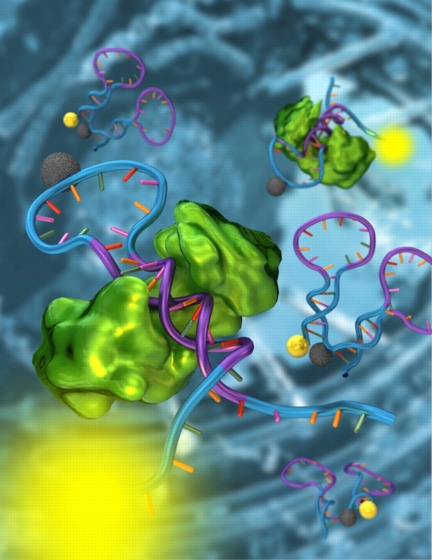 |
| A structure-switching nanosensor made from DNA (blue and purple) detects a specific transcription factor (green). Using these nanosensors, a team of researchers from UCSB has demonstrated the detection of transcription factors directly in cellular extracts. The researchers believe that their strategies will allow biologists to monitor the activity of thousands of transcription factors, leading to a better understanding of the mechanisms underlying cell division and development. Credit: Peter Allen |
Abstract:
Sensors made from custom DNA molecules could be used to personalize cancer treatments and monitor the quality of stem cells, according to an international team of researchers led by scientists at UC Santa Barbara and the University of Rome Tor Vergata.
Nanosensors Made from DNA May Light Path to New Cancer Tests and Drugs
Santa Barbara, CA | Posted on September 7th, 2011The new nanosensors can quickly detect a broad class of proteins called transcription factors, which serve as the master control switches of life. The research is described in an article published in Journal of the American Chemical society.
"The fate of our cells is controlled by thousands of different proteins, called transcription factors," said Alexis Vallée-Bélisle, a postdoctoral researcher in UCSB's Department of Chemistry and Biochemistry, who led the study. "The role of these proteins is to read the genome and translate it into instructions for the synthesis of the various molecules that compose and control the cell. Transcription factors act a little bit like the ‘settings' of our cells, just like the settings on our phones or computers. What our sensors do is read those settings."
When scientists take stem cells and turn them into specialized cells, they do so by changing the levels of a few transcription factors, he explained. This process is called cell reprogramming. "Our sensors monitor transcription factor activities, and could be used to make sure that stem cells have been properly reprogrammed," said Vallée-Bélisle. "They could also be used to determine which transcription factors are activated or repressed in a patient's cancer cells, thus enabling physicians to use the right combination of drugs for each patient."
Andrew Bonham, a postdoctoral scholar at UCSB and co-first author of the study, explained that many labs have invented ways to read transcription factors; however, this team's approach is very quick and convenient. "In most labs, researchers spend hours extracting the proteins from cells before analyzing them," said Bonham. "With the new sensors, we just mash the cells up, put the sensors in, and measure the level of fluorescence of the sample."
This international research effort -- organized by senior authors Kevin Plaxco, professor in UCSB's Department of Chemistry and Biochemistry, and Francesco Ricci, professor at the University of Rome, Tor Vergata -- started when Ricci realized that all of the information necessary to detect transcription factor activities is already encrypted in the human genome, and could be used to build sensors. "Upon activation, these thousands of different transcription factors bind to their own specific target DNA sequence," said Ricci. "We use these sequences as a starting point to build our new nanosensors."
The key breakthrough underlying this new technology came from studies of the natural biosensors inside cells. "All creatures, from bacteria to humans, monitor their environments using ‘biomolecular switches' -- shape-changing molecules made from RNA or proteins," said Plaxco. "For example, in our sinuses, there are millions of receptor proteins that detect different odor molecules by switching from an ‘off state' to an ‘on state.' The beauty of these switches is that they are small enough to operate inside a cell, and specific enough to work in the very complex environments found there."
Inspired by the efficiency of these natural nanosensors, the research group teamed with Norbert Reich, also a professor in UCSB's Department of Chemistry and Biochemistry, to build synthetic switching nanosensors using DNA, rather than proteins or RNA.
Specifically, the team re-engineered three naturally occurring DNA sequences, each recognizing a different transcription factor, into molecular switches that become fluorescent when they bind to their intended targets. Using these nanometer-scale sensors, the researchers could determine transcription factor activity directly in cellular extracts by simply measuring their fluorescence level.
The researchers believe that this strategy will ultimately allow biologists to monitor the activation of thousands of transcription factors, leading to a better understanding of the mechanisms underlying cell division and development. "Alternatively, since these nanosensors work directly in biological samples, we also believe that they could be used to screen and test new drugs that could, for example, inhibit transcription-factor binding activity responsible for the growth of tumor cells," said Plaxco.
This work was funded by the National Institute of Health, the Fond Québécois de la Recherche sur la Nature et les Technologies, the Italian Ministry of University and Research (MIUR) project "Futuro in Ricerca," and the Tri-County Blood Bank Santa Barbara Foundation.
####
For more information, please click here
Contacts:
Gail Gallessich
805-893-7220
George Foulsham
805-893-3071
FEATURED RESEARCHERS
Kevin Plaxco
805-893-5558
Alexis Vallée-Bélisle
805-696-8261
Francesco Ricci
Copyright © UC Santa Barbara
If you have a comment, please Contact us.Issuers of news releases, not 7th Wave, Inc. or Nanotechnology Now, are solely responsible for the accuracy of the content.
Bookmark:


| Related News Press |
News and information
 Quantum computer improves AI predictions April 17th, 2026
Flexible sensor gains sensitivity under pressure April 17th, 2026
A reusable chip for particulate matter sensing April 17th, 2026
Detecting vibrational quantum beating in the predissociation dynamics of SF6 using time-resolved photoelectron spectroscopy April 17th, 2026
Govt.-Legislation/Regulation/Funding/Policy
Quantum computer improves AI predictions April 17th, 2026
Metasurfaces smooth light to boost magnetic sensing precision January 30th, 2026
New imaging approach transforms study of bacterial biofilms August 8th, 2025
Nanomedicine
A fundamentally new therapeutic approach to cystic fibrosis: Nanobody repairs cellular defect April 17th, 2026
New molecular technology targets tumors and simultaneously silences two ‘undruggable’ cancer genes August 8th, 2025
New imaging approach transforms study of bacterial biofilms August 8th, 2025
Electrifying results shed light on graphene foam as a potential material for lab grown cartilage June 6th, 2025
Sensors
Flexible sensor gains sensitivity under pressure April 17th, 2026
Tiny nanosheets, big leap: A new sensor detects ethanol at ultra-low levels January 30th, 2026
From sensors to smart systems: the rise of AI-driven photonic noses January 30th, 2026
Sensors innovations for smart lithium-based batteries: advancements, opportunities, and potential challenges August 8th, 2025
Discoveries
Quantum computer improves AI predictions April 17th, 2026
Flexible sensor gains sensitivity under pressure April 17th, 2026
A reusable chip for particulate matter sensing April 17th, 2026
Detecting vibrational quantum beating in the predissociation dynamics of SF6 using time-resolved photoelectron spectroscopy April 17th, 2026
Announcements
A fundamentally new therapeutic approach to cystic fibrosis: Nanobody repairs cellular defect April 17th, 2026
UC Irvine physicists discover method to reverse ‘quantum scrambling’ : The work addresses the problem of information loss in quantum computing system April 17th, 2026
Nanobiotechnology
A fundamentally new therapeutic approach to cystic fibrosis: Nanobody repairs cellular defect April 17th, 2026
New molecular technology targets tumors and simultaneously silences two ‘undruggable’ cancer genes August 8th, 2025
New imaging approach transforms study of bacterial biofilms August 8th, 2025
Electrifying results shed light on graphene foam as a potential material for lab grown cartilage June 6th, 2025
Research partnerships
Lab to industry: InSe wafer-scale breakthrough for future electronics August 8th, 2025
HKU physicists uncover hidden order in the quantum world through deconfined quantum critical points April 25th, 2025
 |
||
 |
||
| The latest news from around the world, FREE | ||
 |
||
|
|
||
| Premium Products | ||
 |
||
|
Only the news you want to read!
Learn More |
||
 |
||
|
Full-service, expert consulting
Learn More |
||
|
|
||