Home > Press > A nanotech solution controlling the path of light can brighten up our lives
 |
Abstract:
We want our electrical devices to have bright screens with low energy needs, so they can be used for a long time before recharge is required. Scientists are increasing the intensity of light by making nanometer scale patterns on surfaces. The nanoimprinting method will change devices‚ optical properties, without making them demand more energy. Except for brighter mobile phone and computer screens, we may soon have the possibility to benefit from this nanotech solution while driving.
A nanotech solution controlling the path of light can brighten up our lives
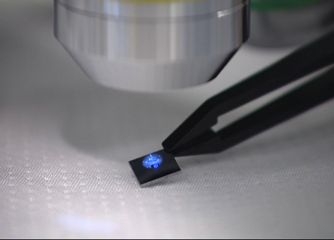
Italy | Posted on July 18th, 2011Researchers have modified surface structures by making nanometer scale patterns, with the help from a technology called nanoimprinting. Nanoimprinting is a high through-put and low cost method that produces these patterns through the use of a stamp. In the European Commission-funded project NaPANIL (Nanopatterning, Production and Applications based on Nanoimprinting Lithography) 18 partners are working on 3D nano-manufacturing based on NIL (nanoimprinting lithography), materials, stamps, tools and software required for new applications, and industrial suitable modeling and metrology tools.
Nanoimprinting has made it possible for the NaPANIL researchers to significantly increase emitted light‚s intensity by controlling the light path through glass or diffusing a single ray into homogenous illumination. The results from their research have several application areas. The industrial partners are focusing on making mobile phone displays that are brighter than displays on the market, but use less energy, and head-up displays (HUDs) for vehicles‚ windscreens that are easy to read in all light conditions. Car manufacturers are developing different head-up displays to make it easier for drivers to concentrate on the road, while at the same time clearly see and process all the information they can be flooded with from different systems. For example, General Motors in collaboration with researchers at several universities is testing a system with infrared cameras that can identify the road‚s edge, when it is almost invisible in fog, and make it visible with the help of laser which highlights it onto the windscreen. However, the system will not be introduced to the market in the near future. The NaPANIL project‚s Emissive Head-Up Display (eHUD) from Fiat may be closer and has a integrated light emitting layer that is offering this feature of easy-reading all day, compared to conventional HUDs which project images.
The project partners also hope to introduce eco-friendly windows that can reduce the need for artificial lights during the day, by redirecting sunlight to parts of our buildings unreachable with regular windows. The process of structuring surfaces through nanoimprinting is an innovative approach that has the potential to brighten up our lives in several ways, in our homes, while travelling and at work.
####
For more information, please click here
Contacts:
Elisabeth Schmid
Phone: + 39 02 700 25 71
Fax: + 39 02 700 25 40
E-mail:
Copyright © youris.com
If you have a comment, please Contact us.Issuers of news releases, not 7th Wave, Inc. or Nanotechnology Now, are solely responsible for the accuracy of the content.
Bookmark:


| Related News Press |
News and information
 Quantum computer improves AI predictions April 17th, 2026
Flexible sensor gains sensitivity under pressure April 17th, 2026
A reusable chip for particulate matter sensing April 17th, 2026
Detecting vibrational quantum beating in the predissociation dynamics of SF6 using time-resolved photoelectron spectroscopy April 17th, 2026
Display technology/LEDs/SS Lighting/OLEDs
Spinel-type sulfide semiconductors to operate the next-generation LEDs and solar cells For solar-cell absorbers and green-LED source October 3rd, 2025
Efficient and stable hybrid perovskite-organic light-emitting diodes with external quantum efficiency exceeding 40 per cent July 5th, 2024
Discoveries
Quantum computer improves AI predictions April 17th, 2026
Flexible sensor gains sensitivity under pressure April 17th, 2026
A reusable chip for particulate matter sensing April 17th, 2026
Detecting vibrational quantum beating in the predissociation dynamics of SF6 using time-resolved photoelectron spectroscopy April 17th, 2026
Announcements
A fundamentally new therapeutic approach to cystic fibrosis: Nanobody repairs cellular defect April 17th, 2026
UC Irvine physicists discover method to reverse ‘quantum scrambling’ : The work addresses the problem of information loss in quantum computing system April 17th, 2026
Automotive/Transportation
Decoding hydrogen‑bond network of electrolyte for cryogenic durable aqueous zinc‑ion batteries January 30th, 2026
Sensors innovations for smart lithium-based batteries: advancements, opportunities, and potential challenges August 8th, 2025
Simple algorithm paired with standard imaging tool could predict failure in lithium metal batteries August 8th, 2025
Photonics/Optics/Lasers
Metasurfaces smooth light to boost magnetic sensing precision January 30th, 2026
From sensors to smart systems: the rise of AI-driven photonic noses January 30th, 2026
Printing/Lithography/Inkjet/Inks/Bio-printing/Dyes
Presenting: Ultrasound-based printing of 3D materials—potentially inside the body December 8th, 2023
Simple ballpoint pen can write custom LEDs August 11th, 2023
Disposable electronics on a simple sheet of paper October 7th, 2022
 |
||
 |
||
| The latest news from around the world, FREE | ||
 |
||
|
|
||
| Premium Products | ||
 |
||
|
Only the news you want to read!
Learn More |
||
 |
||
|
Full-service, expert consulting
Learn More |
||
|
|
||