Home > Press > Key Ingredient: Change in Material Boosts Prospects of Ultrafast Single-photon Detector
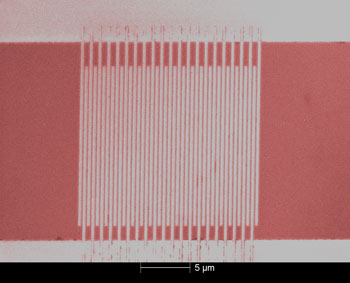 |
| Colorized micrograph of an ultrafast single-photon detector made of superconducting nanowires. NIST researchers use electron beam lithography to pattern the nanowires (vertical lines) on a thin film of tungsten-silicon alloy, which produces more reliable signals than the niobium nitride material used previously. Credit: Baek/NIST |
Abstract:
By swapping one superconducting material for another, researchers at the National Institute of Standards and Technology (NIST) have found a practical way to boost the efficiency of the world's fastest single-photon detector, while also extending light sensitivity to longer wavelengths. The new tungsten-silicon alloy could make the ultrafast detectors more practical for use in quantum communications and computing systems, experiments testing the nature of reality, and emerging applications such as remote sensing.
Key Ingredient: Change in Material Boosts Prospects of Ultrafast Single-photon Detector
Boulder, CO | Posted on July 2nd, 2011The detector, made of superconducting nanowires, is one of several sensor designs developed or used at NIST to register individual photons (particles of light). The original nanowire detector, invented in Russia, uses wires made of niobium nitride and has a detection or quantum efficiency—ability to generate an electrical signal for each arriving photon—of less than 10 percent in its simplest, most compact model. NIST's tungsten-silicon alloy version has an efficiency of 19 to 40 percent over a broad wavelength range of 1280 to 1650 nanometers, including bands used in telecommunications.* The limitations are due mainly to imperfect photon absorption, suggesting that, with further design improvements, detector efficiency could approach 100 percent reliably, researchers say.
Superconducting nanowire detectors have many advantages. They are very fast, able to count nearly a billion photons per second, and they operate over a large range of wavelengths, have low dark (false) counts, and produce strong signals, especially at telecom wavelengths. The detectors produce a signal when a photon breaks apart some of the electron pairs that carry current in the superconducting state, where the material has zero resistance. If the nanowires are narrow enough and the DC current across the device is very close to the transition between ordinary and super conductance, a resistive band temporarily forms across each wire, resulting in a measurable voltage pulse.
Niobium nitride is difficult to make into nanowires that are narrow, long, and sensitive enough to work well. NIST researchers selected the tungsten-silicon alloy mainly because it has higher energy sensitivity, resulting in more reliable signals. A photon breaks more electron pairs in the tungsten-silicon alloy than in niobium nitride. The tungsten alloy also has a more uniform and less granular internal structure, making the nanowires more reliably sensitive throughout. As a result of the higher energy sensitivity, tungsten-silicon nanowires can have larger dimensions (150 nanometers wide versus 100 nanometers or less for niobium nitride), which enlarges the detectors' functional areas to more easily capture all photons.
The NIST team now hopes to raise the efficiency of tungsten alloy detectors by embedding them in optical cavities, which trap light for extremely high absorption. High efficiency may enable the use of nanowire detectors in demanding applications such as linear optical quantum computing, which encodes information in single photons. An equally intriguing application may be an experiment to test quantum mechanics—the so-called "loophole-free Bell test." This test of what Einstein called "spooky action at a distance" depends critically on having a nearly 100-percent efficient photon detector. Tungsten-silicon detectors also are sensitive to longer wavelengths of light, in the mid-infrared range, which could be useful for applications such as laser-based remote sensing of trace gases.
* B. Baek, A.E. Lita, V. Verma and S.W. Nam. Superconducting a-WxSi1-x nanowire single-photon detector with saturated internal quantum efficiency from visible to 1850 nm. Applied Physics Letters 98, 251105. Published online June 21, 2011.
####
About National Institute of Standards and Technology (NIST)
The National Institute of Standards and Technology (NIST) is an agency of the U.S. Department of Commerce.
For more information, please click here
Contacts:
Laura Ost
303-497-4880
Copyright © NIST
If you have a comment, please Contact us.Issuers of news releases, not 7th Wave, Inc. or Nanotechnology Now, are solely responsible for the accuracy of the content.
Bookmark:


| Related News Press |
News and information
 Quantum computer improves AI predictions April 17th, 2026
Flexible sensor gains sensitivity under pressure April 17th, 2026
A reusable chip for particulate matter sensing April 17th, 2026
Detecting vibrational quantum beating in the predissociation dynamics of SF6 using time-resolved photoelectron spectroscopy April 17th, 2026
Laboratories
Researchers develop molecular qubits that communicate at telecom frequencies October 3rd, 2025
A battery’s hopping ions remember where they’ve been: Seen in atomic detail, the seemingly smooth flow of ions through a battery’s electrolyte is surprisingly complicated February 16th, 2024
Govt.-Legislation/Regulation/Funding/Policy
Quantum computer improves AI predictions April 17th, 2026
Metasurfaces smooth light to boost magnetic sensing precision January 30th, 2026
New imaging approach transforms study of bacterial biofilms August 8th, 2025
Quantum Computing
Quantum computer improves AI predictions April 17th, 2026
UC Irvine physicists discover method to reverse ‘quantum scrambling’ : The work addresses the problem of information loss in quantum computing system April 17th, 2026
Researchers develop molecular qubits that communicate at telecom frequencies October 3rd, 2025
Sensors
Flexible sensor gains sensitivity under pressure April 17th, 2026
Tiny nanosheets, big leap: A new sensor detects ethanol at ultra-low levels January 30th, 2026
From sensors to smart systems: the rise of AI-driven photonic noses January 30th, 2026
Sensors innovations for smart lithium-based batteries: advancements, opportunities, and potential challenges August 8th, 2025
Discoveries
Quantum computer improves AI predictions April 17th, 2026
Flexible sensor gains sensitivity under pressure April 17th, 2026
A reusable chip for particulate matter sensing April 17th, 2026
Detecting vibrational quantum beating in the predissociation dynamics of SF6 using time-resolved photoelectron spectroscopy April 17th, 2026
Announcements
A fundamentally new therapeutic approach to cystic fibrosis: Nanobody repairs cellular defect April 17th, 2026
UC Irvine physicists discover method to reverse ‘quantum scrambling’ : The work addresses the problem of information loss in quantum computing system April 17th, 2026
Tools
Metasurfaces smooth light to boost magnetic sensing precision January 30th, 2026
From sensors to smart systems: the rise of AI-driven photonic noses January 30th, 2026
Japan launches fully domestically produced quantum computer: Expo visitors to experience quantum computing firsthand August 8th, 2025
 |
||
 |
||
| The latest news from around the world, FREE | ||
 |
||
|
|
||
| Premium Products | ||
 |
||
|
Only the news you want to read!
Learn More |
||
 |
||
|
Full-service, expert consulting
Learn More |
||
|
|
||