Home > Press > First Demonstration of 'Spin-Orbit Coupling' in Ultracold Atomic Gases
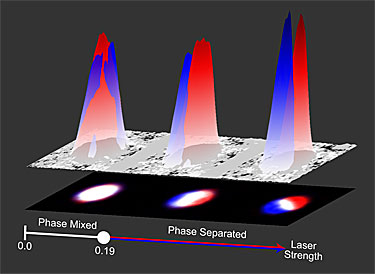 |
| In an ultracold gas of nearly 200,000 rubidium-87 atoms (shown as the large humps) the atoms can occupy one of two energy levels (represented as red and blue); lasers then link together these levels as a function of the atoms’ motion. At first atoms in the red and blue energy states occupy the same region (Phase Mixed), then at higher laser strengths, they separate into different regions (Phase Separated). Credit: Ian Spielman, JQI/NIST |
Abstract:
Physicists at the Joint Quantum Institute (JQI) have for the first time caused a gas of atoms to exhibit an important quantum phenomenon known as spin-orbit coupling. Their technique opens new possibilities for studying and better understanding fundamental physics and has potential applications to quantum computing, next-generation "spintronics" devices and even "atomtronic" devices built from ultracold atoms.
First Demonstration of 'Spin-Orbit Coupling' in Ultracold Atomic Gases
Gaithersburg, MD | Posted on March 21st, 2011The JQI is a collaboration of the National Institute of Standards and Technology (NIST) and the University of Maryland-College Park.
One of the most important phenomena in quantum physics, spin-orbit coupling describes the interplay that can occur between a particle's internal properties and its external properties. In atoms, it usually describes interactions that only occur within an atom: how an electron's orbit around an atom's core (nucleus) affects the orientation of the electron's internal bar-magnet-like "spin." In semiconductor materials such as gallium arsenide, spin-orbit coupling is an interaction between an electron's spin and its linear motion in a material.
In the researchers' demonstration of spin-orbit coupling, two lasers allow an atom's motion to flip it between a pair of energy states. The new work, published in Nature,* demonstrates this effect for the first time in bosons, which make up one of the two major classes of particles. The same technique could be applied to fermions, the other major class of particles, according to the researchers. The special properties of fermions would make them ideal for studying new kinds of interactions between two particles—for example, those leading to novel "p-wave" superconductivity, which may enable a long-sought form of quantum computing known as topological quantum computation.
In an unexpected development, the team also discovered that the lasers modified how the atoms interacted with each other and caused atoms in one energy state to separate in space from atoms in the other energy state. This promises to lead to useful experimental techniques.
"Spin-orbit coupling is often a bad thing," said JQI's Ian Spielman, senior author of the paper. "Researchers make ‘spintronic' devices out of gallium arsenide, and if you've prepared a spin in some desired orientation, the last thing you'd want it to do is to flip to some other spin when it's moving."
"But from the point of view of fundamental physics, spin-orbit coupling is really interesting," he said. "It's what drives these new kinds of materials called ‘topological insulators.'"
One of the hottest topics in physics right now, topological insulators are special materials in which location is everything: the ability of particles to flow depends on where they are located within the material. They may lead to useful devices. While researchers have been making higher and higher quality versions of this special class of material in solids, spin-orbit coupling in trapped ultracold gases of atoms could help realize topological insulators in their purest, most pristine form, as gases are free of impurity atoms and the other complexities of solid materials.
* Y.-J. Lin, K. Jiménez-García and I.B. Spielman. Spin-orbit-coupled Bose-Einstein condensates. Nature. Posted online March 2, 2011.
####
For more information, please click here
Contacts:
Ben Stein
(301) 975-3097
Copyright © NIST
If you have a comment, please Contact us.Issuers of news releases, not 7th Wave, Inc. or Nanotechnology Now, are solely responsible for the accuracy of the content.
Bookmark:


| Related Links |
| Related News Press |
News and information
 Quantum computer improves AI predictions April 17th, 2026
Flexible sensor gains sensitivity under pressure April 17th, 2026
A reusable chip for particulate matter sensing April 17th, 2026
Detecting vibrational quantum beating in the predissociation dynamics of SF6 using time-resolved photoelectron spectroscopy April 17th, 2026
Physics
UC Irvine physicists discover method to reverse ‘quantum scrambling’ : The work addresses the problem of information loss in quantum computing system April 17th, 2026
Quantum computers simulate fundamental physics: shedding light on the building blocks of nature June 6th, 2025
Spintronics
Quantum materials: Electron spin measured for the first time June 9th, 2023
Quantum Computing
Quantum computer improves AI predictions April 17th, 2026
UC Irvine physicists discover method to reverse ‘quantum scrambling’ : The work addresses the problem of information loss in quantum computing system April 17th, 2026
Researchers develop molecular qubits that communicate at telecom frequencies October 3rd, 2025
Discoveries
Quantum computer improves AI predictions April 17th, 2026
Flexible sensor gains sensitivity under pressure April 17th, 2026
A reusable chip for particulate matter sensing April 17th, 2026
Detecting vibrational quantum beating in the predissociation dynamics of SF6 using time-resolved photoelectron spectroscopy April 17th, 2026
Announcements
A fundamentally new therapeutic approach to cystic fibrosis: Nanobody repairs cellular defect April 17th, 2026
UC Irvine physicists discover method to reverse ‘quantum scrambling’ : The work addresses the problem of information loss in quantum computing system April 17th, 2026
Quantum nanoscience
Beyond silicon: Electronics at the scale of a single molecule January 30th, 2026
MXene nanomaterials enter a new dimension Multilayer nanomaterial: MXene flakes created at Drexel University show new promise as 1D scrolls January 30th, 2026
ICFO researchers overcome long-standing bottleneck in single photon detection with twisted 2D materials August 8th, 2025
 |
||
 |
||
| The latest news from around the world, FREE | ||
 |
||
|
|
||
| Premium Products | ||
 |
||
|
Only the news you want to read!
Learn More |
||
 |
||
|
Full-service, expert consulting
Learn More |
||
|
|
||