Home > Press > Battery technology firm wins 2011 Clean Energy Prize
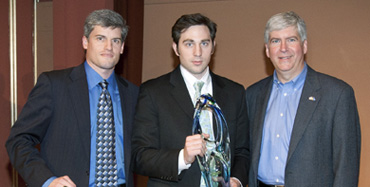 |
| From left to right: U-M Technology Transfer mentor Nick Cucinelli, left, with first place winner Nick Moroz and Gov. Rick Snyder U-M Photo Services / Eric Bronson |
Abstract:
A company whose technology could lead to cheaper lithium-ion batteries won the top prize of $50,000 in the 2011 Clean Energy Prize business plan competition. Gov. Rick Snyder spoke at the awards ceremony Friday at the University of Michigan's Rackham Auditorium.
Battery technology firm wins 2011 Clean Energy Prize
Ann Arbor, MI | Posted on February 21st, 2011"It's great to see the intersection of three things that I love," Snyder told the audience that included hundreds of students. "We're talking about innovation and entrepreneurship, we're talking about clean energy, something that is vitally important for our future. It's about economic growth, and doing it in the most responsible way possible in terms of the legacy we leave and the opportunity it provides us and the third thing is it involves students.
"To have those three things come together is really special."
The Clean Energy Prize, established by DTE Energy and U-M in 2008, is designed to encourage entrepreneurship in Michigan and the development of clean-energy technologies. This year's contest was organized by the U-M College of Engineering's Center for Entrepreneurship and DTE.
The winning company, CSquared Innovations, is a U-M start-up project that has developed a faster, cheaper, laser-based method of making nano-structured materials and coatings for lithium-ion battery electrodes, solar cells, and industrial coatings. The company, which should launch shortly from U-M Tech Transfer's Venture Center, is based on technology developed in the lab of Pravansu Mohanty, a professor in the Department of Mechanical Engineering at U-M Dearborn.
"The exposure and experience we've gained from the Clean Energy Prize are extremely valuable to us at this point in our business," said team leader Nick Moroz, a doctoral student in the U-M Ann Arbor Department of Materials Science and Engineering. "I'm very excited to take the next step and to establish our firm as a strong cleantech presence in the Li-ion battery market and to begin creating jobs in Michigan."
In addition to Mohanty and Moroz, other team members are Ramesh Guduru, chief scientist and Harishankar Umapathy, operations manager.
U-M President Mary Sue Coleman commended all the participants for their ideas and their energy.
"We can all be proud of the teams that competed in this statewide event, because it is a powerful statement about our collective future," Coleman said.
Gerard Anderson, DTE Energy president and CEO, said this year's competition exceeded expectations in several ways.
"With a starting field of 23 teams representing seven Michigan colleges, the competition has achieved a scale that we had hoped for but did not anticipate reaching in just three years. Also, the quality of the proposals and the talent of the students continue to surprise and impress us," Anderson said.
Previous Clean Energy Prize winners continue to build their businesses
Algal Scientific, the 2008 winner, has raised more than $300,000 in cash and in-kind services to support its technology that uses algae to simultaneously treat wastewater and produce the raw materials for biofuels. The company employs nearly a dozen staff and technical advisers and is deploying a demonstration-scale wastewater treatment plant at an industrial facility in Ohio.
Enertia, the 2009-2010, winner, is continuing to develop and refine their tiny generators that produce electricity from random ambient vibrations. The company has demonstrated a second-generation prototype that can turn vibrations from traffic on a suspension bridge into useable electricity.
Three other teams were honored in the 2011 contest. Team Smart Energy, out of U-M, won second prize and $25,000 for its innovative financing model to retrofit municipal buildings for energy efficiency savings. Team Impact Card, also out of U-M, won third and $10,000 for its first-of-its-kind funding mechanism that aggregates consumer credit card reward points as project financing for renewable energy development. Team Perennial BioEnergy, out of Western Michigan University, finished fourth and received $7,000 for its plan to develop a pennycress-based biodiesel industry.
Contest sponsors include The Masco Corporation Foundation, The Kresge Foundation, UBS Investment Bank, Google, Huron River Ventures and GM Ventures. In addition to the Center for Entrepreneurship, other U-M groups involved in organizing the contest are the Ross School of Business's student organization Ross Energy Club, the Business Engagement Center, the Michigan Memorial Phoenix Energy Institute and the Office of the Vice President for Research.
####
For more information, please click here
Contacts:
Nicole Casal Moore
Phone: (734) 647-7087
John Austerberry
DTE Energy
Phone: (313) 235-8859
Copyright © University of Michigan
If you have a comment, please Contact us.Issuers of news releases, not 7th Wave, Inc. or Nanotechnology Now, are solely responsible for the accuracy of the content.
Bookmark:


| Related News Press |
News and information
 Quantum computer improves AI predictions April 17th, 2026
Flexible sensor gains sensitivity under pressure April 17th, 2026
A reusable chip for particulate matter sensing April 17th, 2026
Detecting vibrational quantum beating in the predissociation dynamics of SF6 using time-resolved photoelectron spectroscopy April 17th, 2026
Academic/Education
Rice University launches Rice Synthetic Biology Institute to improve lives January 12th, 2024
Multi-institution, $4.6 million NSF grant to fund nanotechnology training September 9th, 2022
Announcements
A fundamentally new therapeutic approach to cystic fibrosis: Nanobody repairs cellular defect April 17th, 2026
UC Irvine physicists discover method to reverse ‘quantum scrambling’ : The work addresses the problem of information loss in quantum computing system April 17th, 2026
Environment
A reusable chip for particulate matter sensing April 17th, 2026
Researchers unveil a groundbreaking clay-based solution to capture carbon dioxide and combat climate change June 6th, 2025
Energy
Sensors innovations for smart lithium-based batteries: advancements, opportunities, and potential challenges August 8th, 2025
Simple algorithm paired with standard imaging tool could predict failure in lithium metal batteries August 8th, 2025
Automotive/Transportation
Decoding hydrogen‑bond network of electrolyte for cryogenic durable aqueous zinc‑ion batteries January 30th, 2026
Sensors innovations for smart lithium-based batteries: advancements, opportunities, and potential challenges August 8th, 2025
Simple algorithm paired with standard imaging tool could predict failure in lithium metal batteries August 8th, 2025
Battery Technology/Capacitors/Generators/Piezoelectrics/Thermoelectrics/Energy storage
Decoding hydrogen‑bond network of electrolyte for cryogenic durable aqueous zinc‑ion batteries January 30th, 2026
COF scaffold membrane with gate‑lane nanostructure for efficient Li+/Mg2+ separation January 30th, 2026
MXene nanomaterials enter a new dimension Multilayer nanomaterial: MXene flakes created at Drexel University show new promise as 1D scrolls January 30th, 2026
Grants/Sponsored Research/Awards/Scholarships/Gifts/Contests/Honors/Records
Quantum computer improves AI predictions April 17th, 2026
Detecting vibrational quantum beating in the predissociation dynamics of SF6 using time-resolved photoelectron spectroscopy April 17th, 2026
Metasurfaces smooth light to boost magnetic sensing precision January 30th, 2026
 |
||
 |
||
| The latest news from around the world, FREE | ||
 |
||
|
|
||
| Premium Products | ||
 |
||
|
Only the news you want to read!
Learn More |
||
 |
||
|
Full-service, expert consulting
Learn More |
||
|
|
||