Home > Press > Squeezed Through too Small a Hole
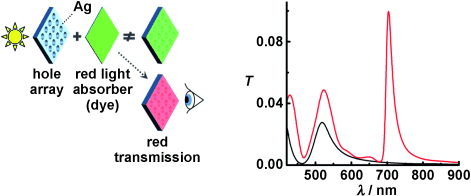 |
| Transparent windows are opened in optically thick metallic films perforated with subwavelength holes by adsorbing a thin layer of molecules at the surface. Counterintuitively, transmission occurs at wavelengths at which the molecular layer absorbs strongly (in this case at 700 nm), as revealed by transmission spectra of the hole array without (black curve) and with adsorbed molecules (red). |
Abstract:
Photon-plasmon coupling: Dye guides light through perforated metal foil
Squeezed Through too Small a Hole
Weinheim, Germany | Posted on January 27th, 2011Just as photons are bundles of light energy, plasmons are energy packets of plasma oscillations—oscillations of the electron density in a solid body, which are known as surface plasmons when occurring at a metal interface. Surface plasmons introduce new possibilities for the manipulation and transmission of light for applications in a variety of areas, from modern data processing to biomedical sensing. In the journal Angewandte Chemie, Thomas W. Ebbesen, James A. Hutchison, and a team from the University of Strasbourg (France) introduce an interesting new effect based on the coupling of photons and plasmons: dye molecules help light pass through holes in metal foils that are so small that conventional theory predicts the light should not actually be able to pass through at all.
According to classical aperture theory, light should not be able to pass through tiny holes when the diameter is significantly smaller than the wavelength of the light. However, as reported by Ebbesen's group over a decade ago, light transmission can be much higher than predicted for regular arrays of holes owing to the involvement of surface plasmons. In essence, light is converted into surface plasmons, and in this coupled state the photons can pass though the holes to the other side of the metal as plasmons. They can then uncouple and reappear as light.
The French team has now described another phenomenon: if dye molecules are placed directly on the perforated metal surface, they significantly increase its transparence. Contrary to expectation, the additional windows of transparency can occur at wavelengths that are strongly absorbed by the molecules. Interestingly, this also occurs if the arrangement of holes in the foil is irregular; even a single hole is enough.
The researchers propose that two complementary effects are at play. On one hand, the dye molecules in the holes generate a large index variation in the hole favoring the transmission near the absorption band. On the other, the dye molecule generates a kind of "mirror image" of its electric dipole in the metal's free electron plasma, and the dipole and mirror-image dipole interact. If the molecule then absorbs light, it is not re-emitted; instead, the light energy is completely transferred to the metal surface, where it couples with surface plasmons helping the transmission process. This combination enables the light to pass efficiently to the other side of the metal foil.
This discovery represents a new approach for making perforated metal films with tailored transmission of visible light by simply applying a dye that absorbs light with the desired wavelength, which would have application in solar energy technology, filters, and sensing. That the transient excited states of molecules have absorption properties that are very different to their ground state adds a further dynamic dimension to these films, with all-optical, ultra-fast switches another possible application.
Author: Thomas W. Ebbesen, Université de Strasbourg (France), www-isis.u-strasbg.fr/nano/start
Title: Absorption-Induced Transparency
Angewandte Chemie International Edition, Permalink dx.doi.org/10.1002/anie.201006019
####
For more information, please click here
Copyright © Angewandte Chemie International Edition
If you have a comment, please Contact us.Issuers of news releases, not 7th Wave, Inc. or Nanotechnology Now, are solely responsible for the accuracy of the content.
Bookmark:


| Related News Press |
News and information
 Quantum computer improves AI predictions April 17th, 2026
Flexible sensor gains sensitivity under pressure April 17th, 2026
A reusable chip for particulate matter sensing April 17th, 2026
Detecting vibrational quantum beating in the predissociation dynamics of SF6 using time-resolved photoelectron spectroscopy April 17th, 2026
Possible Futures
A fundamentally new therapeutic approach to cystic fibrosis: Nanobody repairs cellular defect April 17th, 2026
UC Irvine physicists discover method to reverse ‘quantum scrambling’ : The work addresses the problem of information loss in quantum computing system April 17th, 2026
Academic/Education
Rice University launches Rice Synthetic Biology Institute to improve lives January 12th, 2024
Multi-institution, $4.6 million NSF grant to fund nanotechnology training September 9th, 2022
Sensors
Flexible sensor gains sensitivity under pressure April 17th, 2026
Tiny nanosheets, big leap: A new sensor detects ethanol at ultra-low levels January 30th, 2026
From sensors to smart systems: the rise of AI-driven photonic noses January 30th, 2026
Sensors innovations for smart lithium-based batteries: advancements, opportunities, and potential challenges August 8th, 2025
Discoveries
Quantum computer improves AI predictions April 17th, 2026
Flexible sensor gains sensitivity under pressure April 17th, 2026
A reusable chip for particulate matter sensing April 17th, 2026
Detecting vibrational quantum beating in the predissociation dynamics of SF6 using time-resolved photoelectron spectroscopy April 17th, 2026
Announcements
A fundamentally new therapeutic approach to cystic fibrosis: Nanobody repairs cellular defect April 17th, 2026
UC Irvine physicists discover method to reverse ‘quantum scrambling’ : The work addresses the problem of information loss in quantum computing system April 17th, 2026
Photonics/Optics/Lasers
Metasurfaces smooth light to boost magnetic sensing precision January 30th, 2026
From sensors to smart systems: the rise of AI-driven photonic noses January 30th, 2026
Research partnerships
Lab to industry: InSe wafer-scale breakthrough for future electronics August 8th, 2025
HKU physicists uncover hidden order in the quantum world through deconfined quantum critical points April 25th, 2025
Solar/Photovoltaic
Spinel-type sulfide semiconductors to operate the next-generation LEDs and solar cells For solar-cell absorbers and green-LED source October 3rd, 2025
KAIST researchers introduce new and improved, next-generation perovskite solar cell November 8th, 2024
Groundbreaking precision in single-molecule optoelectronics August 16th, 2024
Development of zinc oxide nanopagoda array photoelectrode: photoelectrochemical water-splitting hydrogen production January 12th, 2024
 |
||
 |
||
| The latest news from around the world, FREE | ||
 |
||
|
|
||
| Premium Products | ||
 |
||
|
Only the news you want to read!
Learn More |
||
 |
||
|
Full-service, expert consulting
Learn More |
||
|
|
||