Home > Press > New Architectures of Nano-Brushes Developed
 |
Abstract:
Just as cilia lining the lungs help keep passages clear by moving particles along the tips of the tiny hair-structures, man-made miniscule bristles known as nano-brushes can help reduce friction along surfaces at the molecular level, among other things.
In their latest series of experiments, Duke University engineers have developed a novel approach to synthesize these nano-brushes, which could improve their versatility in the future. These polymer brushes are currently being used in biologic sensors and microscopic devices, such as microcantilevers, and they will play an important role in the future drive to miniaturization, the researchers said.
New Architectures of Nano-Brushes Developed
Durham, NC | Posted on August 25th, 2010Nano-brushes are typically made of polymer molecules grown on flat surfaces with strands of the molecules growing up and out from a surface, much like hairs on a brush. Polymers are large man-made molecules ubiquitous in the manufacture of everyday products.
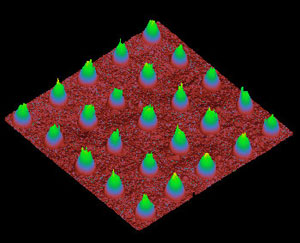
Like microscopic orchard keepers, the Duke scientists have grafted bundles of polymer "limbs" on flat surfaces known as substrates, already covered with brush bristles. In their approach, two dissimilar brushes can be joined and patterned on the micro-scale. Because the "limbs" can be made out of a different substance than the substrate, the scientists believe these nano-structures are able to significantly modify the properties of a given surface.
To make such a nano-brush, scientists add a chemical known as an initiator to the flat surface, which spurs the growth of the strands.
"One of the common ways of growing brushes is much like a dot matrix printer, with an initiator being the ink ‘printed' onto an inorganic substrate, such as a silicon wafer or a gold surface, which then causes the brush bristles to grow in specified patterns," said Stefan Zauscher, Alfred M. Hunt Faculty Scholar and associate professor of mechanical engineering and materials science at Duke's Pratt School of Engineering.
"In our patterning approach we are now also able to initiate polymer brush growth on existing brush substrates and thus obtain patterned block copolymer brushes, just like grafts, on polymeric substrates," Zauscher said. "The ability to create more intricate brush structures provides the potential for using them in biomedical applications as sensors for the detection of proteins or glucose."
The results of his team's experiments were published online in the journal Small. The research is supported by the National Science Foundation.
Zauscher said this new approach could be readily expanded to many other types of polymers, and to make either single or double layers of brushes. These nano-brushes, he said, would have many potential uses, and would open up the possibilities for building more complicated polymer architectures, which are much in demand for current and future technologies.
In recent research, published earlier in the journal Advanced Materials, Zauscher showed that stimulus-responsive nano-brushes resemble and act like sea anemones, which have a multitude of arms reaching up from an attached base. In the same fashion as these sea animals, nano-brushes can be used to capture and release micro-particles as they move across a surface.
"These microstructures have a potential use in microfluidic systems -- such as labs-on-a-chip -- to capture and release particles at predefined locations, much like the sea anemones capture their prey and guide it to their mouths," Zauscher said.
Other Duke members of the team are Tao Chen and Debby Chang.
####
For more information, please click here
Contacts:
(919) 660-5399
Copyright © Duke University
If you have a comment, please Contact us.Issuers of news releases, not 7th Wave, Inc. or Nanotechnology Now, are solely responsible for the accuracy of the content.
Bookmark:


| Related News Press |
News and information
 Quantum computer improves AI predictions April 17th, 2026
Flexible sensor gains sensitivity under pressure April 17th, 2026
A reusable chip for particulate matter sensing April 17th, 2026
Detecting vibrational quantum beating in the predissociation dynamics of SF6 using time-resolved photoelectron spectroscopy April 17th, 2026
Govt.-Legislation/Regulation/Funding/Policy
Quantum computer improves AI predictions April 17th, 2026
Metasurfaces smooth light to boost magnetic sensing precision January 30th, 2026
New imaging approach transforms study of bacterial biofilms August 8th, 2025
Possible Futures
A fundamentally new therapeutic approach to cystic fibrosis: Nanobody repairs cellular defect April 17th, 2026
UC Irvine physicists discover method to reverse ‘quantum scrambling’ : The work addresses the problem of information loss in quantum computing system April 17th, 2026
Academic/Education
Rice University launches Rice Synthetic Biology Institute to improve lives January 12th, 2024
Multi-institution, $4.6 million NSF grant to fund nanotechnology training September 9th, 2022
Sensors
Flexible sensor gains sensitivity under pressure April 17th, 2026
Tiny nanosheets, big leap: A new sensor detects ethanol at ultra-low levels January 30th, 2026
From sensors to smart systems: the rise of AI-driven photonic noses January 30th, 2026
Sensors innovations for smart lithium-based batteries: advancements, opportunities, and potential challenges August 8th, 2025
Announcements
A fundamentally new therapeutic approach to cystic fibrosis: Nanobody repairs cellular defect April 17th, 2026
UC Irvine physicists discover method to reverse ‘quantum scrambling’ : The work addresses the problem of information loss in quantum computing system April 17th, 2026
Nanobiotechnology
A fundamentally new therapeutic approach to cystic fibrosis: Nanobody repairs cellular defect April 17th, 2026
New molecular technology targets tumors and simultaneously silences two ‘undruggable’ cancer genes August 8th, 2025
New imaging approach transforms study of bacterial biofilms August 8th, 2025
Electrifying results shed light on graphene foam as a potential material for lab grown cartilage June 6th, 2025
 |
||
 |
||
| The latest news from around the world, FREE | ||
 |
||
|
|
||
| Premium Products | ||
 |
||
|
Only the news you want to read!
Learn More |
||
 |
||
|
Full-service, expert consulting
Learn More |
||
|
|
||