Home > Press > Advance made toward communication, computing at terahertz speeds
 |
Abstract:
Physicists in the United States and Germany have discovered a way to use a gallium arsenide nanodevice as a signal processor at terahertz speeds, the first time it's been used for this purpose and an important step forward in the new world of optical communication and computing.
Advance made toward communication, computing at terahertz speeds
Corvallis, OR | Posted on July 22nd, 2010Existing communications and computer architecture are increasingly being limited by the pedestrian speed of electrons moving through wires, and the future of high-speed communication and computing is in optics, experts say. The Holy Grail of results would be "wireless interconnecting," which operates at speeds 100 to 1,000 times faster than current technology.
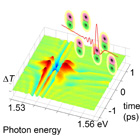
The new discovery, made by researchers at Oregon State University, the University of Iowa and Philipps University in Germany, has identified a way in which nanoscale devices based on gallium arsenide can respond to strong terahertz pulses for an extremely short period, controlling the electrical signal in a semiconductor. The research builds on previous findings for which OSU holds an issued patent.
"Optical communication uses the extraordinary speed of light as the signal, but right now it's still controlled and limited by electrical signaling at the end," said Yun-shik Lee, an associate professor in the OSU Department of Physics. "Electrons and wires are too slow, they're a bottleneck. The future is in optical switching, in which wires are replaced by emitters and detectors that can function at terahertz speeds."
The gallium arsenide devices used in this research can do that, the scientists discovered.
"This could be very important," Lee said. "We were able to manipulate and observe the quantum system, basically create a strong response and the first building block of optical signal processing."
The first applications of this type of technology, Lee said, would probably be in optical communications of almost any type - video, audio or others. The ultimate application could be quantum computing, in which computers would be orders of magnitude faster than they are now, working with a different physical and logic basis, not even using conventional transistors. Among other uses, their extraordinary speeds would make them extremely valuable for secure codes and communications.
The current use of gallium arsenide was done at the very low temperatures of liquid helium, which would not be practical for broader use. Other materials will need to be identified that can accomplish similar tasks at room temperature, the researchers said.
This research was just published in Solid State Electronics, a professional journal. It was supported by the National Science Foundation and the Oregon Nanoscience and Microtechnologies Institute.
The professional publication this story is based on is available here ir.library.oregonstate.edu/jspui/handle/1957/16735
####
For more information, please click here
Copyright © Oregon Nanoscience and Microtechnologies Institute
If you have a comment, please Contact us.Issuers of news releases, not 7th Wave, Inc. or Nanotechnology Now, are solely responsible for the accuracy of the content.
Bookmark:


| Related News Press |
News and information
 Quantum computer improves AI predictions April 17th, 2026
Flexible sensor gains sensitivity under pressure April 17th, 2026
A reusable chip for particulate matter sensing April 17th, 2026
Detecting vibrational quantum beating in the predissociation dynamics of SF6 using time-resolved photoelectron spectroscopy April 17th, 2026
Govt.-Legislation/Regulation/Funding/Policy
Quantum computer improves AI predictions April 17th, 2026
Metasurfaces smooth light to boost magnetic sensing precision January 30th, 2026
New imaging approach transforms study of bacterial biofilms August 8th, 2025
Possible Futures
A fundamentally new therapeutic approach to cystic fibrosis: Nanobody repairs cellular defect April 17th, 2026
UC Irvine physicists discover method to reverse ‘quantum scrambling’ : The work addresses the problem of information loss in quantum computing system April 17th, 2026
Academic/Education
Rice University launches Rice Synthetic Biology Institute to improve lives January 12th, 2024
Multi-institution, $4.6 million NSF grant to fund nanotechnology training September 9th, 2022
Chip Technology
A reusable chip for particulate matter sensing April 17th, 2026
Metasurfaces smooth light to boost magnetic sensing precision January 30th, 2026
Quantum Computing
Quantum computer improves AI predictions April 17th, 2026
UC Irvine physicists discover method to reverse ‘quantum scrambling’ : The work addresses the problem of information loss in quantum computing system April 17th, 2026
Researchers develop molecular qubits that communicate at telecom frequencies October 3rd, 2025
Nanoelectronics
Lab to industry: InSe wafer-scale breakthrough for future electronics August 8th, 2025
Interdisciplinary: Rice team tackles the future of semiconductors Multiferroics could be the key to ultralow-energy computing October 6th, 2023
Key element for a scalable quantum computer: Physicists from Forschungszentrum Jülich and RWTH Aachen University demonstrate electron transport on a quantum chip September 23rd, 2022
Reduced power consumption in semiconductor devices September 23rd, 2022
Discoveries
Quantum computer improves AI predictions April 17th, 2026
Flexible sensor gains sensitivity under pressure April 17th, 2026
A reusable chip for particulate matter sensing April 17th, 2026
Detecting vibrational quantum beating in the predissociation dynamics of SF6 using time-resolved photoelectron spectroscopy April 17th, 2026
Announcements
A fundamentally new therapeutic approach to cystic fibrosis: Nanobody repairs cellular defect April 17th, 2026
UC Irvine physicists discover method to reverse ‘quantum scrambling’ : The work addresses the problem of information loss in quantum computing system April 17th, 2026
Photonics/Optics/Lasers
Metasurfaces smooth light to boost magnetic sensing precision January 30th, 2026
From sensors to smart systems: the rise of AI-driven photonic noses January 30th, 2026
 |
||
 |
||
| The latest news from around the world, FREE | ||
 |
||
|
|
||
| Premium Products | ||
 |
||
|
Only the news you want to read!
Learn More |
||
 |
||
|
Full-service, expert consulting
Learn More |
||
|
|
||