Home > Press > Battery research could lead to shorter recharge time for cell phones
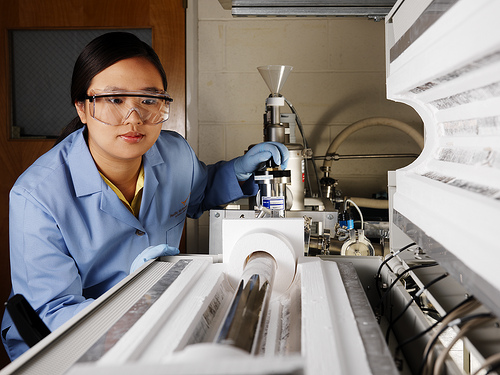 |
| New battery materials developed by the Department of Energy’s Pacific Northwest National Laboratory and Vorbeck Materials Corp. could enable electric vehicles and other consumer electronics to recharge in minutes rather than hours. Here a PNNL researcher prepares and tests lithium ion batteries and lithium/air batteries for vehicle and other mobile applications. |
Abstract:
Adding a bit of graphene to battery materials could dramatically cut the time it takes to recharge electronics
Battery research could lead to shorter recharge time for cell phones
Richland, WA | Posted on July 14th, 2010New battery materials developed by the Department of Energy's Pacific Northwest National Laboratory and Vorbeck Materials Corp. of Jessup, Md., could enable electric vehicles, power tools and even cell phones to recharge in minutes rather than hours.
In collaboration with Vorbeck and researcher Ilhan Aksay at Princeton University, PNNL has demonstrated that small quantities of graphene — an ultra-thin sheet of carbon atoms — can dramatically improve the power and cycling stability of lithium-ion batteries, while maintaining high energy storage capacity. The pioneering work could lead to the development of batteries that store larger amounts of energy and recharge quickly.
Today, a typical cell phone battery takes between two and five hours to fully recharge. Researchers think using new battery materials with graphene could cut recharge time to less than 10 minutes.
Battelle, which operates PNNL for DOE, entered into a Cooperative Research and Development Agreement with Vorbeck for use of its unique graphene material, Vor-xTM, in battery materials synthesis research.
This research is made possible the by the Department of Energy's Office of Energy Efficiency and Renewable Energy's Technology Commercialization Fund.
####
About Pacific Northwest National Laboratory
Pacific Northwest National Laboratory is a Department of Energy Office of Science national laboratory where interdisciplinary teams advance science and technology and deliver solutions to America's most intractable problems in energy, the environment and national security. PNNL employs 4,700 staff, has an annual budget of nearly $1.1 billion, and has been managed by Ohio-based Battelle since the lab's inception in 1965.
For more information, please click here
Copyright © Pacific Northwest National Laboratory
If you have a comment, please Contact us.Issuers of news releases, not 7th Wave, Inc. or Nanotechnology Now, are solely responsible for the accuracy of the content.
Bookmark:


| Related News Press |
News and information
 Quantum computer improves AI predictions April 17th, 2026
Flexible sensor gains sensitivity under pressure April 17th, 2026
A reusable chip for particulate matter sensing April 17th, 2026
Detecting vibrational quantum beating in the predissociation dynamics of SF6 using time-resolved photoelectron spectroscopy April 17th, 2026
Possible Futures
A fundamentally new therapeutic approach to cystic fibrosis: Nanobody repairs cellular defect April 17th, 2026
UC Irvine physicists discover method to reverse ‘quantum scrambling’ : The work addresses the problem of information loss in quantum computing system April 17th, 2026
Academic/Education
Rice University launches Rice Synthetic Biology Institute to improve lives January 12th, 2024
Multi-institution, $4.6 million NSF grant to fund nanotechnology training September 9th, 2022
Nanotubes/Buckyballs/Fullerenes/Nanorods/Nanostrings/Nanosheets
Tiny nanosheets, big leap: A new sensor detects ethanol at ultra-low levels January 30th, 2026
Enhancing power factor of p- and n-type single-walled carbon nanotubes April 25th, 2025
Chainmail-like material could be the future of armor: First 2D mechanically interlocked polymer exhibits exceptional flexibility and strength January 17th, 2025
Innovative biomimetic superhydrophobic coating combines repair and buffering properties for superior anti-erosion December 13th, 2024
Announcements
A fundamentally new therapeutic approach to cystic fibrosis: Nanobody repairs cellular defect April 17th, 2026
UC Irvine physicists discover method to reverse ‘quantum scrambling’ : The work addresses the problem of information loss in quantum computing system April 17th, 2026
Energy
Sensors innovations for smart lithium-based batteries: advancements, opportunities, and potential challenges August 8th, 2025
Simple algorithm paired with standard imaging tool could predict failure in lithium metal batteries August 8th, 2025
Battery Technology/Capacitors/Generators/Piezoelectrics/Thermoelectrics/Energy storage
Decoding hydrogen‑bond network of electrolyte for cryogenic durable aqueous zinc‑ion batteries January 30th, 2026
COF scaffold membrane with gate‑lane nanostructure for efficient Li+/Mg2+ separation January 30th, 2026
MXene nanomaterials enter a new dimension Multilayer nanomaterial: MXene flakes created at Drexel University show new promise as 1D scrolls January 30th, 2026
Research partnerships
Lab to industry: InSe wafer-scale breakthrough for future electronics August 8th, 2025
HKU physicists uncover hidden order in the quantum world through deconfined quantum critical points April 25th, 2025
 |
||
 |
||
| The latest news from around the world, FREE | ||
 |
||
|
|
||
| Premium Products | ||
 |
||
|
Only the news you want to read!
Learn More |
||
 |
||
|
Full-service, expert consulting
Learn More |
||
|
|
||