Home > Press > Researchers Discover New Properties of World's Thinnest Material
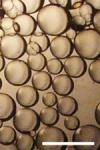 |
| Graphene oxide sheets stabilized organic solvent droplets in water. |
Abstract:
Graphene oxide, a single-atomic-layered material made by reacting graphite powders with strong oxidizing agents, has attracted a lot of interest from scientists because of its ability to easily convert to graphene — a hotly studied material that scientists believe could be used to produce low-cost carbon-based transparent and flexible electronics.
Researchers Discover New Properties of World's Thinnest Material
Evanston, IL | Posted on June 16th, 2010But to Jiaxing Huang, assistant professor of materials science and engineering, and his research group at the McCormick School of Engineering and Applied Science at Northwestern University, graphene oxide itself is even more interesting. Huang and his group have studied the material for years and have discovered how to assemble these soft sheets like floating water lilies pads. They also used a camera flash to turn them into graphene, and invented a fluorescence quenching technique to make them visible under microscopes.
Now, working with Kenneth R. Shull, professor of materials science and engineering, they have discovered that graphene oxide sheets behave like surfactants, the chemicals in soap and shampoo that make stains disperse in water. The team's results are published online in the Journal of the American Chemical Society.
Graphene oxide has been known in the scientific world for more than a century and was largely described as hydrophilic, or attracted to water. But Huang and his research group thought that graphene oxide should be amphiphilic, a property of surfactants that can both attracts and repels water, because part of the graphene oxide structure is actually water repelling.
"We view graphene oxide as a soft material," Huang says. "For example, it is essentially two-dimensional polymers composed of carbon, hydrogen and oxygen. They are also colloidal particles with very exotic shapes."
To test their hypothesis, Huang and his group put graphene oxide in carbonated water. They found that the sheets can hitchhike onto the rising bubbles to reach the water surface — just like a surfactant would do. Next they found that graphite oxide can disperse oil droplets in water — just like a surfactant would.
This new insight into a fundamental property of the material, according to Huang, is important for understanding how graphene oxide is processed and handled. It could lead to new applications for the material.
Its surfactant properties mean it could be used as a dispersing agent for insoluble materials, like carbon nanotubes. Common surfactants are non-conducting, so when used as a dispersing agent for conducting materials, they need to be removed from the material. Graphite oxide, which turns into conducting graphene through heating, would actually help conductivity.
The surfactant behavior inspired another exciting discovery — that water surface can act as a filter for separating graphene oxide sheets by size.
"The smaller the sheet, the more water-liking it becomes, so eventually it will sink into water," Huang says. This effect makes it easier to harvest large sheets of graphene oxide, which are more useful for graphene device fabrication.
This work was funded by the National Science Foundation. In addition to Huang and Shull, the other authors of the paper include graduate students Jaemyung Kim, Laura Cote, Wa Yuan and postdoc Franklin Kim.
####
For more information, please click here
Contacts:
Phone: (847) 491-5220
Copyright © Robert R. McCormick School of Engineering and Applied Scienc
If you have a comment, please Contact us.Issuers of news releases, not 7th Wave, Inc. or Nanotechnology Now, are solely responsible for the accuracy of the content.
Bookmark:


| Related News Press |
News and information
 Quantum computer improves AI predictions April 17th, 2026
Flexible sensor gains sensitivity under pressure April 17th, 2026
A reusable chip for particulate matter sensing April 17th, 2026
Detecting vibrational quantum beating in the predissociation dynamics of SF6 using time-resolved photoelectron spectroscopy April 17th, 2026
Govt.-Legislation/Regulation/Funding/Policy
Quantum computer improves AI predictions April 17th, 2026
Metasurfaces smooth light to boost magnetic sensing precision January 30th, 2026
New imaging approach transforms study of bacterial biofilms August 8th, 2025
Possible Futures
A fundamentally new therapeutic approach to cystic fibrosis: Nanobody repairs cellular defect April 17th, 2026
UC Irvine physicists discover method to reverse ‘quantum scrambling’ : The work addresses the problem of information loss in quantum computing system April 17th, 2026
Academic/Education
Rice University launches Rice Synthetic Biology Institute to improve lives January 12th, 2024
Multi-institution, $4.6 million NSF grant to fund nanotechnology training September 9th, 2022
Nanotubes/Buckyballs/Fullerenes/Nanorods/Nanostrings/Nanosheets
Tiny nanosheets, big leap: A new sensor detects ethanol at ultra-low levels January 30th, 2026
Enhancing power factor of p- and n-type single-walled carbon nanotubes April 25th, 2025
Chainmail-like material could be the future of armor: First 2D mechanically interlocked polymer exhibits exceptional flexibility and strength January 17th, 2025
Innovative biomimetic superhydrophobic coating combines repair and buffering properties for superior anti-erosion December 13th, 2024
Discoveries
Quantum computer improves AI predictions April 17th, 2026
Flexible sensor gains sensitivity under pressure April 17th, 2026
A reusable chip for particulate matter sensing April 17th, 2026
Detecting vibrational quantum beating in the predissociation dynamics of SF6 using time-resolved photoelectron spectroscopy April 17th, 2026
Announcements
A fundamentally new therapeutic approach to cystic fibrosis: Nanobody repairs cellular defect April 17th, 2026
UC Irvine physicists discover method to reverse ‘quantum scrambling’ : The work addresses the problem of information loss in quantum computing system April 17th, 2026
 |
||
 |
||
| The latest news from around the world, FREE | ||
 |
||
|
|
||
| Premium Products | ||
 |
||
|
Only the news you want to read!
Learn More |
||
 |
||
|
Full-service, expert consulting
Learn More |
||
|
|
||