Home > Press > Shining Light on Graphene-Metal Interactions
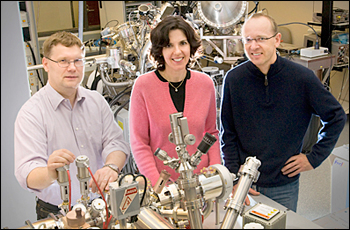 |
| From left, Jurek Sadowski, Eli Sutter, and Peter Sutter |
Abstract:
By controlling the layered growth of graphene - a relatively "new" form of carbon that's just a single atom thick - researchers at Brookhaven National Laboratory have uncovered intriguing details about the material's superior electrical and optical properties. Their findings could help position graphene as the next-generation material for future computers, digital displays, and electronic sensors.
By Kendra Snyder
Shining Light on Graphene-Metal Interactions
Upton, NY | Posted on April 2nd, 2010"Graphene is a material that really has the potential to replace silicon in the electronics industry," said Peter Sutter, a materials scientist in Brookhaven's Center for Functional Nanomaterials. "It's thin, transparent, strong, and highly conductive - all extremely appealing characteristics for everything from computer chips to touch screens and solar cells."
One of the biggest challenges facing researchers is figuring out how to produce graphene in large quantities. The simplest method is peeling off single sheets of graphene from graphite, a material consisting of many graphene layers, with pieces of tape. But this method yields only small, jagged flakes that aren't useful for most applications.
At Brookhaven, Sutter's group grows graphene on a metal substrate, a technique that can produce single-layer sheets over very large areas, thousands of times larger than the pieces made with the "Scotch tape" method. First, a single crystal of ruthenium is heated up to temperatures higher than 1000 degrees Celsius while being exposed to a carbon-rich gas. At high temperatures, carbon atoms are able to squeeze into spaces within the metal crystal, similar to water being taken in by a sponge. As the crystal is slowly cooled, these carbon atoms are expelled to the surface of the metal, where they form individual layers of graphene. The number of layers formed can be controlled by the amount of carbon atoms initially absorbed into the ruthenium crystal.
"One of the unique aspects of this method is that we can control the thickness of the material, growing graphene layer by layer," Sutter said. "This has allowed us to see how the structure and electronic properties of the material change as single atomic carbon layers are added to the substrate one at a time."
Because the research group wanted to determine how the metal substrate affects the properties of graphene, it was important to monitor the layered material's characteristics as it was grown — a capability provided by a special microscope at the National Synchrotron Light Source.
"First, we were able to watch how the material grew, and then, without moving it from the system, we were able to switch on the photon beam and determine its electronic structure," Stutter said. "It's extremely valuable to do everything in the same environment."
To obtain measurements for the material with different numbers of graphene sheets, the group used micro-angle-resolved photoelectron spectroscopy, a technique that allows researchers to study the electronic structure of very small regions of interest.
Their findings, published in the July 8, 2009 edition of Nano Letters, were surprising.
"We found that if a single graphene sheet is grown on a metal like ruthenium, the metal binds very strongly to the carbon atoms and disrupts the characteristic properties normally found in isolated graphene," Sutter said. "But those properties re-emerge in subsequent layers grown on the substrate."
In other words, the first graphene layer grown on ruthenium satiates the metal substrate, allowing the rest of the layers to reclaim their normal properties.
"As a result of this growth process, a two-layer stack acts like an isolated monolayer of graphene and a three-layer stack acts like an isolated bilayer," Sutter said.
The findings of the group, which also includes Brookhaven researchers Mark Hybertsen, Jurek Sadowski, and Eli Sutter, lays groundwork for future graphene production for advanced technologies, and helps researchers understand how metals — for example in device contacts — change the properties of graphene.
This work was funded by the U.S. Department of Energy Office of Basic Energy Sciences within the Office of Science.
####
About Brookhaven National Laboratory
One of ten national laboratories overseen and primarily funded by the Office of Science of the U.S. Department of Energy (DOE), Brookhaven National Laboratory conducts research in the physical, biomedical, and environmental sciences, as well as in energy technologies and national security. Brookhaven Lab also builds and operates major scientific facilities available to university, industry and government researchers. Brookhaven is operated and managed for DOE's Office of Science by Brookhaven Science Associates, a limited-liability company founded by Stony Brook University, the largest academic user of Laboratory facilities, and Battelle, a nonprofit, applied science and technology organization.
For more information, please click here
Copyright © Brookhaven National Laboratory
If you have a comment, please Contact us.Issuers of news releases, not 7th Wave, Inc. or Nanotechnology Now, are solely responsible for the accuracy of the content.
Bookmark:


| Related News Press |
News and information
 Quantum computer improves AI predictions April 17th, 2026
Flexible sensor gains sensitivity under pressure April 17th, 2026
A reusable chip for particulate matter sensing April 17th, 2026
Detecting vibrational quantum beating in the predissociation dynamics of SF6 using time-resolved photoelectron spectroscopy April 17th, 2026
Display technology/LEDs/SS Lighting/OLEDs
Spinel-type sulfide semiconductors to operate the next-generation LEDs and solar cells For solar-cell absorbers and green-LED source October 3rd, 2025
Efficient and stable hybrid perovskite-organic light-emitting diodes with external quantum efficiency exceeding 40 per cent July 5th, 2024
Govt.-Legislation/Regulation/Funding/Policy
Quantum computer improves AI predictions April 17th, 2026
Metasurfaces smooth light to boost magnetic sensing precision January 30th, 2026
New imaging approach transforms study of bacterial biofilms August 8th, 2025
Possible Futures
A fundamentally new therapeutic approach to cystic fibrosis: Nanobody repairs cellular defect April 17th, 2026
UC Irvine physicists discover method to reverse ‘quantum scrambling’ : The work addresses the problem of information loss in quantum computing system April 17th, 2026
Chip Technology
A reusable chip for particulate matter sensing April 17th, 2026
Metasurfaces smooth light to boost magnetic sensing precision January 30th, 2026
Nanotubes/Buckyballs/Fullerenes/Nanorods/Nanostrings/Nanosheets
Tiny nanosheets, big leap: A new sensor detects ethanol at ultra-low levels January 30th, 2026
Enhancing power factor of p- and n-type single-walled carbon nanotubes April 25th, 2025
Chainmail-like material could be the future of armor: First 2D mechanically interlocked polymer exhibits exceptional flexibility and strength January 17th, 2025
Innovative biomimetic superhydrophobic coating combines repair and buffering properties for superior anti-erosion December 13th, 2024
Sensors
Flexible sensor gains sensitivity under pressure April 17th, 2026
Tiny nanosheets, big leap: A new sensor detects ethanol at ultra-low levels January 30th, 2026
From sensors to smart systems: the rise of AI-driven photonic noses January 30th, 2026
Sensors innovations for smart lithium-based batteries: advancements, opportunities, and potential challenges August 8th, 2025
Nanoelectronics
Lab to industry: InSe wafer-scale breakthrough for future electronics August 8th, 2025
Interdisciplinary: Rice team tackles the future of semiconductors Multiferroics could be the key to ultralow-energy computing October 6th, 2023
Key element for a scalable quantum computer: Physicists from Forschungszentrum Jülich and RWTH Aachen University demonstrate electron transport on a quantum chip September 23rd, 2022
Reduced power consumption in semiconductor devices September 23rd, 2022
Materials/Metamaterials/Magnetoresistance
First real-time observation of two-dimensional melting process: Researchers at Mainz University unveil new insights into magnetic vortex structures August 8th, 2025
Researchers unveil a groundbreaking clay-based solution to capture carbon dioxide and combat climate change June 6th, 2025
A 1960s idea inspires NBI researchers to study hitherto inaccessible quantum states June 6th, 2025
Institute for Nanoscience hosts annual proposal planning meeting May 16th, 2025
Announcements
A fundamentally new therapeutic approach to cystic fibrosis: Nanobody repairs cellular defect April 17th, 2026
UC Irvine physicists discover method to reverse ‘quantum scrambling’ : The work addresses the problem of information loss in quantum computing system April 17th, 2026
Solar/Photovoltaic
Spinel-type sulfide semiconductors to operate the next-generation LEDs and solar cells For solar-cell absorbers and green-LED source October 3rd, 2025
KAIST researchers introduce new and improved, next-generation perovskite solar cell November 8th, 2024
Groundbreaking precision in single-molecule optoelectronics August 16th, 2024
Development of zinc oxide nanopagoda array photoelectrode: photoelectrochemical water-splitting hydrogen production January 12th, 2024
 |
||
 |
||
| The latest news from around the world, FREE | ||
 |
||
|
|
||
| Premium Products | ||
 |
||
|
Only the news you want to read!
Learn More |
||
 |
||
|
Full-service, expert consulting
Learn More |
||
|
|
||