Home > Press > Six Brookhaven Lab Scientists Named American Physical Society Fellows
 |
Abstract:
Six scientists at the U.S. Department of Energy's Brookhaven National Laboratory have been named Fellows of the American Physical Society (APS), a professional organization with more than 47,000 members. Election to APS Fellowship is limited to no more than one half of one percent of its membership in a given year, and election for this honor indicates recognition by scientific peers for outstanding contributions to physics.
Six Brookhaven Lab Scientists Named American Physical Society Fellows
Upton, NY | Posted on December 17th, 2009One of the 2009 Fellows from Brookhaven is:
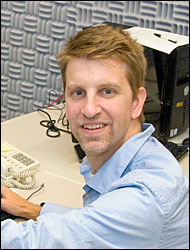
Charles Black
"For pioneering contributions to the integration of nanometer-scale polymer self-assembly in the fabrication of high-performance semiconductor microelectronic devices."
During his career at IBM, Black pioneered the use of self-assembly in nanotechnology to fabricate high-performance semiconductor devices used in microelectronics. Self-assembly is the spontaneous organization of materials into regular patterns. Under controlled conditions, certain materials will self-organize into patterns on the scale of tens of nanometers with dimensions and uniformity unattainable by conventional means. In his current research at Brookhaven's Center for Functional Nanomaterials (CFN), Black is designing and applying self-assembly approaches to build nanostructured solar cells from low-cost polymer and nanocrystal materials.
Black earned a Ph.D. in physics from Harvard University in 1996, and started his career at the IBM Thomas J. Watson Research Center as a research staff member. In 2006, he joined Brookhaven as a scientist and group leader, managing the CFN's Electronic Nanomaterials Group. Black has been recognized for his innovative research contributions, including receiving Industry Week Magazine's Technology of the Year Award in 2004, and IBM's Outstanding Technical Achievement Award in 2005.
Read the entire release to learn about all 6 www.bnl.gov/bnlweb/pubaf/pr/PR_display.asp?prID=1057
####
About Brookhaven National Laboratory
One of ten national laboratories overseen and primarily funded by the Office of Science of the U.S. Department of Energy (DOE), Brookhaven National Laboratory conducts research in the physical, biomedical, and environmental sciences, as well as in energy technologies and national security. Brookhaven Lab also builds and operates major scientific facilities available to university, industry and government researchers. Brookhaven is operated and managed for DOE's Office of Science by Brookhaven Science Associates, a limited-liability company founded by Stony Brook University, the largest academic user of Laboratory facilities, and Battelle, a nonprofit, applied science and technology organization.
For more information, please click here
Contacts:
Diane Greenberg
(631) 344-2347
Mona S. Rowe
(631) 344-5056
Copyright © Brookhaven National Laboratory
If you have a comment, please Contact us.Issuers of news releases, not 7th Wave, Inc. or Nanotechnology Now, are solely responsible for the accuracy of the content.
Bookmark:


| Related News Press |
News and information
 Quantum computer improves AI predictions April 17th, 2026
Flexible sensor gains sensitivity under pressure April 17th, 2026
A reusable chip for particulate matter sensing April 17th, 2026
Detecting vibrational quantum beating in the predissociation dynamics of SF6 using time-resolved photoelectron spectroscopy April 17th, 2026
Chip Technology
A reusable chip for particulate matter sensing April 17th, 2026
Metasurfaces smooth light to boost magnetic sensing precision January 30th, 2026
Self Assembly
Diamond glitter: A play of colors with artificial DNA crystals May 17th, 2024
Liquid crystal templated chiral nanomaterials October 14th, 2022
Nanoclusters self-organize into centimeter-scale hierarchical assemblies April 22nd, 2022
Atom by atom: building precise smaller nanoparticles with templates March 4th, 2022
Nanoelectronics
Lab to industry: InSe wafer-scale breakthrough for future electronics August 8th, 2025
Interdisciplinary: Rice team tackles the future of semiconductors Multiferroics could be the key to ultralow-energy computing October 6th, 2023
Key element for a scalable quantum computer: Physicists from Forschungszentrum Jülich and RWTH Aachen University demonstrate electron transport on a quantum chip September 23rd, 2022
Reduced power consumption in semiconductor devices September 23rd, 2022
Announcements
A fundamentally new therapeutic approach to cystic fibrosis: Nanobody repairs cellular defect April 17th, 2026
UC Irvine physicists discover method to reverse ‘quantum scrambling’ : The work addresses the problem of information loss in quantum computing system April 17th, 2026
 |
||
 |
||
| The latest news from around the world, FREE | ||
 |
||
|
|
||
| Premium Products | ||
 |
||
|
Only the news you want to read!
Learn More |
||
 |
||
|
Full-service, expert consulting
Learn More |
||
|
|
||