Home > Press > UC Riverside Physicist Receives Highest Honor U.S. Government Bestows on Young Scientists or Engineers
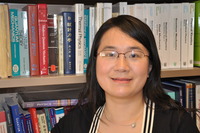 |
| Chun Ning (Jeanie) Lau is an associate professor in the Department of Physics and Astronomy at UC Riverside. Photo credit: UCR Strategic Communications. |
Abstract:
UC Riverside's Chun Ning (Jeanie) Lau has received a national honor that few outstanding researchers who are beginning their independent research careers are given.
Lau, an associate professor of physics, is one of the recipients of the Presidential Early Career Awards for Scientists and Engineers (PECASE) for the 2008 competition. PECASE represents the highest honor a beginning scientist or engineer can receive in the United States.
UC Riverside Physicist Receives Highest Honor U.S. Government Bestows on Young Scientists or Engineers
Riverside, CA | Posted on July 9th, 2009Established in 1996, the PECASE program recognizes outstanding scientists and engineers who, early in their careers, show exceptional potential for leadership at the frontiers of knowledge. A total of 100 PECASE winners were named for 2008.
Selection for the award is based on nominees' innovative research at the frontiers of science and technology as well as community service demonstrated through scientific leadership, education or community outreach. The White House Office of Science and Technology Policy selects the awardees.
Lau and the other PECASE winners will be presented with their awards at a White House ceremony in the fall of 2009.
Individuals cannot apply for PECASE. A handful of participating funding agencies nominate young scientists and engineers for the awards. Each year the National Science Foundation (NSF) selects up to 20 nominees for PECASE from among those who have received awards under the NSF's CAREER program and who are most likely to become leaders of academic research and education in the twenty-first century.
Lau, the first PECASE winner at UCR, received a CAREER award from NSF in 2008, enabling her to experimentally investigate the electrical properties of graphene coupled to normal and superconducting electrodes. Graphene, first experimentally isolated in 2004, consists of carbon atoms only one atomic layer thick, with the unique characteristic that its electrons behave as if they have zero mass. Graphene has attracted tremendous attention from academic and industrial sectors for its potential as the "material of the future" to supplement or replace silicon in electronic circuits.
Besides graphene, Lau studies nanowires and carbon nanotubes. Her research has helped physicists gain fundamental understanding of how atoms and electrons behave when they are ruled by quantum mechanics. Her lab studies novel electrical properties that arise from the quantum confinement of atoms and charges to nanoscale systems. Her research team has shown that graphene can act as an atomic-scale billiard table, with electric charges acting as billiard balls.
Her other research interests include superconductivity, thermal management and electronic transport in nanostructures, and engineering new classes of nanoscale devices.
An educational component of Lau's research effort is the active involvement of high school, undergraduate, and graduate students, especially minority and women, in her cutting-edge research, taking advantage of the ethnic diversity of UCR's student population and local communities. She is a founding faculty member of the UCR Undergraduate Research Journal. She also organized a "Women in Physics" lunch group that provides a friendly platform for female students, postdocs and faculty members to interact.
After receiving her bachelor's degree in physics from the University of Chicago in 1994, Lau proceeded to Harvard University from where she received her master's and doctoral degrees in physics in 1997 and 2001, respectively. She joined UCR in 2004, after an appointment as a research associate in the Hewlett-Packard Laboratory. At UCR she is a member of the Center for Nanoscale Science and Engineering.
Lau's awards and honors include the Richter Fellowship for Undergraduate Research, 1992; a David W. Grainger Senior Scholarship, 1993; and a Robert T. Poe Faculty Development Grant from the Chinese-American Faculty Association of Southern California, 2007. She has published more than 30 research articles in peer-reviewed journals.
####
About UC Riverside
The University of California, Riverside is a doctoral research university, a living laboratory for groundbreaking exploration of issues critical to Inland Southern California, the state and communities around the world. Reflecting California's diverse culture, UCR's enrollment of about 17,000 is expected to grow to 21,000 students by 2020. The campus is planning a medical school and has reached the heart of the Coachella Valley by way of the UCR Palm Desert Graduate Center. The campus has an annual statewide economic impact of more than $1 billion.
For more information, please click here
Contacts:
edia Relations
900 University Avenue
University Village 204B
Riverside, CA 92521
Tel: (951) 827-6397 (951) UCR-NEWS
Fax: (951) 827-5008
Iqbal Pittalwala
Tel: (951) 827-6050
Copyright © UC Riverside
If you have a comment, please Contact us.Issuers of news releases, not 7th Wave, Inc. or Nanotechnology Now, are solely responsible for the accuracy of the content.
Bookmark:


| Related News Press |
News and information
 Quantum computer improves AI predictions April 17th, 2026
Flexible sensor gains sensitivity under pressure April 17th, 2026
A reusable chip for particulate matter sensing April 17th, 2026
Detecting vibrational quantum beating in the predissociation dynamics of SF6 using time-resolved photoelectron spectroscopy April 17th, 2026
Govt.-Legislation/Regulation/Funding/Policy
Quantum computer improves AI predictions April 17th, 2026
Metasurfaces smooth light to boost magnetic sensing precision January 30th, 2026
New imaging approach transforms study of bacterial biofilms August 8th, 2025
Academic/Education
Rice University launches Rice Synthetic Biology Institute to improve lives January 12th, 2024
Multi-institution, $4.6 million NSF grant to fund nanotechnology training September 9th, 2022
Nanotubes/Buckyballs/Fullerenes/Nanorods/Nanostrings/Nanosheets
Tiny nanosheets, big leap: A new sensor detects ethanol at ultra-low levels January 30th, 2026
Enhancing power factor of p- and n-type single-walled carbon nanotubes April 25th, 2025
Chainmail-like material could be the future of armor: First 2D mechanically interlocked polymer exhibits exceptional flexibility and strength January 17th, 2025
Innovative biomimetic superhydrophobic coating combines repair and buffering properties for superior anti-erosion December 13th, 2024
Nanoelectronics
Lab to industry: InSe wafer-scale breakthrough for future electronics August 8th, 2025
Interdisciplinary: Rice team tackles the future of semiconductors Multiferroics could be the key to ultralow-energy computing October 6th, 2023
Key element for a scalable quantum computer: Physicists from Forschungszentrum Jülich and RWTH Aachen University demonstrate electron transport on a quantum chip September 23rd, 2022
Reduced power consumption in semiconductor devices September 23rd, 2022
Announcements
A fundamentally new therapeutic approach to cystic fibrosis: Nanobody repairs cellular defect April 17th, 2026
UC Irvine physicists discover method to reverse ‘quantum scrambling’ : The work addresses the problem of information loss in quantum computing system April 17th, 2026
Grants/Sponsored Research/Awards/Scholarships/Gifts/Contests/Honors/Records
Quantum computer improves AI predictions April 17th, 2026
Detecting vibrational quantum beating in the predissociation dynamics of SF6 using time-resolved photoelectron spectroscopy April 17th, 2026
Metasurfaces smooth light to boost magnetic sensing precision January 30th, 2026
Quantum nanoscience
Beyond silicon: Electronics at the scale of a single molecule January 30th, 2026
MXene nanomaterials enter a new dimension Multilayer nanomaterial: MXene flakes created at Drexel University show new promise as 1D scrolls January 30th, 2026
ICFO researchers overcome long-standing bottleneck in single photon detection with twisted 2D materials August 8th, 2025
 |
||
 |
||
| The latest news from around the world, FREE | ||
 |
||
|
|
||
| Premium Products | ||
 |
||
|
Only the news you want to read!
Learn More |
||
 |
||
|
Full-service, expert consulting
Learn More |
||
|
|
||