Home > Press > New material to make next generation of electronics faster and more efficient With the increase of new technology and artificial intelligence, the demand for efficient and powerful semiconductors continues to grow
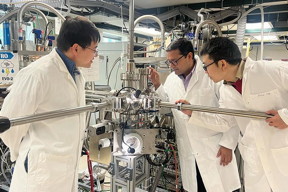 |
| Researchers in the Quantum Materials Design and Synthesis Group (from left to right) Zhifei Yang, Bharat Jalan, and Fengdeng Liu who worked to create a new material to help improve the next generation of high-power electronics. Credit: Kalie Pluchel/University of Minnesota Credit Kalie Pluchel/University of Minnesota |
Abstract:
Researchers at the University of Minnesota have achieved a new material that will be pivotal in making the next generation of high-power electronics faster, transparent and more efficient. This artificially designed material allows electrons to move faster while remaining transparent to both visible and ultraviolet light, breaking the previous record.
New material to make next generation of electronics faster and more efficient With the increase of new technology and artificial intelligence, the demand for efficient and powerful semiconductors continues to grow
Minneapolis, MN | Posted on November 8th, 2024The research, published in Science Advances, a peer-reviewed scientific journal, marks a significant leap forward in semiconductor design, which is crucial to a trillion-dollar global industry expected to continue growing as digital technologies expand.
Semiconductors power nearly all electronics, from smartphones to medical devices. A key to advancing these technologies lies in improving what scientists refer to as "ultra-wide band gap" materials. These materials can conduct electricity efficiently even under extreme conditions. Ultra-wide band gap semiconductors enable high-performance at elevated temperatures, making them essential for more durable and robust electronics.
In this paper, the researchers looked at creating a new class of materials with increased “band gap,” enhancing both transparency and conductivity. This unique achievement supports the development of faster, more efficient devices, paving the way for breakthroughs in computers, smartphones, and potentially even quantum computing.
The new material is a transparent conducting oxide, created with a specialized thin-layered structure that enhances transparency without sacrificing conductivity. As technology and artificial intelligence applications demand ever-more capable materials, this groundbreaking development offers a promising solution.
"This breakthrough is a game-changer for transparent conducting materials, enabling us to overcome limitations that have held back deep ultra-violet device performance for years," said Bharat Jalan, Shell Chair and Professor in the University of Minnesota's Department of Chemical Engineering and Materials Science.
The work not only demonstrates an unprecedented combination of transparency and conductivity in the deep-ultraviolet spectrum but also paves the way for innovations in high-power and optoelectronic devices that can operate in the most demanding environments, Jalan explained.
The study’s first co-authors Fengdeng Liu and Zhifei Yang, chemical engineering and materials science Ph.D. students working in Jalan’s lab, said they proved that the properties of the material were almost too perfect to believe for these electronic applications. They ran multiple experiments and eliminated defects in the material to increase its performance.
“Through detailed electron microscopy, we saw this material was clean with no obvious defects, revealing just how powerful oxide-based perovskites can be as semiconductors if defects are controlled,” said Andre Mkhoyan, a senior author on the paper and Ray D. and Mary T. Johnson Chair and Professor in the University of Minnesota Department of Chemical Engineering and Materials Science.
In addition to Jalan, Liu, Yang, and Mkhoyan, the team included Silo Guo from the University of Minnesota’s Department of Chemical Engineering and Materials Science and David Abramovitch and Marco Bernardi from the California Institute of Technology’s Department of Applied Physics and Materials Science.
This work was funded by the Air Force Office of Scientific Research (AFOSR), the National Science Foundation, and the University of Minnesota Materials Research Science and Engineering Center (MRSEC). The work was completed in collaboration with the University of Minnesota Characterization Facility and the Minnesota Nano Center.
####
For more information, please click here
Contacts:
Rhonda Zurn
University of Minnesota
Office: 612-626-7959
Copyright © University of Minnesota
If you have a comment, please Contact us.Issuers of news releases, not 7th Wave, Inc. or Nanotechnology Now, are solely responsible for the accuracy of the content.
Bookmark:


| Related Links |
| Related News Press |
News and information
 Quantum computer improves AI predictions April 17th, 2026
Flexible sensor gains sensitivity under pressure April 17th, 2026
A reusable chip for particulate matter sensing April 17th, 2026
Detecting vibrational quantum beating in the predissociation dynamics of SF6 using time-resolved photoelectron spectroscopy April 17th, 2026
Imaging
Simple algorithm paired with standard imaging tool could predict failure in lithium metal batteries August 8th, 2025
Possible Futures
A fundamentally new therapeutic approach to cystic fibrosis: Nanobody repairs cellular defect April 17th, 2026
UC Irvine physicists discover method to reverse ‘quantum scrambling’ : The work addresses the problem of information loss in quantum computing system April 17th, 2026
Chip Technology
A reusable chip for particulate matter sensing April 17th, 2026
Metasurfaces smooth light to boost magnetic sensing precision January 30th, 2026
Optical computing/Photonic computing
ICFO researchers overcome long-standing bottleneck in single photon detection with twisted 2D materials August 8th, 2025
Programmable electron-induced color router array May 14th, 2025
Discoveries
Quantum computer improves AI predictions April 17th, 2026
Flexible sensor gains sensitivity under pressure April 17th, 2026
A reusable chip for particulate matter sensing April 17th, 2026
Detecting vibrational quantum beating in the predissociation dynamics of SF6 using time-resolved photoelectron spectroscopy April 17th, 2026
Materials/Metamaterials/Magnetoresistance
First real-time observation of two-dimensional melting process: Researchers at Mainz University unveil new insights into magnetic vortex structures August 8th, 2025
Researchers unveil a groundbreaking clay-based solution to capture carbon dioxide and combat climate change June 6th, 2025
A 1960s idea inspires NBI researchers to study hitherto inaccessible quantum states June 6th, 2025
Institute for Nanoscience hosts annual proposal planning meeting May 16th, 2025
Announcements
A fundamentally new therapeutic approach to cystic fibrosis: Nanobody repairs cellular defect April 17th, 2026
UC Irvine physicists discover method to reverse ‘quantum scrambling’ : The work addresses the problem of information loss in quantum computing system April 17th, 2026
Interviews/Book Reviews/Essays/Reports/Podcasts/Journals/White papers/Posters
A fundamentally new therapeutic approach to cystic fibrosis: Nanobody repairs cellular defect April 17th, 2026
UC Irvine physicists discover method to reverse ‘quantum scrambling’ : The work addresses the problem of information loss in quantum computing system April 17th, 2026
Tools
Metasurfaces smooth light to boost magnetic sensing precision January 30th, 2026
From sensors to smart systems: the rise of AI-driven photonic noses January 30th, 2026
Japan launches fully domestically produced quantum computer: Expo visitors to experience quantum computing firsthand August 8th, 2025
 |
||
 |
||
| The latest news from around the world, FREE | ||
 |
||
|
|
||
| Premium Products | ||
 |
||
|
Only the news you want to read!
Learn More |
||
 |
||
|
Full-service, expert consulting
Learn More |
||
|
|
||