Home > Press > Discovering features of band topology in amorphous thin films
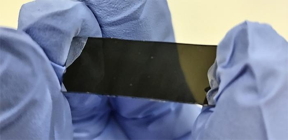 |
| The amorphous thin film experimented on in this study. CREDIT Tohoku University |
Abstract:
In recent years, scientists have been studying special materials called topological materials, with special attention paid to the shape, i.e., topology, of their electronic structures (electronic bands). Although it is not visible in real space, their unusual shape in topological materials produces various unique properties that can be suitable for making next-generation devices.
Discovering features of band topology in amorphous thin films
Sendai City, Japan | Posted on June 30th, 2023It was thought that in order to exploit topological physical properties, crystalline materials, where atoms are highly ordered and arranged in repeating patterns, were needed. Materials in the amorphous state, i.e., where atoms are disordered and only periodically arranged over short distances, were considered unsuitable for hosting the outstanding physical properties of topological materials.
Now, a collaborative research group has verified that even amorphous materials can have these special properties. The group was led by Associate Professor Kohei Fujiwara and Professor Atsushi Tsukazaki from Tohoku University's Institute for Materials Research (IMR); Lecturer Yasuyuki Kato and Professor Yukitoshi Motome from the University of Tokyo's Graduate School of Engineering and Associate Professor Hitoshi Abe at the High Energy Accelerator Research Organization's Institute for Materials Structure Science.
Details of their findings were reported in the journal Nature Communications on June 13, 2023.
"We discovered that the concept of band topology, which has been discussed mainly in crystals, is also valid and technologically useful in amorphous states," stated Fujiwara.
To make their discovery, the team performed experiments and model calculations on iron-tin amorphous thin films. They demonstrated that despite a short-range atom arrangement, the amorphous material still showed the same special effects as in the crystalline materials, notably the anomalous Hall effect and the Nernst effect.
"Amorphous materials are easier and cheaper to make compared to crystals, so this opens up new possibilities for developing devices using these materials. This could lead to advancements in sensing technology, which is important for creating the Internet of Things (IoT) where many devices are connected and communicate with each other," adds Fujiwara.
Looking ahead, the group is eager to unearth more amorphous materials and develop innovative devices using them.
####
For more information, please click here
Contacts:
Public Relations
Tohoku University
Copyright © Tohoku University
If you have a comment, please Contact us.Issuers of news releases, not 7th Wave, Inc. or Nanotechnology Now, are solely responsible for the accuracy of the content.
Bookmark:


| Related Links |
| Related News Press |
News and information
 Quantum computer improves AI predictions April 17th, 2026
Flexible sensor gains sensitivity under pressure April 17th, 2026
A reusable chip for particulate matter sensing April 17th, 2026
Detecting vibrational quantum beating in the predissociation dynamics of SF6 using time-resolved photoelectron spectroscopy April 17th, 2026
Possible Futures
A fundamentally new therapeutic approach to cystic fibrosis: Nanobody repairs cellular defect April 17th, 2026
UC Irvine physicists discover method to reverse ‘quantum scrambling’ : The work addresses the problem of information loss in quantum computing system April 17th, 2026
Chip Technology
A reusable chip for particulate matter sensing April 17th, 2026
Metasurfaces smooth light to boost magnetic sensing precision January 30th, 2026
Discoveries
Quantum computer improves AI predictions April 17th, 2026
Flexible sensor gains sensitivity under pressure April 17th, 2026
A reusable chip for particulate matter sensing April 17th, 2026
Detecting vibrational quantum beating in the predissociation dynamics of SF6 using time-resolved photoelectron spectroscopy April 17th, 2026
Materials/Metamaterials/Magnetoresistance
First real-time observation of two-dimensional melting process: Researchers at Mainz University unveil new insights into magnetic vortex structures August 8th, 2025
Researchers unveil a groundbreaking clay-based solution to capture carbon dioxide and combat climate change June 6th, 2025
A 1960s idea inspires NBI researchers to study hitherto inaccessible quantum states June 6th, 2025
Institute for Nanoscience hosts annual proposal planning meeting May 16th, 2025
Announcements
A fundamentally new therapeutic approach to cystic fibrosis: Nanobody repairs cellular defect April 17th, 2026
UC Irvine physicists discover method to reverse ‘quantum scrambling’ : The work addresses the problem of information loss in quantum computing system April 17th, 2026
Interviews/Book Reviews/Essays/Reports/Podcasts/Journals/White papers/Posters
A fundamentally new therapeutic approach to cystic fibrosis: Nanobody repairs cellular defect April 17th, 2026
UC Irvine physicists discover method to reverse ‘quantum scrambling’ : The work addresses the problem of information loss in quantum computing system April 17th, 2026
 |
||
 |
||
| The latest news from around the world, FREE | ||
 |
||
|
|
||
| Premium Products | ||
 |
||
|
Only the news you want to read!
Learn More |
||
 |
||
|
Full-service, expert consulting
Learn More |
||
|
|
||