Home > Press > New family of wheel-like metallic clusters exhibit unique properties
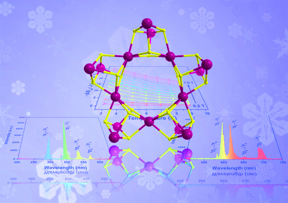 |
| A multi-institute research team synthesized a family of nano-wheel-like metallic clusters, each with specific properties — such as fluorescence and different types of magnetism — that could advance next-generation technologies. CREDIT Polyoxometalates, Tsinghua University Press |
Abstract:
While the wheel does not need to be reinvented, there are benefits to the development of new nano-wheels, according to a multi-institute research team based in China. The group fabricated a novel family of metallic compounds, each of which exhibit unique properties desirable for next-generation technologies, such as advanced sensors.
New family of wheel-like metallic clusters exhibit unique properties
Tsinghua, China | Posted on April 14th, 2023Their findings were made available online on March 12 in Polyoxometalates.
“Polymetallic complexes are of great interest not only for their appealing molecular structure but also for their versatile applications in various fields,” said co-corresponding author Yan-Zhen Zheng, professor in the Frontier Institute of Science and Technology (FIST) at Xi’an Jiaotong University.
Polymetallic complexes, which comprise multiple atoms of various metals or a combination of metals and other elements, have the potential to imbue materials with specific properties if the molecules can be synthesized, Zheng said. Such properties include the ability to fluoresce, or glow, and magnetic quirks that allow drastic temperature changes and control.
Zheng and his team focused on creating polymetallic complexes made with lanthanide elements, a group of 15 metallic materials also known as rare earth elements. They specifically used europium, terbium and gadolinium.
“Among all polymetallic complexes, lanthanide-based compounds have drawn unprecedented attention due to their interesting magnetic and luminescence behaviors,” Zheng said. “Several such compounds have been successfully isolated, but direct synthesis has been a challenge.”
The components of the complexes require are geometrically diverse, requiring significant coordination, according to Zheng.
“Previous findings revealed that controlling the hydrolysis — breaking down a compound with water — of lanthanide metal ions in the presence of appropriate organic ligands would be a powerful strategy to obtain desired species,” Zheng said. A ligand is a molecule that bonds to a metal atom. Its addition to the complex can stabilize the structure.
The researchers used hydrolysis to breakdown lanthanides in a bath containing a ligand called tricine. Tricine contains multiple arms of oxygen and hydrogen, meaning it can accommodate a large range of metals and help stabilize the resulting clusters.
“Through the simple hydrolysis reaction, we synthesized three lanthanide nano-clusters, and used X-ray diffraction analyses to reveal their stable, wheel-like structure,” Zheng said. “Owing to the presence of different lanthanide metal ions in these analogues, each compound shows distinctive properties.”
The europium-based cluster fluoresced red emissions, while the terbium-based cluster fluoresced green emissions. The gadolinium-based cluster exhibited potential applications in magnetic cooling. According to Zheng, the research group is continuing to investigate the synthesis and application of these clusters.
Other contributors include Peng-Fei Sun, Xiao-Nan Zhang, Cai-Hong Fan and co-corresponding author Wei-Peng Chen, all with FIST, the State Key Laboratory of Mechanical Behavior for Materials, the MOE Key Laboratory for Nonequilibrium Synthesis of Condensed Matter, the Xi’an Key Laboratory of Sustainable Energy and Materials Chemistry and the School of Chemistry at Xi’an Jiaotong University
The National Science Foundation of China, the Special Support Plan of Shaanxi Province for Young Top-Notch Talent, the Instrument Analysis Center of Xi’an Jiaotong University and the Fundamental Research Fund for Central Universities supported this work.
####
About Tsinghua University Press
About Polyoxometalates
Polyoxometalates is a peer-reviewed, international and interdisciplinary research journal that focuses on all aspects of polyoxometalates, featured in rapid review and fast publishing, sponsored by Tsinghua University and published by Tsinghua University Press. Submissions are solicited in all topical areas, ranging from basic aspects of the science of polyoxometalates to practical applications of such materials. Polyoxometalates offers readers an attractive mix of authoritative and comprehensive Reviews, original cutting-edge research in Communication and Full Paper formats, Comments, and Highlight.
About SciOpen
SciOpen is a professional open access resource for discovery of scientific and technical content published by the Tsinghua University Press and its publishing partners, providing the scholarly publishing community with innovative technology and market-leading capabilities. SciOpen provides end-to-end services across manuscript submission, peer review, content hosting, analytics, and identity management and expert advice to ensure each journal’s development by offering a range of options across all functions as Journal Layout, Production Services, Editorial Services, Marketing and Promotions, Online Functionality, etc. By digitalizing the publishing process, SciOpen widens the reach, deepens the impact, and accelerates the exchange of ideas.
For more information, please click here
Contacts:
Yao Meng
Tsinghua University Press
Office: 86-108-347-0574
Copyright © Tsinghua University Press
If you have a comment, please Contact us.Issuers of news releases, not 7th Wave, Inc. or Nanotechnology Now, are solely responsible for the accuracy of the content.
Bookmark:


| Related Links |
| Related News Press |
News and information
 Quantum computer improves AI predictions April 17th, 2026
Flexible sensor gains sensitivity under pressure April 17th, 2026
A reusable chip for particulate matter sensing April 17th, 2026
Detecting vibrational quantum beating in the predissociation dynamics of SF6 using time-resolved photoelectron spectroscopy April 17th, 2026
Possible Futures
A fundamentally new therapeutic approach to cystic fibrosis: Nanobody repairs cellular defect April 17th, 2026
UC Irvine physicists discover method to reverse ‘quantum scrambling’ : The work addresses the problem of information loss in quantum computing system April 17th, 2026
Sensors
Flexible sensor gains sensitivity under pressure April 17th, 2026
Tiny nanosheets, big leap: A new sensor detects ethanol at ultra-low levels January 30th, 2026
From sensors to smart systems: the rise of AI-driven photonic noses January 30th, 2026
Sensors innovations for smart lithium-based batteries: advancements, opportunities, and potential challenges August 8th, 2025
Discoveries
Quantum computer improves AI predictions April 17th, 2026
Flexible sensor gains sensitivity under pressure April 17th, 2026
A reusable chip for particulate matter sensing April 17th, 2026
Detecting vibrational quantum beating in the predissociation dynamics of SF6 using time-resolved photoelectron spectroscopy April 17th, 2026
Announcements
A fundamentally new therapeutic approach to cystic fibrosis: Nanobody repairs cellular defect April 17th, 2026
UC Irvine physicists discover method to reverse ‘quantum scrambling’ : The work addresses the problem of information loss in quantum computing system April 17th, 2026
Interviews/Book Reviews/Essays/Reports/Podcasts/Journals/White papers/Posters
A fundamentally new therapeutic approach to cystic fibrosis: Nanobody repairs cellular defect April 17th, 2026
UC Irvine physicists discover method to reverse ‘quantum scrambling’ : The work addresses the problem of information loss in quantum computing system April 17th, 2026
 |
||
 |
||
| The latest news from around the world, FREE | ||
 |
||
|
|
||
| Premium Products | ||
 |
||
|
Only the news you want to read!
Learn More |
||
 |
||
|
Full-service, expert consulting
Learn More |
||
|
|
||