Home > Press > In new step toward quantum tech, scientists synthesize 'bright' quantum bits: Innovative step by Northwestern, UChicago scientists could boost computing, sensing
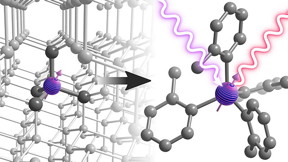 |
| Scientists have developed a way to synthesize tailor-made molecular qubits. Illustration courtesy of Daniel Laorenza, Northwestern University. |
Abstract:
With their ability to harness the strange powers of quantum mechanics, qubits are the basis for potentially world-changing technologies--like powerful new types of computers or ultra-precise sensors.
In new step toward quantum tech, scientists synthesize 'bright' quantum bits: Innovative step by Northwestern, UChicago scientists could boost computing, sensing
Evanston, IL | Posted on December 10th, 2020Qubits (short for quantum bits) are often made of the same semiconducting materials as our everyday electronics. But an interdisciplinary team of chemists and physicists at Northwestern University and the University of Chicago has developed a new method to create tailor-made qubits: by chemically synthesizing molecules that encode quantum information into their magnetic, or "spin," states.
This new bottom-up approach could ultimately lead to quantum systems that have extraordinary flexibility and control, helping pave the way for next-generation quantum technology.
"Chemical synthesis enables atomistic control over qubit structure," said Danna Freedman, professor of chemistry at Northwestern's Weinberg College of Arts and Sciences. "Molecular chemistry creates a new paradigm for quantum information science." She led the research along with her colleague David Awschalom at the University of Chicago's Pritzker School of Molecular Engineering.
The results were published in the journal Science in November.
"This is a proof-of-concept of a powerful and scalable quantum technology," said Awschalom, the Liew Family Professor in Molecular Engineering. "We can harness the techniques of molecular design to create new atomic-scale systems for quantum information science. Bringing these two communities together will broaden interest and has the potential to enhance quantum sensing and computation."
Awschalom also is director of Q-NEXT, a Department of Energy National Quantum Information Science Research Center established in August and led by Argonne National Laboratory. Freedman, along with two other Northwestern faculty, is a member of the new center.
Qubits work by harnessing a phenomenon called superposition. While the classical bits used by conventional computers measure either 1 or 0, a qubit can be both 1 and 0 at the same time.
The team wanted to find a new bottom-up approach to develop molecules whose spin states can be used as qubits and can be readily interfaced with the outside world. To do so, they used organometallic chromium molecules to create a spin state that they could control with light and microwaves.
By exciting the molecules with precisely controlled laser pulses and measuring the light emitted, they could "read" the molecules' spin state after being placed in a superposition--a key requirement for using them in quantum technologies.
By varying just a few different atoms on these molecules through synthetic chemistry, they were also able to modify both their optical and magnetic properties, highlighting the promise for tailor-made molecular qubits.
"Over the last few decades, optically addressable spins in semiconductors have been shown to be extremely powerful for applications including quantum-enhanced sensing," Awschalom said. "Translating the physics of these systems into a molecular architecture opens a powerful toolbox of synthetic chemistry to enable novel functionality that we are only just beginning to explore."
"Our results open up a new area of synthetic chemistry," Freedman said. "We demonstrated that synthetic control of symmetry and bonding creates qubits that can be addressed in the same way as defects in semiconductors. Our bottom-up approach enables both functionalization of individual units as 'designer qubits' for target applications and the creation of arrays of readily controllable quantum states, offering the possibility of scalable quantum systems."
One potential application for these molecules could be quantum sensors that are designed to target specific molecules. Such sensors could find specific cells within the body, detect when food spoils or even spot dangerous chemicals.
This bottom-up approach could also help integrate quantum technologies with existing classical technologies.
"Some of the challenges facing quantum technologies might be able to be overcome with this very different bottom-up approach," said Sam Bayliss, a postdoctoral scholar in the Awschalom group and co-first author on the paper. "Using molecular systems in light-emitting diodes was a transformative shift; perhaps something similar could happen with molecular qubits."
Daniel Laorenza, a graduate student in Freedman's lab and co-first author, sees tremendous potential for chemical innovation in this space. "This chemically specific control over the environment around the qubit provides a valuable feature to integrate optically addressable molecular qubits into a wide range of environments," he said.
####
For more information, please click here
Contacts:
Megan Fellman
847-491-3115
@northwesternu
Copyright © Northwestern University
If you have a comment, please Contact us.Issuers of news releases, not 7th Wave, Inc. or Nanotechnology Now, are solely responsible for the accuracy of the content.
Bookmark:


| Related Links |
| Related News Press |
News and information
 Quantum computer improves AI predictions April 17th, 2026
Flexible sensor gains sensitivity under pressure April 17th, 2026
A reusable chip for particulate matter sensing April 17th, 2026
Detecting vibrational quantum beating in the predissociation dynamics of SF6 using time-resolved photoelectron spectroscopy April 17th, 2026
Quantum Physics
Detecting vibrational quantum beating in the predissociation dynamics of SF6 using time-resolved photoelectron spectroscopy April 17th, 2026
Possible Futures
A fundamentally new therapeutic approach to cystic fibrosis: Nanobody repairs cellular defect April 17th, 2026
UC Irvine physicists discover method to reverse ‘quantum scrambling’ : The work addresses the problem of information loss in quantum computing system April 17th, 2026
Chip Technology
A reusable chip for particulate matter sensing April 17th, 2026
Metasurfaces smooth light to boost magnetic sensing precision January 30th, 2026
Quantum Computing
Quantum computer improves AI predictions April 17th, 2026
UC Irvine physicists discover method to reverse ‘quantum scrambling’ : The work addresses the problem of information loss in quantum computing system April 17th, 2026
Researchers develop molecular qubits that communicate at telecom frequencies October 3rd, 2025
Discoveries
Quantum computer improves AI predictions April 17th, 2026
Flexible sensor gains sensitivity under pressure April 17th, 2026
A reusable chip for particulate matter sensing April 17th, 2026
Detecting vibrational quantum beating in the predissociation dynamics of SF6 using time-resolved photoelectron spectroscopy April 17th, 2026
Announcements
A fundamentally new therapeutic approach to cystic fibrosis: Nanobody repairs cellular defect April 17th, 2026
UC Irvine physicists discover method to reverse ‘quantum scrambling’ : The work addresses the problem of information loss in quantum computing system April 17th, 2026
Interviews/Book Reviews/Essays/Reports/Podcasts/Journals/White papers/Posters
A fundamentally new therapeutic approach to cystic fibrosis: Nanobody repairs cellular defect April 17th, 2026
UC Irvine physicists discover method to reverse ‘quantum scrambling’ : The work addresses the problem of information loss in quantum computing system April 17th, 2026
 |
||
 |
||
| The latest news from around the world, FREE | ||
 |
||
|
|
||
| Premium Products | ||
 |
||
|
Only the news you want to read!
Learn More |
||
 |
||
|
Full-service, expert consulting
Learn More |
||
|
|
||