Home > Press > Atomtronic device could probe boundary between quantum, everyday worlds: Clouds of supercooled atoms offer highly sensitive rotation sensors and tests of quantum mechanics
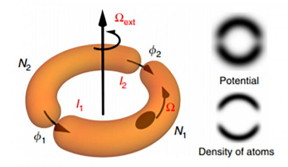 |
| A schematic of an atomtronic SQUID shows semicircular traps that separate clouds of atoms, which quantum mechanically interfere when the device is rotated. CREDIT Los Alamos National Laboratory |
Abstract:
A new device that relies on flowing clouds of ultracold atoms promises potential tests of the intersection between the weirdness of the quantum world and the familiarity of the macroscopic world we experience every day. The atomtronic Superconducting QUantum Interference Device (SQUID) is also potentially useful for ultrasensitive rotation measurements and as a component in quantum computers.
Atomtronic device could probe boundary between quantum, everyday worlds: Clouds of supercooled atoms offer highly sensitive rotation sensors and tests of quantum mechanics
Los Alamos, NM | Posted on July 17th, 2020"In a conventional SQUID, the quantum interference in electron currents can be used to make one of the most sensitive magnetic field detectors," said Changhyun Ryu, a physicist with the Material Physics and Applications Quantum group at Los Alamos National Laboratory. "We use neutral atoms rather than charged electrons. Instead of responding to magnetic fields, the atomtronic version of a SQUID is sensitive to mechanical rotation."
Although small, at only about ten millionths of a meter across, the atomtronic SQUID is thousands of times larger than the molecules and atoms that are typically governed by the laws of quantum mechanics. The relatively large scale of the device lets it test theories of macroscopic realism, which could help explain how the world we are familiar with is compatible with the quantum weirdness that rules the universe on very small scales. On a more pragmatic level, atomtronic SQUIDs could offer highly sensitive rotation sensors or perform calculations as part of quantum computers.
The researchers created the device by trapping cold atoms in a sheet of laser light. A second laser intersecting the sheet "painted" patterns that guided the atoms into two semicircles separated by small gaps known as Josephson Junctions.
When the SQUID is rotated and the Josephson Junctions are moved toward each other, the populations of atoms in the semicircles change as a result of quantum mechanical interference of currents through Josephson Junctions. By counting the atoms in each section of the semicircle, the researchers can very precisely determine the rate the system is rotating.
As the first prototype atomtronic SQUID, the device has a long way to go before it can lead to new guidance systems or insights into the connection between the quantum and classical worlds. The researchers expect that scaling the device up to produce larger diameter atomtronic SQUIDs could open the door to practical applications and new quantum mechanical insights.
####
About Los Alamos National Laboratory
Los Alamos National Laboratory, a multidisciplinary research institution engaged in strategic science on behalf of national security, is managed by Triad, a public service oriented, national security science organization equally owned by its three founding members: Battelle Memorial Institute (Battelle), the Texas A&M University System (TAMUS), and the Regents of the University of California (UC) for the Department of Energy's National Nuclear Security Administration.
Los Alamos enhances national security by ensuring the safety and reliability of the U.S. nuclear stockpile, developing technologies to reduce threats from weapons of mass destruction, and solving problems related to energy, environment, infrastructure, health, and global security concerns.
For more information, please click here
Contacts:
James Riordon
505-551-4004
@LosAlamosNatLab
Copyright © Los Alamos National Laboratory
If you have a comment, please Contact us.Issuers of news releases, not 7th Wave, Inc. or Nanotechnology Now, are solely responsible for the accuracy of the content.
Bookmark:


| Related Links |
| Related News Press |
News and information
 Quantum computer improves AI predictions April 17th, 2026
Flexible sensor gains sensitivity under pressure April 17th, 2026
A reusable chip for particulate matter sensing April 17th, 2026
Detecting vibrational quantum beating in the predissociation dynamics of SF6 using time-resolved photoelectron spectroscopy April 17th, 2026
Quantum Physics
Detecting vibrational quantum beating in the predissociation dynamics of SF6 using time-resolved photoelectron spectroscopy April 17th, 2026
Beyond silicon: Electronics at the scale of a single molecule January 30th, 2026
MXene nanomaterials enter a new dimension Multilayer nanomaterial: MXene flakes created at Drexel University show new promise as 1D scrolls January 30th, 2026
ICFO researchers overcome long-standing bottleneck in single photon detection with twisted 2D materials August 8th, 2025
Superconductivity
Physics
UC Irvine physicists discover method to reverse ‘quantum scrambling’ : The work addresses the problem of information loss in quantum computing system April 17th, 2026
Quantum computers simulate fundamental physics: shedding light on the building blocks of nature June 6th, 2025
Laboratories
Researchers develop molecular qubits that communicate at telecom frequencies October 3rd, 2025
Govt.-Legislation/Regulation/Funding/Policy
Quantum computer improves AI predictions April 17th, 2026
Metasurfaces smooth light to boost magnetic sensing precision January 30th, 2026
New imaging approach transforms study of bacterial biofilms August 8th, 2025
Possible Futures
A fundamentally new therapeutic approach to cystic fibrosis: Nanobody repairs cellular defect April 17th, 2026
UC Irvine physicists discover method to reverse ‘quantum scrambling’ : The work addresses the problem of information loss in quantum computing system April 17th, 2026
Quantum Computing
Quantum computer improves AI predictions April 17th, 2026
UC Irvine physicists discover method to reverse ‘quantum scrambling’ : The work addresses the problem of information loss in quantum computing system April 17th, 2026
Researchers develop molecular qubits that communicate at telecom frequencies October 3rd, 2025
Discoveries
Quantum computer improves AI predictions April 17th, 2026
Flexible sensor gains sensitivity under pressure April 17th, 2026
A reusable chip for particulate matter sensing April 17th, 2026
Detecting vibrational quantum beating in the predissociation dynamics of SF6 using time-resolved photoelectron spectroscopy April 17th, 2026
Announcements
A fundamentally new therapeutic approach to cystic fibrosis: Nanobody repairs cellular defect April 17th, 2026
UC Irvine physicists discover method to reverse ‘quantum scrambling’ : The work addresses the problem of information loss in quantum computing system April 17th, 2026
Interviews/Book Reviews/Essays/Reports/Podcasts/Journals/White papers/Posters
A fundamentally new therapeutic approach to cystic fibrosis: Nanobody repairs cellular defect April 17th, 2026
UC Irvine physicists discover method to reverse ‘quantum scrambling’ : The work addresses the problem of information loss in quantum computing system April 17th, 2026
 |
||
 |
||
| The latest news from around the world, FREE | ||
 |
||
|
|
||
| Premium Products | ||
 |
||
|
Only the news you want to read!
Learn More |
||
 |
||
|
Full-service, expert consulting
Learn More |
||
|
|
||