Home > Press > Towards lasers powerful enough to investigate a new kind of physics: An international team of researchers has demonstrated an innovative technique for increasing the intensity of lasers
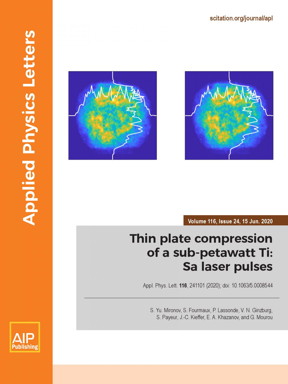 |
| The paper "Thin plate compression of a sub-petawatt Ti:Sa laser pulses" made the cover of the journal Applied Physics Letters, Volume 116, Issue 24 published June 15, 2020. CREDIT AIP Publishing |
Abstract:
In a paper that made the cover of the journal Applied Physics Letters, an international team of researchers has demonstrated an innovative technique for increasing the intensity of lasers. This approach, based on the compression of light pulses, would make it possible to reach a threshold intensity for a new type of physics that has never been explored before: quantum electrodynamics phenomena.
Towards lasers powerful enough to investigate a new kind of physics: An international team of researchers has demonstrated an innovative technique for increasing the intensity of lasers
Barcelona, Spain | Posted on July 3rd, 2020Researchers Jean-Claude Kieffer of the Institut national de la recherche scientifique (INRS), E. A. Khazanov of the Institute of Applied Physics of the Russian Academy of Sciences and in France Gérard Mourou, Professor Emeritus of the Ecole Polytechnique, who was awarded the Nobel Prize in Physics in 2018, have chosen another direction to achieve a power of around 10^23 Watts (W). Rather than increasing the energy of the laser, they decrease the pulse duration to only a few femtoseconds. This would keep the system within a reasonable size and keep operating costs down.
To generate the shortest possible pulse, the researchers are exploiting the effects of non-linear optics. “A laser beam is sent through an extremely thin and perfectly homogeneous glass plate. The particular behaviour of the wave inside this solid medium broadens the spectrum and allows for a shorter pulse when it is recompressed at the exit of the plate,” explains Jean-Claude Kieffer, co-author of the study published online on 15 June 2020 in the journal Applied Physics Letters.
Installed in the Advanced Laser Light Source (ALLS) facility at INRS, the researchers limited themselves to an energy of 3 joules for a 10-femtosecond pulse, or 300 terawatts (1012W). They plan to repeat the experiment with an energy of 13 joules over 5 femtoseconds, or an intensity of 3 petawatts (1015 W). “We would be among the first in the world to achieve this level of power with a laser that has such short pulses,” says Professor Kieffer.
“If we achieve very short pulses, we enter relativistic problem classes. This is an extremely interesting direction that has the potential to take the scientific community to new horizons,” says Professor Kieffer. “It was a very nice piece of work solidifying the paramount potential of this technique,” concludes Gérard Mourou.
####
For more information, please click here
Contacts:
Audrey-Maude Vezina
418-254-2156
@Inrsciences
Copyright © INRS
If you have a comment, please Contact us.Issuers of news releases, not 7th Wave, Inc. or Nanotechnology Now, are solely responsible for the accuracy of the content.
Bookmark:


| Related Links |
| Related News Press |
News and information
 Quantum computer improves AI predictions April 17th, 2026
Flexible sensor gains sensitivity under pressure April 17th, 2026
A reusable chip for particulate matter sensing April 17th, 2026
Detecting vibrational quantum beating in the predissociation dynamics of SF6 using time-resolved photoelectron spectroscopy April 17th, 2026
Physics
UC Irvine physicists discover method to reverse ‘quantum scrambling’ : The work addresses the problem of information loss in quantum computing system April 17th, 2026
Quantum computers simulate fundamental physics: shedding light on the building blocks of nature June 6th, 2025
Govt.-Legislation/Regulation/Funding/Policy
Quantum computer improves AI predictions April 17th, 2026
Metasurfaces smooth light to boost magnetic sensing precision January 30th, 2026
New imaging approach transforms study of bacterial biofilms August 8th, 2025
Possible Futures
A fundamentally new therapeutic approach to cystic fibrosis: Nanobody repairs cellular defect April 17th, 2026
UC Irvine physicists discover method to reverse ‘quantum scrambling’ : The work addresses the problem of information loss in quantum computing system April 17th, 2026
Discoveries
Quantum computer improves AI predictions April 17th, 2026
Flexible sensor gains sensitivity under pressure April 17th, 2026
A reusable chip for particulate matter sensing April 17th, 2026
Detecting vibrational quantum beating in the predissociation dynamics of SF6 using time-resolved photoelectron spectroscopy April 17th, 2026
Announcements
A fundamentally new therapeutic approach to cystic fibrosis: Nanobody repairs cellular defect April 17th, 2026
UC Irvine physicists discover method to reverse ‘quantum scrambling’ : The work addresses the problem of information loss in quantum computing system April 17th, 2026
Interviews/Book Reviews/Essays/Reports/Podcasts/Journals/White papers/Posters
A fundamentally new therapeutic approach to cystic fibrosis: Nanobody repairs cellular defect April 17th, 2026
UC Irvine physicists discover method to reverse ‘quantum scrambling’ : The work addresses the problem of information loss in quantum computing system April 17th, 2026
Grants/Sponsored Research/Awards/Scholarships/Gifts/Contests/Honors/Records
Quantum computer improves AI predictions April 17th, 2026
Detecting vibrational quantum beating in the predissociation dynamics of SF6 using time-resolved photoelectron spectroscopy April 17th, 2026
Metasurfaces smooth light to boost magnetic sensing precision January 30th, 2026
Photonics/Optics/Lasers
Metasurfaces smooth light to boost magnetic sensing precision January 30th, 2026
From sensors to smart systems: the rise of AI-driven photonic noses January 30th, 2026
 |
||
 |
||
| The latest news from around the world, FREE | ||
 |
||
|
|
||
| Premium Products | ||
 |
||
|
Only the news you want to read!
Learn More |
||
 |
||
|
Full-service, expert consulting
Learn More |
||
|
|
||