Home > Press > Teaching physics to neural networks removes 'chaos blindness'
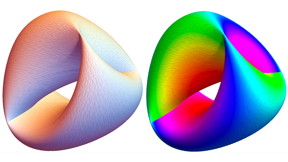 |
| The Hamiltonian flow represented as a donut-like torus; rainbow colors code a fourth dimension. |
Abstract:
Researchers from North Carolina State University have discovered that teaching physics to neural networks enables those networks to better adapt to chaos within their environment. The work has implications for improved artificial intelligence (AI) applications ranging from medical diagnostics to automated drone piloting.
Teaching physics to neural networks removes 'chaos blindness'
Raleigh, NC | Posted on June 19th, 2020Neural networks are an advanced type of AI loosely based on the way that our brains work. Our natural neurons exchange electrical impulses according to the strengths of their connections. Artificial neural networks mimic this behavior by adjusting numerical weights and biases during training sessions to minimize the difference between their actual and desired outputs. For example, a neural network can be trained to identify photos of dogs by sifting through a large number of photos, making a guess about whether the photo is of a dog, seeing how far off it is and then adjusting its weights and biases until they are closer to reality.
The drawback to this neural network training is something called "chaos blindness" - an inability to predict or respond to chaos in a system. Conventional AI is chaos blind. But researchers from NC State's Nonlinear Artificial Intelligence Laboratory (NAIL) have found that incorporating a Hamiltonian function into neural networks better enables them to "see" chaos within a system and adapt accordingly.
Simply put, the Hamiltonian embodies the complete information about a dynamic physical system - the total amount of all the energies present, kinetic and potential. Picture a swinging pendulum, moving back and forth in space over time. Now look at a snapshot of that pendulum. The snapshot cannot tell you where that pendulum is in its arc or where it is going next. Conventional neural networks operate from a snapshot of the pendulum. Neural networks familiar with the Hamiltonian flow understand the entirety of the pendulum's movement - where it is, where it will or could be, and the energies involved in its movement.
In a proof-of-concept project, the NAIL team incorporated Hamiltonian structure into neural networks, then applied them to a known model of stellar and molecular dynamics called the Hénon-Heiles model. The Hamiltonian neural network accurately predicted the dynamics of the system, even as it moved between order and chaos.
"The Hamiltonian is really the 'special sauce' that gives neural networks the ability to learn order and chaos," says John Lindner, visiting researcher at NAIL, professor of physics at The College of Wooster and corresponding author of a paper describing the work. "With the Hamiltonian, the neural network understands underlying dynamics in a way that a conventional network cannot. This is a first step toward physics-savvy neural networks that could help us solve hard problems."
The work appears in Physical Review E and is supported in part by the Office of Naval Research (grant N00014-16-1-3066). NC State postdoctoral researcher Anshul Choudhary is first author. Bill Ditto, professor of physics at NC State, is director of NAIL. Visiting researcher Scott Miller; Sudeshna Sinha, from the Indian Institute of Science Education and Research Mohali; and NC State graduate student Elliott Holliday also contributed to the work.
####
For more information, please click here
Contacts:
Tracey Peake
919-515-6142
@NCStateNews
Copyright © North Carolina State University
If you have a comment, please Contact us.Issuers of news releases, not 7th Wave, Inc. or Nanotechnology Now, are solely responsible for the accuracy of the content.
Bookmark:


| Related Links |
 "Physics enhanced neural networks predict order and chaos"
| Related News Press |
News and information
Quantum computer improves AI predictions April 17th, 2026
Flexible sensor gains sensitivity under pressure April 17th, 2026
A reusable chip for particulate matter sensing April 17th, 2026
Detecting vibrational quantum beating in the predissociation dynamics of SF6 using time-resolved photoelectron spectroscopy April 17th, 2026
Physics
UC Irvine physicists discover method to reverse ‘quantum scrambling’ : The work addresses the problem of information loss in quantum computing system April 17th, 2026
Quantum computers simulate fundamental physics: shedding light on the building blocks of nature June 6th, 2025
Govt.-Legislation/Regulation/Funding/Policy
Quantum computer improves AI predictions April 17th, 2026
Metasurfaces smooth light to boost magnetic sensing precision January 30th, 2026
New imaging approach transforms study of bacterial biofilms August 8th, 2025
Possible Futures
A fundamentally new therapeutic approach to cystic fibrosis: Nanobody repairs cellular defect April 17th, 2026
UC Irvine physicists discover method to reverse ‘quantum scrambling’ : The work addresses the problem of information loss in quantum computing system April 17th, 2026
Discoveries
Quantum computer improves AI predictions April 17th, 2026
Flexible sensor gains sensitivity under pressure April 17th, 2026
A reusable chip for particulate matter sensing April 17th, 2026
Detecting vibrational quantum beating in the predissociation dynamics of SF6 using time-resolved photoelectron spectroscopy April 17th, 2026
Announcements
A fundamentally new therapeutic approach to cystic fibrosis: Nanobody repairs cellular defect April 17th, 2026
UC Irvine physicists discover method to reverse ‘quantum scrambling’ : The work addresses the problem of information loss in quantum computing system April 17th, 2026
Interviews/Book Reviews/Essays/Reports/Podcasts/Journals/White papers/Posters
A fundamentally new therapeutic approach to cystic fibrosis: Nanobody repairs cellular defect April 17th, 2026
UC Irvine physicists discover method to reverse ‘quantum scrambling’ : The work addresses the problem of information loss in quantum computing system April 17th, 2026
Military
Quantum engineers ‘squeeze’ laser frequency combs to make more sensitive gas sensors January 17th, 2025
Chainmail-like material could be the future of armor: First 2D mechanically interlocked polymer exhibits exceptional flexibility and strength January 17th, 2025
Single atoms show their true color July 5th, 2024
NRL charters Navy’s quantum inertial navigation path to reduce drift April 5th, 2024
Artificial Intelligence
Quantum computer improves AI predictions April 17th, 2026
From sensors to smart systems: the rise of AI-driven photonic noses January 30th, 2026
New quantum encoding methods slash circuit complexity in machine learning November 8th, 2024
 |
||
 |
||
| The latest news from around the world, FREE | ||
 |
||
|
|
||
| Premium Products | ||
 |
||
|
Only the news you want to read!
Learn More |
||
 |
||
|
Full-service, expert consulting
Learn More |
||
|
|
||