Home > Press > Single-spin electron paramagnetic resonance spectrum with kilohertz spectral resolution
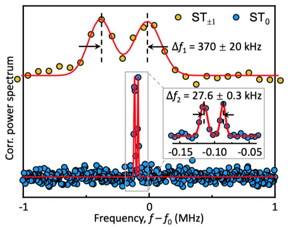 |
| The comparison of the paramagnetic resonance spectrum between the traditional method (top) and the new method (bottom) of noise-insensitive. It clearly shows that the spectral resolution has been significantly improved, and more precise coupling information has been observed. CREDIT DU Jiangfeng et al. |
Abstract:
A high-resolution paramagnetic resonance detection method based on the diamond nitrogen-vacancy (NV) color center quantum sensor was proposed and experimentally implemented in a study led by academician DU Jiangfeng from CAS Key Laboratory of Microscale Magnetic Resonance of University of Science and Technology of China (USTC) of the Chinese Academy of Sciences (CAS).
Single-spin electron paramagnetic resonance spectrum with kilohertz spectral resolution
Hefei, P.R.China | Posted on June 19th, 2020The researchers obtained the single-spin paramagnetic resonance spectrum with kilohertz (kHz) spectral resolution. The study was published in Science Advances.
A major development trend of electron paramagnetic resonance spectroscopy is to get as accurate information as possible from as few samples as possible, which requires enhancing both spatial resolution and spectral resolution. In recent decades, the spatial resolution has been improved considerably, and the detection of single-spin paramagnetic resonance even reached to the nanoscale due to the emergence of new detection technology. However, the spectral resolution remains in the megahertz (MHz) scale because of uncontrollable external noise. Therefore, a new method has to be found in order to break through the current limitation of spectral resolution caused by noise.
One more direct and effective way is to make the measured spin naturally insensitive to external noise. A certain kind of spin states can resist the disturbance of external magnetic field noise, and the spectral lines generated by electron when transiting between these spin states will be narrowed. It has been reported that this phenomenon also exists for a kind of paramagnetic material under zero magnetic field in previous research. However, the detection sensitivity of traditional paramagnetic resonance technology is related to the magnitude of magnetic field, and the detection efficiency in zero field is extremely low, which limits the practical application.
Therefore, the researchers used NV color center quantum sensor in diamond to detect paramagnetic resonance. Previous work has proved that the NV color center still has single-spin level detection sensitivity even at zero field.
In order to observe the narrowing of the spectral lines and realize high-resolution spectroscopy detection, it is also necessary to eliminate the broadening of the spectral line caused by the NV sensor itself. Inspired by the correlation detection in nuclear magnetic resonance (NMR), DU's team designed a paramagnetic resonance correlation sequence suitable for zero field, which greatly suppressed the intrinsic broadening of NV sensors.
Using this new method, they successfully detected the narrowing transition of the electron spin of a single nitrogen atom in diamond in their experiment. Compared with the traditional method, the spectral resolution has been improved considerably by 27 times, reaching 8.6 kHz.
This experimental results showed that the paramagnetic resonance technology based on NV quantum sensor can achieve both high spatial and high spectral resolution. At the same time, this method is not limited by harsh environmental conditions (such as vacuum or low temperature), which is very competitive in biological applications. More detailed information of structural, dynamic changes and local environmental characteristics of a single molecule can be analyzed.
####
For more information, please click here
Contacts:
Jane FAN Qiong
86-551-636-07280
Copyright © University of Science and Technology of China (USTC)
If you have a comment, please Contact us.Issuers of news releases, not 7th Wave, Inc. or Nanotechnology Now, are solely responsible for the accuracy of the content.
Bookmark:


| Related Links |
| Related News Press |
News and information
 Quantum computer improves AI predictions April 17th, 2026
Flexible sensor gains sensitivity under pressure April 17th, 2026
A reusable chip for particulate matter sensing April 17th, 2026
Detecting vibrational quantum beating in the predissociation dynamics of SF6 using time-resolved photoelectron spectroscopy April 17th, 2026
Imaging
Simple algorithm paired with standard imaging tool could predict failure in lithium metal batteries August 8th, 2025
Possible Futures
A fundamentally new therapeutic approach to cystic fibrosis: Nanobody repairs cellular defect April 17th, 2026
UC Irvine physicists discover method to reverse ‘quantum scrambling’ : The work addresses the problem of information loss in quantum computing system April 17th, 2026
Sensors
Flexible sensor gains sensitivity under pressure April 17th, 2026
Tiny nanosheets, big leap: A new sensor detects ethanol at ultra-low levels January 30th, 2026
From sensors to smart systems: the rise of AI-driven photonic noses January 30th, 2026
Sensors innovations for smart lithium-based batteries: advancements, opportunities, and potential challenges August 8th, 2025
Discoveries
Quantum computer improves AI predictions April 17th, 2026
Flexible sensor gains sensitivity under pressure April 17th, 2026
A reusable chip for particulate matter sensing April 17th, 2026
Detecting vibrational quantum beating in the predissociation dynamics of SF6 using time-resolved photoelectron spectroscopy April 17th, 2026
Announcements
A fundamentally new therapeutic approach to cystic fibrosis: Nanobody repairs cellular defect April 17th, 2026
UC Irvine physicists discover method to reverse ‘quantum scrambling’ : The work addresses the problem of information loss in quantum computing system April 17th, 2026
Interviews/Book Reviews/Essays/Reports/Podcasts/Journals/White papers/Posters
A fundamentally new therapeutic approach to cystic fibrosis: Nanobody repairs cellular defect April 17th, 2026
UC Irvine physicists discover method to reverse ‘quantum scrambling’ : The work addresses the problem of information loss in quantum computing system April 17th, 2026
 |
||
 |
||
| The latest news from around the world, FREE | ||
 |
||
|
|
||
| Premium Products | ||
 |
||
|
Only the news you want to read!
Learn More |
||
 |
||
|
Full-service, expert consulting
Learn More |
||
|
|
||