Home > Press > Researchers demonstrate transport of mechanical energy, even through damaged pathways: Topological pump can provide stability for communication technologies
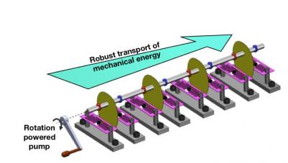 |
| Diagram for temporal pump CREDIT Guarav Bahl |
Abstract:
Most technologies today rely on devices that transport energy in the form of light, radio, or mechanical waves. However, these wave-guiding channels are susceptible to disorder and damage, either in manufacturing or after they are deployed in harsh environments.
Researchers demonstrate transport of mechanical energy, even through damaged pathways: Topological pump can provide stability for communication technologies
Urbana, IL | Posted on May 22nd, 2020Researchers from the University of Illinois at Urbana-Champaign's Grainger College of Engineering have experimentally demonstrated a new way to transport energy even through wave-guides that are defective, and even if the disorder is a transient phenomenon in time. This work could lead to much more robust devices that continue to operate in spite of damage.
Gaurav Bahl, associate professor in mechanical science and engineering, and Taylor Hughes, physics professor, published their findings in Nature Communications. This important work was led by postdoctoral researcher Inbar Grinberg, also in mechanical science and engineering.
Their article, "Robust temporal pumping in a magneto-mechanical topological insulator," details the demonstration of a topological pump, a system that produces on-demand, robust transport of mechanical energy when it is periodically driven in time. The researchers built the topological pump using a one-dimensional magneto-mechanical artificial material, composed of springs, masses, and magnets.
The inspiration for the pump came from Nobel-prize winning physicist David Thouless' work from 1983, in which he proposed a scheme to achieve quantized transport of single particles, e.g. electrons, through a periodic potential, e.g. a chain of atoms. The underlying principle is to make gradual, periodic modulations to the structure of the chain as a function of time. At the completion of each period of the pumping cycle, a single particle must enter the chain on one end, and simultaneously a single particle must exit the other end of the chain. This reliably occurs even if the chain of atoms has some moderate amount of disorder.
This type of system is termed a pump because its technical description evokes a vision of an Archimedes Screw, a hand-cranked water pump with historical references dating back to ancient Egypt.
The Grainger researchers took Thouless' idea and implemented it into a mechanical topological pump. A notable distinction is that their pump transports mechanical energy, not particles or water, across the entire chain in one period of the pumping cycle. Moreover, the pump operates successfully even if the chain has significant amount of disorder in space or time. To complete the analogy to a water screw pump, the researchers powered their demonstration with a rotating crank shaft.
"Ultimately, we would like to extend this demonstration to produce similarly resilient wave-guides for light, sound, and electricity," explained Bahl. "The dream is to put a signal in on one end of a one-dimensional channel, and have guaranteed transport to the other end, in a robust fashion whenever the user wants it. We believe that topological pumps are a great way to do that."
Optical fiber and copper lines form the backbone of all our communication technologies. Presently, moderate damage along such communication channels - e.g. anything but complete disconnection - can reduce signal strength and even produce undesirable reflections, which adversely affect the amount of data that these channels can carry.
The research team believes that topological pumping could be a great solution in these scenarios.
####
For more information, please click here
Contacts:
Guarav Bahl
@EngineeringAtIL
Copyright © University of Illinois Grainger College of Engineering
If you have a comment, please Contact us.Issuers of news releases, not 7th Wave, Inc. or Nanotechnology Now, are solely responsible for the accuracy of the content.
Bookmark:


| Related Links |
| Related News Press |
News and information
 Quantum computer improves AI predictions April 17th, 2026
Flexible sensor gains sensitivity under pressure April 17th, 2026
A reusable chip for particulate matter sensing April 17th, 2026
Detecting vibrational quantum beating in the predissociation dynamics of SF6 using time-resolved photoelectron spectroscopy April 17th, 2026
Wireless/telecommunications/RF/Antennas/Microwaves
Researchers develop molecular qubits that communicate at telecom frequencies October 3rd, 2025
HKUST researchers develop new integration technique for efficient coupling of III-V and silicon February 16th, 2024
Possible Futures
A fundamentally new therapeutic approach to cystic fibrosis: Nanobody repairs cellular defect April 17th, 2026
UC Irvine physicists discover method to reverse ‘quantum scrambling’ : The work addresses the problem of information loss in quantum computing system April 17th, 2026
Discoveries
Quantum computer improves AI predictions April 17th, 2026
Flexible sensor gains sensitivity under pressure April 17th, 2026
A reusable chip for particulate matter sensing April 17th, 2026
Detecting vibrational quantum beating in the predissociation dynamics of SF6 using time-resolved photoelectron spectroscopy April 17th, 2026
Materials/Metamaterials/Magnetoresistance
First real-time observation of two-dimensional melting process: Researchers at Mainz University unveil new insights into magnetic vortex structures August 8th, 2025
Researchers unveil a groundbreaking clay-based solution to capture carbon dioxide and combat climate change June 6th, 2025
A 1960s idea inspires NBI researchers to study hitherto inaccessible quantum states June 6th, 2025
Institute for Nanoscience hosts annual proposal planning meeting May 16th, 2025
Announcements
A fundamentally new therapeutic approach to cystic fibrosis: Nanobody repairs cellular defect April 17th, 2026
UC Irvine physicists discover method to reverse ‘quantum scrambling’ : The work addresses the problem of information loss in quantum computing system April 17th, 2026
Interviews/Book Reviews/Essays/Reports/Podcasts/Journals/White papers/Posters
A fundamentally new therapeutic approach to cystic fibrosis: Nanobody repairs cellular defect April 17th, 2026
UC Irvine physicists discover method to reverse ‘quantum scrambling’ : The work addresses the problem of information loss in quantum computing system April 17th, 2026
 |
||
 |
||
| The latest news from around the world, FREE | ||
 |
||
|
|
||
| Premium Products | ||
 |
||
|
Only the news you want to read!
Learn More |
||
 |
||
|
Full-service, expert consulting
Learn More |
||
|
|
||