Home > Press > A combined optical transmitter and receiver: Bidirectional optical signal transmission between two identical devices using perovskite diodes
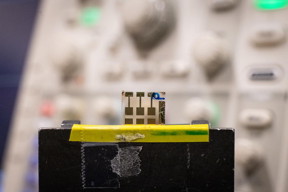 |
| The tiny unit that can both receive and transmit optical signals. CREDIT Magnus Johansson |
Abstract:
Researchers at Linköping University, together with colleagues in China, have developed a tiny unit that is both an optical transmitter and a receiver. "This is highly significant for the miniaturisation of optoelectronic systems", says LiU professor Feng Gao.
A combined optical transmitter and receiver: Bidirectional optical signal transmission between two identical devices using perovskite diodes
Linköping, Sweden | Posted on April 3rd, 2020Chunxiong Bao, postdoc at Linköping University, types in a sentence on a computer screen, and the same sentence immediately appears on the neighbouring screen, optically transferred from one diode to another. The diode is made from perovskite, one of a large family of materials defined by their special crystal structure.
Perovskites consist of metal and halogen and have proved to be versatile semiconductors that are easy and cheap to manufacture. They also have the useful property of both detecting and emitting light. Researchers at Linköping University, together with colleagues in China, have now developed a diode that can be directed in two directions: it can receive optical signals and it can just as easily transmit them. This means that text and photographs can be wirelessly transmitted from one unit to the other and back again, using two identical units. And so rapidly that we experience it as happening in real time.
In the autumn of 2018, Chunxiong Bao discovered the correct perovskite to build a photodetector showing higher performance and longer lifetime, and described this in an article in Advanced Materials. The development of light-emitting diodes from perovskites has also made rapid progress. Weidong Xu, postdoc at Linköping University, developed a perovskite light-emitting diode with an efficiency of 21% last year, which is among the best in the world, and published the results in Nature Photonics. What the scientists have now achieved is to develop a perovskite that comprises a light-emitting diode and that at the same time is an excellent photodetector.
All optical communication requires rapid and reliable photodetectors - devices that capture light and convert it into an electrical signal. Current optical communication systems use photodetectors made from materials such as silicon and indium gallium arsenide. These are, however, expensive and they cannot be used in applications that require low weight, flexibility, or large surfaces.
"In order to demonstrate the potential of our diode with double function, we have built a monolithic sensor that detects heart beats in real time, and an optical, bidirectional communication system", says Chunxiong Bao, researcher in the Division of Biomolecular and Organic Electronics.
This tiny unit that can both receive and transmit optical signals provides a unique opportunity to simplify and shrink the functionality of the current optical systems, in particular given that it can also be integrated with traditional electronic circuits.
"We have managed to integrate optical signal transmission and reception into one circuit, something that makes it possible to transmit optical signals in both directions between two identical circuits. This is valuable in the field of miniaturised and integrated optoelectronics", says Feng Gao, professor and head of research at the Division of Biomolecular and Organic Electronics.
####
For more information, please click here
Contacts:
Feng Gao
46-132-86882
@liu_universitet
Copyright © Linköping University
If you have a comment, please Contact us.Issuers of news releases, not 7th Wave, Inc. or Nanotechnology Now, are solely responsible for the accuracy of the content.
Bookmark:


| Related Links |
 The results have been published in Nature Electronics.
| Related News Press |
News and information
Quantum computer improves AI predictions April 17th, 2026
Flexible sensor gains sensitivity under pressure April 17th, 2026
A reusable chip for particulate matter sensing April 17th, 2026
Detecting vibrational quantum beating in the predissociation dynamics of SF6 using time-resolved photoelectron spectroscopy April 17th, 2026
Perovskites
KAIST researchers introduce new and improved, next-generation perovskite solar cell November 8th, 2024
Efficient and stable hybrid perovskite-organic light-emitting diodes with external quantum efficiency exceeding 40 per cent July 5th, 2024
Govt.-Legislation/Regulation/Funding/Policy
Quantum computer improves AI predictions April 17th, 2026
Metasurfaces smooth light to boost magnetic sensing precision January 30th, 2026
New imaging approach transforms study of bacterial biofilms August 8th, 2025
Possible Futures
A fundamentally new therapeutic approach to cystic fibrosis: Nanobody repairs cellular defect April 17th, 2026
UC Irvine physicists discover method to reverse ‘quantum scrambling’ : The work addresses the problem of information loss in quantum computing system April 17th, 2026
Chip Technology
A reusable chip for particulate matter sensing April 17th, 2026
Metasurfaces smooth light to boost magnetic sensing precision January 30th, 2026
Optical computing/Photonic computing
ICFO researchers overcome long-standing bottleneck in single photon detection with twisted 2D materials August 8th, 2025
Programmable electron-induced color router array May 14th, 2025
Discoveries
Quantum computer improves AI predictions April 17th, 2026
Flexible sensor gains sensitivity under pressure April 17th, 2026
A reusable chip for particulate matter sensing April 17th, 2026
Detecting vibrational quantum beating in the predissociation dynamics of SF6 using time-resolved photoelectron spectroscopy April 17th, 2026
Announcements
A fundamentally new therapeutic approach to cystic fibrosis: Nanobody repairs cellular defect April 17th, 2026
UC Irvine physicists discover method to reverse ‘quantum scrambling’ : The work addresses the problem of information loss in quantum computing system April 17th, 2026
Grants/Sponsored Research/Awards/Scholarships/Gifts/Contests/Honors/Records
Quantum computer improves AI predictions April 17th, 2026
Detecting vibrational quantum beating in the predissociation dynamics of SF6 using time-resolved photoelectron spectroscopy April 17th, 2026
Metasurfaces smooth light to boost magnetic sensing precision January 30th, 2026
Photonics/Optics/Lasers
Metasurfaces smooth light to boost magnetic sensing precision January 30th, 2026
From sensors to smart systems: the rise of AI-driven photonic noses January 30th, 2026
Research partnerships
Lab to industry: InSe wafer-scale breakthrough for future electronics August 8th, 2025
HKU physicists uncover hidden order in the quantum world through deconfined quantum critical points April 25th, 2025
 |
||
 |
||
| The latest news from around the world, FREE | ||
 |
||
|
|
||
| Premium Products | ||
 |
||
|
Only the news you want to read!
Learn More |
||
 |
||
|
Full-service, expert consulting
Learn More |
||
|
|
||