Home > Press > Molecular factories: The combination between nature and chemistry is functional
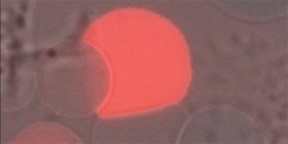 |
| In molecular factories injected into zebrafish embryos, a colour reaction occurs when the trapped enzyme (peroxidase) is working. The researchers thus prove that the combination of synthetic organelles and natural vesicles also works in the living organism. |
Abstract:
Researchers at the University of Basel have succeeded in developing molecular factories that mimic nature. To achieve this they loaded artificial organelles inside micrometer-sized natural blisters (vesicles) produced by cells. These molecular factories remain intact even after injection into an animal model and demonstrate no toxicity, as the team report in the scientific journal Advanced Science.
In molecular factories injected into zebrafish embryos, a color reaction occurs when the trapped enzyme (peroxidase) is working. The researchers thus prove that the combination of synthetic organelles and natural vesicles also works in the living organism.
CREDIT
University of Basel
Molecular factories: The combination between nature and chemistry is functional
Basel, Switzerland | Posted on January 10th, 2020Within the cells, the actual biological factories, the molecules of life are assembled. The assembly lines of cells are small compartments called organelles, where a large variety of chemical reactions take place either inside or between them. For medical applications, molecular factories acting as artificial cells would ideally beused - to produce missing or required molecules or drugs.
Soft, synthetic capsules
Collaboration between the Department of Chemistry at the University of Basel, the Swiss Nanoscience Institute, and the NCCR Molecular Systems Engineering made the successful development of such molecular factories possible. First, researchers led by Professor Cornelia Palivan and Professor Wolfgang Meier designed artificial organelles, that is distinct compartments of cells. They loaded these soft, synthetic capsules with enzymes and equipped them with membrane proteins that act like "gates". These gates allow molecules involved in the enzymatic reaction to enter and leave the capsule.
Subsequently, the natural cells were feed with these artificial organelles. After stimulation, the cells produced natural micrometer-size vesicles. These possess a natural cell membrane and cytoplasm, enclose the artificial organelles and can therefore function as a molecular factory.
Zebra fish embryos as an animal model
The molecular factories were injected into zebra fish embryos by researchers from the group led by Professor Jörg Huwyler (Pharmazentrum of the University of Basel). In this animal model, they produced the desired compound, which was catalyzed by the enzyme in the artificial organelle. The viability of the animal was not compromised by the injection.
"This combination of natural vesicles and small synthetic organelles is what makes the molecular factory: Reactions that take place inside produce an end product, as also happens inside cells," explain Dr. Tomaz Einfalt and Dr. Martina Garni, first authors of the paper.
Within the molecular factories, multiple components can be made and assembled into the end product. The biosynthetic vesicles can also transfer components from one cell to the other. Different molecular factories can be combined so that complex structures with high functionality can be created - the first step toward producing artificial cells in the laboratory or in living organisms.
####
For more information, please click here
Contacts:
Reto Caluori
41-612-072-495
@UniBasel_en
Copyright © University of Basel
If you have a comment, please Contact us.Issuers of news releases, not 7th Wave, Inc. or Nanotechnology Now, are solely responsible for the accuracy of the content.
Bookmark:


| Related Links |
| Related News Press |
News and information
 Quantum computer improves AI predictions April 17th, 2026
Flexible sensor gains sensitivity under pressure April 17th, 2026
A reusable chip for particulate matter sensing April 17th, 2026
Detecting vibrational quantum beating in the predissociation dynamics of SF6 using time-resolved photoelectron spectroscopy April 17th, 2026
Chemistry
Projecting light to dispense liquids: A new route to ultra-precise microdroplets January 30th, 2026
From sensors to smart systems: the rise of AI-driven photonic noses January 30th, 2026
"Nanoreactor" cage uses visible light for catalytic and ultra-selective cross-cycloadditions October 3rd, 2025
Cambridge chemists discover simple way to build bigger molecules – one carbon at a time June 6th, 2025
Possible Futures
A fundamentally new therapeutic approach to cystic fibrosis: Nanobody repairs cellular defect April 17th, 2026
UC Irvine physicists discover method to reverse ‘quantum scrambling’ : The work addresses the problem of information loss in quantum computing system April 17th, 2026
Nanomedicine
A fundamentally new therapeutic approach to cystic fibrosis: Nanobody repairs cellular defect April 17th, 2026
New molecular technology targets tumors and simultaneously silences two ‘undruggable’ cancer genes August 8th, 2025
New imaging approach transforms study of bacterial biofilms August 8th, 2025
Electrifying results shed light on graphene foam as a potential material for lab grown cartilage June 6th, 2025
Announcements
A fundamentally new therapeutic approach to cystic fibrosis: Nanobody repairs cellular defect April 17th, 2026
UC Irvine physicists discover method to reverse ‘quantum scrambling’ : The work addresses the problem of information loss in quantum computing system April 17th, 2026
Interviews/Book Reviews/Essays/Reports/Podcasts/Journals/White papers/Posters
A fundamentally new therapeutic approach to cystic fibrosis: Nanobody repairs cellular defect April 17th, 2026
UC Irvine physicists discover method to reverse ‘quantum scrambling’ : The work addresses the problem of information loss in quantum computing system April 17th, 2026
Nanobiotechnology
A fundamentally new therapeutic approach to cystic fibrosis: Nanobody repairs cellular defect April 17th, 2026
New molecular technology targets tumors and simultaneously silences two ‘undruggable’ cancer genes August 8th, 2025
New imaging approach transforms study of bacterial biofilms August 8th, 2025
Electrifying results shed light on graphene foam as a potential material for lab grown cartilage June 6th, 2025
 |
||
 |
||
| The latest news from around the world, FREE | ||
 |
||
|
|
||
| Premium Products | ||
 |
||
|
Only the news you want to read!
Learn More |
||
 |
||
|
Full-service, expert consulting
Learn More |
||
|
|
||