Home > Press > Clusters of gold atoms form peculiar pyramidal shape
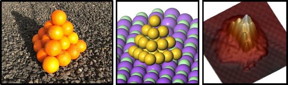 |
| A model of 20 oranges is compared with the theoretical and experimental structure. CREDIT KU Leuven |
Abstract:
Clusters composed of a few atoms tend to be spherical. They are usually organized in shells of atoms around a central atom. This is the case for many elements, but not for gold! Experiments and advanced computations have shown that freestanding clusters of twenty gold atoms take on a pyramidal shape. They have a triangular ground plane made up of ten neatly arranged atoms, with additional triangles of six and three atoms, topped by a single atom [see figure where a model of twenty oranges is compared with the theoretical and experimental structure].
Clusters of gold atoms form peculiar pyramidal shape
Leuven, Belgium | Posted on January 3rd, 2020The remarkable tetrahedral structure has now been imaged for the first time with a scanning tunnelling microscope. This high-tech microscope can visualise single atoms. It operates at extremely low temperatures (269 degrees below zero) and uses quantum tunnelling of an electrical current from a sharp scanning metallic tip through the cluster and into the support. Quantum tunnelling is a process where electrical current flows between two conductors without any physical contact between them.
The researchers used intense plasmas in a complex vacuum chamber setup to sputter gold atoms from a macroscopic piece of gold. "Part of the sputtered atoms grow together to small particles of a few up to a few tens of atoms, due to a process comparable with condensation of water molecules to droplets," says Zhe Li, the main author of the paper, currently at the Harbin Institute of Technology, Shenzhen. "We selected a beam of clusters consisting of exactly twenty gold atoms. We landed these species with one of the triangular facets onto a substrate covered with a very thin layer of kitchen salt (NaCl), precisely three atom layers thick."
The study also revealed the peculiar electronic structure of the small gold pyramid. Similar to noble gas atoms or aromatic molecules, the cluster only has completely filled electron orbitals, which makes them much less reactive than clusters with one or a few atoms more or less.
Gold clusters ranging from a few to several dozens of atoms in size are known to possess remarkable properties.
The new discovery helps scientists evaluate the catalytic and optical performances of these clusters, which is relevant for designing cluster-based catalyst and optical devices. Recent applications of clusters include utilisation in fuel cells and carbon capture.
####
For more information, please click here
Contacts:
Peter Lievens
32-476-481-955
@LeuvenU
Copyright © KU Leuven
If you have a comment, please Contact us.Issuers of news releases, not 7th Wave, Inc. or Nanotechnology Now, are solely responsible for the accuracy of the content.
Bookmark:


| Related Links |
| Related News Press |
News and information
 Quantum computer improves AI predictions April 17th, 2026
Flexible sensor gains sensitivity under pressure April 17th, 2026
A reusable chip for particulate matter sensing April 17th, 2026
Detecting vibrational quantum beating in the predissociation dynamics of SF6 using time-resolved photoelectron spectroscopy April 17th, 2026
Physics
UC Irvine physicists discover method to reverse ‘quantum scrambling’ : The work addresses the problem of information loss in quantum computing system April 17th, 2026
Chemistry
Projecting light to dispense liquids: A new route to ultra-precise microdroplets January 30th, 2026
From sensors to smart systems: the rise of AI-driven photonic noses January 30th, 2026
"Nanoreactor" cage uses visible light for catalytic and ultra-selective cross-cycloadditions October 3rd, 2025
Cambridge chemists discover simple way to build bigger molecules – one carbon at a time June 6th, 2025
Possible Futures
A fundamentally new therapeutic approach to cystic fibrosis: Nanobody repairs cellular defect April 17th, 2026
UC Irvine physicists discover method to reverse ‘quantum scrambling’ : The work addresses the problem of information loss in quantum computing system April 17th, 2026
Discoveries
Quantum computer improves AI predictions April 17th, 2026
Flexible sensor gains sensitivity under pressure April 17th, 2026
A reusable chip for particulate matter sensing April 17th, 2026
Detecting vibrational quantum beating in the predissociation dynamics of SF6 using time-resolved photoelectron spectroscopy April 17th, 2026
Announcements
A fundamentally new therapeutic approach to cystic fibrosis: Nanobody repairs cellular defect April 17th, 2026
UC Irvine physicists discover method to reverse ‘quantum scrambling’ : The work addresses the problem of information loss in quantum computing system April 17th, 2026
Interviews/Book Reviews/Essays/Reports/Podcasts/Journals/White papers/Posters
A fundamentally new therapeutic approach to cystic fibrosis: Nanobody repairs cellular defect April 17th, 2026
UC Irvine physicists discover method to reverse ‘quantum scrambling’ : The work addresses the problem of information loss in quantum computing system April 17th, 2026
Energy
Sensors innovations for smart lithium-based batteries: advancements, opportunities, and potential challenges August 8th, 2025
Simple algorithm paired with standard imaging tool could predict failure in lithium metal batteries August 8th, 2025
Fuel Cells
Deciphering local microstrain-induced optimization of asymmetric Fe single atomic sites for efficient oxygen reduction August 8th, 2025
Current and Future Developments in Nanomaterials and Carbon Nanotubes: Applications of Nanomaterials in Energy Storage and Electronics October 28th, 2022
 |
||
 |
||
| The latest news from around the world, FREE | ||
 |
||
|
|
||
| Premium Products | ||
 |
||
|
Only the news you want to read!
Learn More |
||
 |
||
|
Full-service, expert consulting
Learn More |
||
|
|
||