Home > Press > New laser technique images quantum world in a trillionth of a second: Technique captures a process that commonly causes electrical resistance in materials while, in others, can cause the absence of resistance, or superconductivity
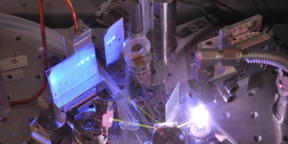 |
| Ultrafast pulses of extreme ultraviolet light are created in a gas jet of white plasma, and are visible as blue dots on a phosphor screen as well as yellow beams from oxygen fluorescence. CREDIT Research to Reality |
Abstract:
For the first time, researchers have been able to record, frame-by-frame, how an electron interacts with certain atomic vibrations in a solid. The technique captures a process that commonly causes electrical resistance in materials while, in others, can cause the exact opposite--the absence of resistance, or superconductivity.
New laser technique images quantum world in a trillionth of a second: Technique captures a process that commonly causes electrical resistance in materials while, in others, can cause the absence of resistance, or superconductivity
Vancouver, Canada | Posted on December 13th, 2019"The way electrons interact with each other and their microscopic environment determines the properties of all solids," said MengXing Na, a University of British Columbia (UBC) PhD student and co-lead author of the study, published last week in Science. "Once we identify the dominant microscopic interactions that define a material's properties, we can find ways to 'turn up' or 'down' the interaction to elicit useful electronic properties."
Controlling these interactions is important for the technological exploitation of quantum materials, including superconductors, which are used in MRI machines, high-speed magnetic levitation trains, and could one day revolutionize how energy is transported.
At tiny scales, atoms in all solids vibrate constantly. Collisions between an electron and an atom can be seen as a 'scattering' event between the electron and the vibration, called a phonon. The scattering can cause the electron to change both its direction and its energy. Such electron-phonon interactions lie at the heart of many exotic phases of matter, where materials display unique properties.
With the support of the Gordon and Betty Moore Foundation, the team at UBC's Stewart Blusson Quantum Matter Institute (SBQMI) developed a new extreme-ultraviolet laser source to enable a technique called time-resolved photoemission spectroscopy for visualizing electron scattering processes at ultrafast timescales.
"Using an ultrashort laser pulse, we excited individual electrons away from their usual equilibrium environment," said Na. "Using a second laser pulse as an effective camera shutter, we captured how the electrons scatter with surrounding atoms on timescales faster than a trillionth of a second. Owing to the very high sensitivity of our setup, we were able to measure directly--for the first time--how the excited electrons interacted with a specific atomic vibration, or phonon."
The researchers performed the experiment on graphite, a crystalline form of carbon and the parent compound of carbon nanotubes, Bucky balls and graphene. Carbon-based electronics is a growing industry, and the scattering processes that contribute to electrical resistance may limit their application in nanoelectronics.
The approach leverages a unique laser facility conceived by David Jones and Andrea Damascelli, and developed by co-lead author Arthur Mills, at the UBC-Moore Centre for Ultrafast Quantum Matter. The study was also supported by theoretical collaborations with the groups of Thomas Devereaux at Stanford University and Alexander Kemper at North Carolina State University.
"Thanks to recent advances in pulsed-laser sources, we're only just beginning to visualize the dynamic properties of quantum materials," said Jones, a professor with UBC's SBQMI and department of Physics and Astronomy.
"By applying these pioneering techniques, we're now poised to reveal the elusive mystery of high-temperature superconductivity and many other fascinating phenomena of quantum matter," said Damascelli, scientific director of SBQMI.
###
The work was supported by the Gordon and Betty Moore Foundation's EPiQS Initiative (Grant GBMF4779 to A.D. and D.J.J.), the Natural Sciences and Engineering Research Council, Canada Foundation for Innovation, the B.C. Knowledge Development Fund, and the Canada First Research Excellence Fund.
####
For more information, please click here
Contacts:
Chris Balma
604-202-5047
@UBCnews
Copyright © University of British Columbia
If you have a comment, please Contact us.Issuers of news releases, not 7th Wave, Inc. or Nanotechnology Now, are solely responsible for the accuracy of the content.
Bookmark:


| Related Links |
| Related News Press |
News and information
 Quantum computer improves AI predictions April 17th, 2026
Flexible sensor gains sensitivity under pressure April 17th, 2026
A reusable chip for particulate matter sensing April 17th, 2026
Detecting vibrational quantum beating in the predissociation dynamics of SF6 using time-resolved photoelectron spectroscopy April 17th, 2026
Quantum Physics
Detecting vibrational quantum beating in the predissociation dynamics of SF6 using time-resolved photoelectron spectroscopy April 17th, 2026
Beyond silicon: Electronics at the scale of a single molecule January 30th, 2026
Superconductivity
Imaging
Govt.-Legislation/Regulation/Funding/Policy
Quantum computer improves AI predictions April 17th, 2026
Metasurfaces smooth light to boost magnetic sensing precision January 30th, 2026
New imaging approach transforms study of bacterial biofilms August 8th, 2025
Possible Futures
A fundamentally new therapeutic approach to cystic fibrosis: Nanobody repairs cellular defect April 17th, 2026
UC Irvine physicists discover method to reverse ‘quantum scrambling’ : The work addresses the problem of information loss in quantum computing system April 17th, 2026
Nanoelectronics
Lab to industry: InSe wafer-scale breakthrough for future electronics August 8th, 2025
Interdisciplinary: Rice team tackles the future of semiconductors Multiferroics could be the key to ultralow-energy computing October 6th, 2023
Key element for a scalable quantum computer: Physicists from Forschungszentrum Jülich and RWTH Aachen University demonstrate electron transport on a quantum chip September 23rd, 2022
Reduced power consumption in semiconductor devices September 23rd, 2022
Discoveries
Quantum computer improves AI predictions April 17th, 2026
Flexible sensor gains sensitivity under pressure April 17th, 2026
A reusable chip for particulate matter sensing April 17th, 2026
Detecting vibrational quantum beating in the predissociation dynamics of SF6 using time-resolved photoelectron spectroscopy April 17th, 2026
Announcements
A fundamentally new therapeutic approach to cystic fibrosis: Nanobody repairs cellular defect April 17th, 2026
UC Irvine physicists discover method to reverse ‘quantum scrambling’ : The work addresses the problem of information loss in quantum computing system April 17th, 2026
Interviews/Book Reviews/Essays/Reports/Podcasts/Journals/White papers/Posters
A fundamentally new therapeutic approach to cystic fibrosis: Nanobody repairs cellular defect April 17th, 2026
UC Irvine physicists discover method to reverse ‘quantum scrambling’ : The work addresses the problem of information loss in quantum computing system April 17th, 2026
Tools
Metasurfaces smooth light to boost magnetic sensing precision January 30th, 2026
From sensors to smart systems: the rise of AI-driven photonic noses January 30th, 2026
Japan launches fully domestically produced quantum computer: Expo visitors to experience quantum computing firsthand August 8th, 2025
Grants/Sponsored Research/Awards/Scholarships/Gifts/Contests/Honors/Records
Quantum computer improves AI predictions April 17th, 2026
Detecting vibrational quantum beating in the predissociation dynamics of SF6 using time-resolved photoelectron spectroscopy April 17th, 2026
Metasurfaces smooth light to boost magnetic sensing precision January 30th, 2026
Quantum nanoscience
Beyond silicon: Electronics at the scale of a single molecule January 30th, 2026
MXene nanomaterials enter a new dimension Multilayer nanomaterial: MXene flakes created at Drexel University show new promise as 1D scrolls January 30th, 2026
ICFO researchers overcome long-standing bottleneck in single photon detection with twisted 2D materials August 8th, 2025
 |
||
 |
||
| The latest news from around the world, FREE | ||
 |
||
|
|
||
| Premium Products | ||
 |
||
|
Only the news you want to read!
Learn More |
||
 |
||
|
Full-service, expert consulting
Learn More |
||
|
|
||