Home > Press > Nanoparticles may have bigger impact on the environment than previously thought: Non-antibacterial nanoparticles can cause resistance in bacteria
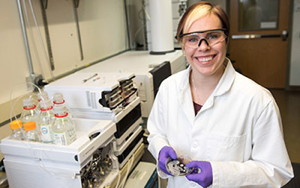 |
| Chemist Erin Carlson led research showing that nanoparticles can cause resistance in bacteria. Credit: Patrick O'Leary, University of Minnesota |
Abstract:
Over the last two decades, nanotechnology has improved many everyday products, from microelectronics to sunscreens. Nanoparticles (particles just a few hundred atoms in size) are ending up in the environment by the ton, but scientists are still unclear about the long-term effects of these super-small particles.
Nanoparticles may have bigger impact on the environment than previously thought: Non-antibacterial nanoparticles can cause resistance in bacteria
Alexandria, VA | Posted on October 17th, 2019In a first-of-its-kind study, published in Chemical Science, researchers have shown that nanoparticles may have a bigger impact on the environment than previously thought.
Researchers at the University of Minnesota, through the National Science Foundation Center for Sustainable Nanotechnology, found that a common, non-disease-causing bacterium in the environment, Shewanella oneidensis MR-1, developed rapid resistance when repeatedly exposed to nanoparticles used in making lithium ion batteries, the rechargeable batteries used in portable electronics and electric vehicles. The resistance means that the fundamental biochemistry and biology of the bacteria are changing.
The results of the study are unusual, the researchers say. Bacterial resistance usually occurs because bacteria become resistant to attempts to kill them. In this case, the nanoparticles used in lithium ion batteries were not intended to kill bacteria. This is the first report of non-antibacterial nanoparticles causing resistance in bacteria.
Bacteria are prevalent in lakes and soil where there is a delicate balance of organisms. Other organisms feed on the microbes, and the resistant bacteria could have effects scientists can't yet predict.
"Research that advances technology and sustains our environment is a priority for the Division of Chemistry," said Michelle Bushey, program director for the NSF Chemical Centers for Innovation Program. "This work reveals the unexplored and long-term impacts some nanoparticles have on the living organisms around us. This discovery at the chemistry-biology interface is a first step toward developing new sustainable materials and practices and providing the groundwork for possible remediation approaches."
####
For more information, please click here
Contacts:
NSF Public Affairs, (703) 292-7090
Copyright © National Science Foundation
If you have a comment, please Contact us.Issuers of news releases, not 7th Wave, Inc. or Nanotechnology Now, are solely responsible for the accuracy of the content.
Bookmark:


| Related Links |
| Related News Press |
News and information
 Quantum computer improves AI predictions April 17th, 2026
Flexible sensor gains sensitivity under pressure April 17th, 2026
A reusable chip for particulate matter sensing April 17th, 2026
Detecting vibrational quantum beating in the predissociation dynamics of SF6 using time-resolved photoelectron spectroscopy April 17th, 2026
Govt.-Legislation/Regulation/Funding/Policy
Quantum computer improves AI predictions April 17th, 2026
Metasurfaces smooth light to boost magnetic sensing precision January 30th, 2026
New imaging approach transforms study of bacterial biofilms August 8th, 2025
Possible Futures
A fundamentally new therapeutic approach to cystic fibrosis: Nanobody repairs cellular defect April 17th, 2026
UC Irvine physicists discover method to reverse ‘quantum scrambling’ : The work addresses the problem of information loss in quantum computing system April 17th, 2026
Discoveries
Quantum computer improves AI predictions April 17th, 2026
Flexible sensor gains sensitivity under pressure April 17th, 2026
A reusable chip for particulate matter sensing April 17th, 2026
Detecting vibrational quantum beating in the predissociation dynamics of SF6 using time-resolved photoelectron spectroscopy April 17th, 2026
Announcements
A fundamentally new therapeutic approach to cystic fibrosis: Nanobody repairs cellular defect April 17th, 2026
UC Irvine physicists discover method to reverse ‘quantum scrambling’ : The work addresses the problem of information loss in quantum computing system April 17th, 2026
Interviews/Book Reviews/Essays/Reports/Podcasts/Journals/White papers/Posters
A fundamentally new therapeutic approach to cystic fibrosis: Nanobody repairs cellular defect April 17th, 2026
UC Irvine physicists discover method to reverse ‘quantum scrambling’ : The work addresses the problem of information loss in quantum computing system April 17th, 2026
Safety-Nanoparticles/Risk management
Tiny nanosheets, big leap: A new sensor detects ethanol at ultra-low levels January 30th, 2026
Onion-like nanoparticles found in aircraft exhaust May 14th, 2025
Closing the gaps — MXene-coating filters can enhance performance and reusability February 28th, 2025
 |
||
 |
||
| The latest news from around the world, FREE | ||
 |
||
|
|
||
| Premium Products | ||
 |
||
|
Only the news you want to read!
Learn More |
||
 |
||
|
Full-service, expert consulting
Learn More |
||
|
|
||