Home > Press > Electronic chip mimics the brain to make memories in a flash: Engineers have mimicked the human brain with an electronic chip that uses light to create and modify memories.
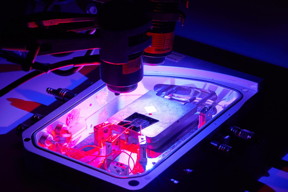 |
| The new chip is based on an ultra-thin material that changes electrical resistance in response to different wavelengths of light. CREDIT RMIT University |
Abstract:
Researchers from RMIT University drew inspiration from an emerging tool in biotechnology - optogenetics - to develop a device that replicates the way the brain stores and loses information.
Electronic chip mimics the brain to make memories in a flash: Engineers have mimicked the human brain with an electronic chip that uses light to create and modify memories.
Melbourne, Australia | Posted on July 19th, 2019Optogenetics allows scientists to delve into the body's electrical system with incredible precision, using light to manipulate neurons so that they can be turned on or off.
The new chip is based on an ultra-thin material that changes electrical resistance in response to different wavelengths of light, enabling it to mimic the way that neurons work to store and delete information in the brain.
Research team leader Dr Sumeet Walia said the technology moves us closer towards artificial intelligence (AI) that can harness the brain's full sophisticated functionality.
"Our optogenetically-inspired chip imitates the fundamental biology of nature's best computer - the human brain," Walia said.
"Being able to store, delete and process information is critical for computing, and the brain does this extremely efficiently.
"We're able to simulate the brain's neural approach simply by shining different colours onto our chip.
"This technology takes us further on the path towards fast, efficient and secure light-based computing.
"It also brings us an important step closer to the realisation of a bionic brain - a brain-on-a-chip that can learn from its environment just like humans do."
Dr Taimur Ahmed, lead author of the study published in Advanced Functional Materials, said being able to replicate neural behavior on an artificial chip offered exciting avenues for research across sectors.
"This technology creates tremendous opportunities for researchers to better understand the brain and how it's affected by disorders that disrupt neural connections, like Alzheimer's disease and dementia," Ahmed said.
The researchers, from the Functional Materials and Microsystems Research Group at RMIT, have also demonstrated the chip can perform logic operations - information processing - ticking another box for brain-like functionality.
Developed at RMIT's MicroNano Research Facility, the technology is compatible with existing electronics and has also been demonstrated on a flexible platform, for integration into wearable electronics.
How the chip works:
Neural connections happen in the brain through electrical impulses. When tiny energy spikes reach a certain threshold of voltage, the neurons bind together - and you've started creating a memory.
On the chip, light is used to generate a photocurrent. Switching between colors causes the current to reverse direction from positive to negative.
This direction switch, or polarity shift, is equivalent to the binding and breaking of neural connections, a mechanism that enables neurons to connect (and induce learning) or inhibit (and induce forgetting).
This is akin to optogenetics, where light-induced modification of neurons causes them to either turn on or off, enabling or inhibiting connections to the next neuron in the chain.
To develop the technology, the researchers used a material called black phosphorus (BP) that can be inherently defective in nature.
This is usually a problem for optoelectronics, but with precision engineering the researchers were able to harness the defects to create new functionality.
"Defects are usually looked on as something to be avoided, but here we're using them to create something novel and useful," Ahmed said.
"It's a creative approach to finding solutions for the technical challenges we face."
####
For more information, please click here
Contacts:
Michael Quin
61-499-515-417
Copyright © RMIT University
If you have a comment, please Contact us.Issuers of news releases, not 7th Wave, Inc. or Nanotechnology Now, are solely responsible for the accuracy of the content.
Bookmark:


| Related Links |
| Related News Press |
News and information
 Quantum computer improves AI predictions April 17th, 2026
Flexible sensor gains sensitivity under pressure April 17th, 2026
A reusable chip for particulate matter sensing April 17th, 2026
Detecting vibrational quantum beating in the predissociation dynamics of SF6 using time-resolved photoelectron spectroscopy April 17th, 2026
Possible Futures
A fundamentally new therapeutic approach to cystic fibrosis: Nanobody repairs cellular defect April 17th, 2026
UC Irvine physicists discover method to reverse ‘quantum scrambling’ : The work addresses the problem of information loss in quantum computing system April 17th, 2026
Chip Technology
A reusable chip for particulate matter sensing April 17th, 2026
Metasurfaces smooth light to boost magnetic sensing precision January 30th, 2026
Optical computing/Photonic computing
ICFO researchers overcome long-standing bottleneck in single photon detection with twisted 2D materials August 8th, 2025
Programmable electron-induced color router array May 14th, 2025
Discoveries
Quantum computer improves AI predictions April 17th, 2026
Flexible sensor gains sensitivity under pressure April 17th, 2026
A reusable chip for particulate matter sensing April 17th, 2026
Detecting vibrational quantum beating in the predissociation dynamics of SF6 using time-resolved photoelectron spectroscopy April 17th, 2026
Announcements
A fundamentally new therapeutic approach to cystic fibrosis: Nanobody repairs cellular defect April 17th, 2026
UC Irvine physicists discover method to reverse ‘quantum scrambling’ : The work addresses the problem of information loss in quantum computing system April 17th, 2026
Interviews/Book Reviews/Essays/Reports/Podcasts/Journals/White papers/Posters
A fundamentally new therapeutic approach to cystic fibrosis: Nanobody repairs cellular defect April 17th, 2026
UC Irvine physicists discover method to reverse ‘quantum scrambling’ : The work addresses the problem of information loss in quantum computing system April 17th, 2026
Artificial Intelligence
Quantum computer improves AI predictions April 17th, 2026
From sensors to smart systems: the rise of AI-driven photonic noses January 30th, 2026
New quantum encoding methods slash circuit complexity in machine learning November 8th, 2024
Photonics/Optics/Lasers
Metasurfaces smooth light to boost magnetic sensing precision January 30th, 2026
From sensors to smart systems: the rise of AI-driven photonic noses January 30th, 2026
 |
||
 |
||
| The latest news from around the world, FREE | ||
 |
||
|
|
||
| Premium Products | ||
 |
||
|
Only the news you want to read!
Learn More |
||
 |
||
|
Full-service, expert consulting
Learn More |
||
|
|
||