Home > Press > High-speed surveillance in solar cells catches recombination red-handed: Researchers at Osaka University introduce a new time-resolved microscopy method that allows them to monitor the trajectories of fast-moving charged particles at unprecedented rates
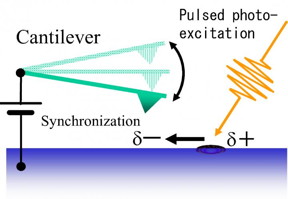 |
| This is a schematic diagram illustrating the principle of tip-synchronized time-resolved electrostatic force microscopy. CREDIT Osaka University |
Abstract:
A research team at Osaka University has developed an improved method for producing microscope images that can spot speedy electrons zipping through nanomaterials used in solar panels. By applying laser light to the device at just the right times, this group achieved nanosecond time resolution for the first time while maintaining the magnification. This work could improve the quality of photovoltaic materials for devices such as solar panels by helping to identify and eliminate inefficiencies during the manufacturing process.
High-speed surveillance in solar cells catches recombination red-handed: Researchers at Osaka University introduce a new time-resolved microscopy method that allows them to monitor the trajectories of fast-moving charged particles at unprecedented rates
Osaka, Japan | Posted on February 21st, 2019Surveillance cameras are ubiquitous, and extremely valuable to the police when trying to catch thieves. However, cameras that record only a single movie frame per minute would be useless for apprehending speedy robbers who can make their getaway in less than sixty seconds. Solar panels harness the power of the sun when electrons become excited to a higher energy level, leaving a void, or "hole", behind. However, if an electron recombines with a hole before reaching the electrode, the harvested energy is lost, "robbing" the device of critical efficiency.
Currently available microscopy methods are too slow to catch the miscreants in the act. So the team at Osaka used electrostatic force microscopy (EFM), in which a tiny, vibrating cantilever tip is made sensitive to electric charges passing beneath it. EFM is still usually too slow to watch electrons and holes in motion, but their key innovation was to apply synchronized laser pulses that hit the sample at the same point of the cantilever's oscillation. By altering the delay time between the start of the cycle and the laser pulse, they were able to create a movie with frames as fast as 300 nanoseconds. "This is the first time anyone was able to combine nanosecond time resolution without sacrificing magnification," said lead author Kento Araki.
When the researchers probed the "scene of the crime", they were able to obtain video evidence of recombination as it was occurring. This method may be extremely useful for designing more efficient solar panels by reducing the energy losses due to recombination. According to senior author Takuya Matsumoto, "the research is also potentially useful for the study of catalysts or batteries that depend on light activation."
####
About Osaka University
Osaka University was founded in 1931 as one of the seven imperial universities of Japan and now has expanded to one of Japan's leading comprehensive universities. The University has now embarked on open research revolution from a position as Japan's most innovative university and among the most innovative institutions in the world according to Reuters 2015 Top 100 Innovative Universities and the Nature Index Innovation 2017. The university's ability to innovate from the stage of fundamental research through the creation of useful technology with economic impact stems from its broad disciplinary spectrum. Website: https://resou.osaka-u.ac.jp/en/top
For more information, please click here
Contacts:
Saori Obayashi
81-661-055-886
Copyright © Osaka University
If you have a comment, please Contact us.Issuers of news releases, not 7th Wave, Inc. or Nanotechnology Now, are solely responsible for the accuracy of the content.
Bookmark:


| Related Links |
| Related News Press |
News and information
 Quantum computer improves AI predictions April 17th, 2026
Flexible sensor gains sensitivity under pressure April 17th, 2026
A reusable chip for particulate matter sensing April 17th, 2026
Detecting vibrational quantum beating in the predissociation dynamics of SF6 using time-resolved photoelectron spectroscopy April 17th, 2026
Imaging
Simple algorithm paired with standard imaging tool could predict failure in lithium metal batteries August 8th, 2025
Possible Futures
A fundamentally new therapeutic approach to cystic fibrosis: Nanobody repairs cellular defect April 17th, 2026
UC Irvine physicists discover method to reverse ‘quantum scrambling’ : The work addresses the problem of information loss in quantum computing system April 17th, 2026
Discoveries
Quantum computer improves AI predictions April 17th, 2026
Flexible sensor gains sensitivity under pressure April 17th, 2026
A reusable chip for particulate matter sensing April 17th, 2026
Detecting vibrational quantum beating in the predissociation dynamics of SF6 using time-resolved photoelectron spectroscopy April 17th, 2026
Announcements
A fundamentally new therapeutic approach to cystic fibrosis: Nanobody repairs cellular defect April 17th, 2026
UC Irvine physicists discover method to reverse ‘quantum scrambling’ : The work addresses the problem of information loss in quantum computing system April 17th, 2026
Interviews/Book Reviews/Essays/Reports/Podcasts/Journals/White papers/Posters
A fundamentally new therapeutic approach to cystic fibrosis: Nanobody repairs cellular defect April 17th, 2026
UC Irvine physicists discover method to reverse ‘quantum scrambling’ : The work addresses the problem of information loss in quantum computing system April 17th, 2026
Tools
Metasurfaces smooth light to boost magnetic sensing precision January 30th, 2026
From sensors to smart systems: the rise of AI-driven photonic noses January 30th, 2026
Japan launches fully domestically produced quantum computer: Expo visitors to experience quantum computing firsthand August 8th, 2025
Energy
Sensors innovations for smart lithium-based batteries: advancements, opportunities, and potential challenges August 8th, 2025
Simple algorithm paired with standard imaging tool could predict failure in lithium metal batteries August 8th, 2025
Solar/Photovoltaic
Spinel-type sulfide semiconductors to operate the next-generation LEDs and solar cells For solar-cell absorbers and green-LED source October 3rd, 2025
KAIST researchers introduce new and improved, next-generation perovskite solar cell November 8th, 2024
Groundbreaking precision in single-molecule optoelectronics August 16th, 2024
Development of zinc oxide nanopagoda array photoelectrode: photoelectrochemical water-splitting hydrogen production January 12th, 2024
 |
||
 |
||
| The latest news from around the world, FREE | ||
 |
||
|
|
||
| Premium Products | ||
 |
||
|
Only the news you want to read!
Learn More |
||
 |
||
|
Full-service, expert consulting
Learn More |
||
|
|
||