Home > Press > Ultra-sensitive sensor with gold nanoparticle array
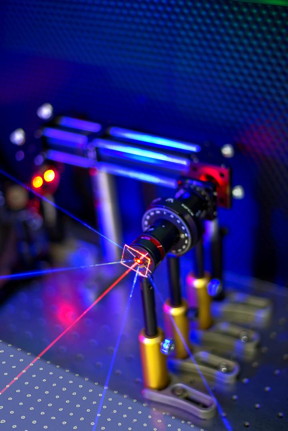 |
| In the sensor, gold nanodisks are arranged in squares, shown bottom-left. The arrangement causes the sensor to emit UV light (in blue). CREDIT V.K Valev and D.C Hooper |
Abstract:
Scientists from the University of Bath (UK) and Northwestern University (USA) have developed a new type of sensor platform using a gold nanoparticle array, which is 100 times more sensitive than current similar sensors.
Ultra-sensitive sensor with gold nanoparticle array
Bath, UK | Posted on January 9th, 2019The sensor is made up of a series of gold disk-shaped nanoparticles on a glass slide. The team at Bath discovered that when they shone an infra-red laser at a precise arrangement of the particles, they started to emit unusual amounts of ultra violet (UV) light.
This mechanism for generating UV light is affected by molecules binding to the surface of the nanoparticles, providing a means of sensing a very small amount of material.
The researchers, from the University of Bath's Department of Physics, hope that in the future they can use the technology to develop new ultra-sensitive sensors for air pollution or for medical diagnostics.
Dr Ventsislav Valev, Royal Society Research Fellow and Reader in Physics at the University of Bath, led the work with Research Associate David Hooper.
He explained: "This new mechanism has great potential for detecting small molecules. It is 100 times more sensitive than current methods.
"The gold nanoparticle disks are arranged on a glass slide in a very precise array - changing the thickness and separation of the disks completely changes the detected signal.
"When molecules bind to the surface of a gold nanoparticle, they affect the electrons at the gold surface, causing them to change the amount of UV light they emit.
"The amount of UV light emitted would depend on the type of molecules that bind to the surface.
"This technique could enable ultra-sensitive detection of molecules in tiny volumes. It could in the future be used for detecting very low concentrations of biological markers for the early diagnostic screening for diseases, such as cancer."
The study has demonstrated the proof of principle for this new sensing mechanism. The team would next like to test the sensing of various types of chemicals and expects the technique to be available to other scientists to use within five years.
###
The nanoparticles were fabricated by researchers at Northwestern University, Illinois (USA).
####
For more information, please click here
Contacts:
Vicky Just
07-966-341-357
Copyright © University of Bath
If you have a comment, please Contact us.Issuers of news releases, not 7th Wave, Inc. or Nanotechnology Now, are solely responsible for the accuracy of the content.
Bookmark:


| Related Links |
| Related News Press |
News and information
 Quantum computer improves AI predictions April 17th, 2026
Flexible sensor gains sensitivity under pressure April 17th, 2026
A reusable chip for particulate matter sensing April 17th, 2026
Detecting vibrational quantum beating in the predissociation dynamics of SF6 using time-resolved photoelectron spectroscopy April 17th, 2026
Cancer
New molecular technology targets tumors and simultaneously silences two ‘undruggable’ cancer genes August 8th, 2025
Ben-Gurion University of the Negev researchers several steps closer to harnessing patient's own T-cells to fight off cancer June 6th, 2025
Self-propelled protein-based nanomotors for enhanced cancer therapy by inducing ferroptosis June 6th, 2025
Possible Futures
A fundamentally new therapeutic approach to cystic fibrosis: Nanobody repairs cellular defect April 17th, 2026
UC Irvine physicists discover method to reverse ‘quantum scrambling’ : The work addresses the problem of information loss in quantum computing system April 17th, 2026
Nanomedicine
A fundamentally new therapeutic approach to cystic fibrosis: Nanobody repairs cellular defect April 17th, 2026
New molecular technology targets tumors and simultaneously silences two ‘undruggable’ cancer genes August 8th, 2025
New imaging approach transforms study of bacterial biofilms August 8th, 2025
Electrifying results shed light on graphene foam as a potential material for lab grown cartilage June 6th, 2025
Sensors
Flexible sensor gains sensitivity under pressure April 17th, 2026
Tiny nanosheets, big leap: A new sensor detects ethanol at ultra-low levels January 30th, 2026
From sensors to smart systems: the rise of AI-driven photonic noses January 30th, 2026
Sensors innovations for smart lithium-based batteries: advancements, opportunities, and potential challenges August 8th, 2025
Discoveries
Quantum computer improves AI predictions April 17th, 2026
Flexible sensor gains sensitivity under pressure April 17th, 2026
A reusable chip for particulate matter sensing April 17th, 2026
Detecting vibrational quantum beating in the predissociation dynamics of SF6 using time-resolved photoelectron spectroscopy April 17th, 2026
Announcements
A fundamentally new therapeutic approach to cystic fibrosis: Nanobody repairs cellular defect April 17th, 2026
UC Irvine physicists discover method to reverse ‘quantum scrambling’ : The work addresses the problem of information loss in quantum computing system April 17th, 2026
Interviews/Book Reviews/Essays/Reports/Podcasts/Journals/White papers/Posters
A fundamentally new therapeutic approach to cystic fibrosis: Nanobody repairs cellular defect April 17th, 2026
UC Irvine physicists discover method to reverse ‘quantum scrambling’ : The work addresses the problem of information loss in quantum computing system April 17th, 2026
Nanobiotechnology
A fundamentally new therapeutic approach to cystic fibrosis: Nanobody repairs cellular defect April 17th, 2026
New molecular technology targets tumors and simultaneously silences two ‘undruggable’ cancer genes August 8th, 2025
New imaging approach transforms study of bacterial biofilms August 8th, 2025
Electrifying results shed light on graphene foam as a potential material for lab grown cartilage June 6th, 2025
Research partnerships
Lab to industry: InSe wafer-scale breakthrough for future electronics August 8th, 2025
HKU physicists uncover hidden order in the quantum world through deconfined quantum critical points April 25th, 2025
 |
||
 |
||
| The latest news from around the world, FREE | ||
 |
||
|
|
||
| Premium Products | ||
 |
||
|
Only the news you want to read!
Learn More |
||
 |
||
|
Full-service, expert consulting
Learn More |
||
|
|
||