Home > Press > Physicists uncover new competing state of matter in superconducting material
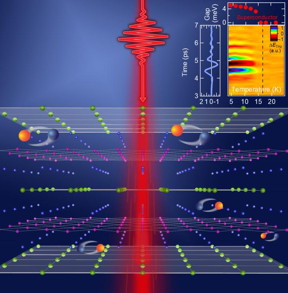 |
| Ames Laboratory researchers used laser pulses of less than a trillionth of a second in much the same way as flash photography, in order to take a series of snapshots. Called terahertz spectroscopy, this technique can be thought of as "laser strobe photography" where many quick images reveal the subtle movement of electron pairings inside the materials using long wavelength far-infrared light. CREDIT US Department of Energy, Ames Laboratory |
Abstract:
A team of experimentalists at the U.S. Department of Energy's Ames Laboratory and theoreticians at University of Alabama Birmingham discovered a remarkably long-lived new state of matter in an iron pnictide superconductor, which reveals a laser-induced formation of collective behaviors that compete with superconductivity.
Physicists uncover new competing state of matter in superconducting material
Ames, IA | Posted on January 4th, 2019"Superconductivity is a strange state of matter, in which the pairing of electrons makes them move faster," said Jigang Wang, Ames Laboratory physicist and Iowa State University professor. "One of the big problems we are trying to solve is how different states in a material compete for those electrons, and how to balance competition and cooperation to increase temperature at which a superconducting state emerges."
To get a closer look, Wang and his team used laser pulses of less than a trillionth of a second in much the same way as flash photography, in order to take a series of snapshots. Called terahertz spectroscopy, this technique can be thought of as "laser strobe photography" where many quick images reveal the subtle movement of electron pairings inside the materials using long wavelength far-infrared light.
"The ability to see these real time dynamics and fluctuations is a way to understanding them better, so that we can create better superconducting electronics and energy-efficient devices," said Wang.
###
The research is further discussed in a paper, "Non-equilibrium Pair Breaking in Ba(Fe1-xCox)2As2 Superconductors: Evidence for Formation of Photo-Induced Excitonic State," authored by X. Yang, L. Luo, M. Mootz, A. Patz, S. L. Bud'ko, P. C. Canfield, I. E. Perakis, and J. Wang; and published in Physical Review Letters.
Ames Laboratory scientist and ISU professor Paul Canfield, expert in the design and characterization of iron pnictides, created the single crystal sample used in this investigation. Martin Mootz and Ilias E. Perakis, at University of Alabama Birmingham, developed the theory to explain the observation.
Spectroscopy work was supported by the U.S. Army Research Office. Sample growth and characterization was supported the U.S. Department of Department of Energy's (DOE) Office of Science. Theory work at the University of Alabama, Birmingham was also supported by the DOE.
####
About Ames Laboratory
Ames Laboratory is a U.S. Department of Energy Office of Science national laboratory operated by Iowa State University. Ames Laboratory creates innovative materials, technologies and energy solutions. We use our expertise, unique capabilities and interdisciplinary collaborations to solve global problems.
DOE's Office of Science is the single largest supporter of basic research in the physical sciences in the United States, and is working to address some of the most pressing challenges of our time. For more information, please visit science.energy.gov.
For more information, please click here
Contacts:
Laura Millsaps
Copyright © Ames Laboratory
If you have a comment, please Contact us.Issuers of news releases, not 7th Wave, Inc. or Nanotechnology Now, are solely responsible for the accuracy of the content.
Bookmark:


| Related News Press |
News and information
 Quantum computer improves AI predictions April 17th, 2026
Flexible sensor gains sensitivity under pressure April 17th, 2026
A reusable chip for particulate matter sensing April 17th, 2026
Detecting vibrational quantum beating in the predissociation dynamics of SF6 using time-resolved photoelectron spectroscopy April 17th, 2026
Superconductivity
MXene nanomaterials enter a new dimension Multilayer nanomaterial: MXene flakes created at Drexel University show new promise as 1D scrolls January 30th, 2026
Physics
UC Irvine physicists discover method to reverse ‘quantum scrambling’ : The work addresses the problem of information loss in quantum computing system April 17th, 2026
Govt.-Legislation/Regulation/Funding/Policy
Quantum computer improves AI predictions April 17th, 2026
Metasurfaces smooth light to boost magnetic sensing precision January 30th, 2026
New imaging approach transforms study of bacterial biofilms August 8th, 2025
Possible Futures
A fundamentally new therapeutic approach to cystic fibrosis: Nanobody repairs cellular defect April 17th, 2026
UC Irvine physicists discover method to reverse ‘quantum scrambling’ : The work addresses the problem of information loss in quantum computing system April 17th, 2026
Discoveries
Quantum computer improves AI predictions April 17th, 2026
Flexible sensor gains sensitivity under pressure April 17th, 2026
A reusable chip for particulate matter sensing April 17th, 2026
Detecting vibrational quantum beating in the predissociation dynamics of SF6 using time-resolved photoelectron spectroscopy April 17th, 2026
Materials/Metamaterials/Magnetoresistance
First real-time observation of two-dimensional melting process: Researchers at Mainz University unveil new insights into magnetic vortex structures August 8th, 2025
Researchers unveil a groundbreaking clay-based solution to capture carbon dioxide and combat climate change June 6th, 2025
A 1960s idea inspires NBI researchers to study hitherto inaccessible quantum states June 6th, 2025
Institute for Nanoscience hosts annual proposal planning meeting May 16th, 2025
Announcements
A fundamentally new therapeutic approach to cystic fibrosis: Nanobody repairs cellular defect April 17th, 2026
UC Irvine physicists discover method to reverse ‘quantum scrambling’ : The work addresses the problem of information loss in quantum computing system April 17th, 2026
Interviews/Book Reviews/Essays/Reports/Podcasts/Journals/White papers/Posters
A fundamentally new therapeutic approach to cystic fibrosis: Nanobody repairs cellular defect April 17th, 2026
UC Irvine physicists discover method to reverse ‘quantum scrambling’ : The work addresses the problem of information loss in quantum computing system April 17th, 2026
Energy
Sensors innovations for smart lithium-based batteries: advancements, opportunities, and potential challenges August 8th, 2025
Simple algorithm paired with standard imaging tool could predict failure in lithium metal batteries August 8th, 2025
 |
||
 |
||
| The latest news from around the world, FREE | ||
 |
||
|
|
||
| Premium Products | ||
 |
||
|
Only the news you want to read!
Learn More |
||
 |
||
|
Full-service, expert consulting
Learn More |
||
|
|
||