Home > Press > Plastic waste disintegrates into nanoparticles, study finds
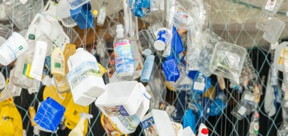 |
| Photo: Inger Ekström |
Abstract:
There is a considerable risk that plastic waste in the environment releases nano-sized particles known as nanoplastics, according to a new study from Lund University. The researchers studied what happened when takeaway coffee cup lids, for example, were subjected to mechanical breakdown, in an effort to mimic the degradation that happens to plastic in the ocean.
Plastic waste disintegrates into nanoparticles, study finds
Lund, Sweden | Posted on December 28th, 2018The majority of all marine debris is plastic. Calculations have shown that ten per cent of all plastic produced globally ends up in the sea. This plastic waste is subjected to both chemical and mechanical degradation. The sun's UV rays contribute to the degradation, as do waves, which cause plastic waste to grind against stones on the water's edge, against the sea floor or against other debris.
Is there a risk that this plastic waste disintegrates to the extent that nanoplastics are released? The research community is divided on whether the degradation process stops at slightly larger plastic fragments - microplastics - or actually continues and creates even smaller particles. The researchers behind the study have now investigated this issue by subjecting plastic material to mechanical degradation under experimental conditions.
"We have been able to show that the mechanical effect on the plastic causes the disintegration of plastic down to nano-sized plastic fragments," says Tommy Cedervall, chemistry researcher at Lund University.
The study relates to the larger issue of what happens to plastic in the environment and how plastic can affect animals and humans. Plastic nano-sized particles are a few millionths of a millimetre, i.e. extremely small particles, so small that they have been shown to reach far into living organisms' bodies.
Last year, in an earlier study from Lund University, researchers showed that nano-sized plastic particles can enter the brains of fish and that this causes brain damage which probably disturbs fish behaviour. Although the study was conducted in a laboratory environment, it indicates that nanoplastics can lead to adverse consequences.
The emphasis of a number of other recent studies from the research community has been on microplastics and their increased distribution among organisms. There are now intense attempts to also identify nanoplastics in the environment.
"It's important to begin mapping what happens to disintegrated plastic in nature", concludes Tommy Cedervall.
####
For more information, please click here
Contacts:
Tommy Cedervall
46-701-473-355
Copyright © Lund University
If you have a comment, please Contact us.Issuers of news releases, not 7th Wave, Inc. or Nanotechnology Now, are solely responsible for the accuracy of the content.
Bookmark:


| Related News Press |
News and information
 Quantum computer improves AI predictions April 17th, 2026
Flexible sensor gains sensitivity under pressure April 17th, 2026
A reusable chip for particulate matter sensing April 17th, 2026
Detecting vibrational quantum beating in the predissociation dynamics of SF6 using time-resolved photoelectron spectroscopy April 17th, 2026
Possible Futures
A fundamentally new therapeutic approach to cystic fibrosis: Nanobody repairs cellular defect April 17th, 2026
UC Irvine physicists discover method to reverse ‘quantum scrambling’ : The work addresses the problem of information loss in quantum computing system April 17th, 2026
Discoveries
Quantum computer improves AI predictions April 17th, 2026
Flexible sensor gains sensitivity under pressure April 17th, 2026
A reusable chip for particulate matter sensing April 17th, 2026
Detecting vibrational quantum beating in the predissociation dynamics of SF6 using time-resolved photoelectron spectroscopy April 17th, 2026
Materials/Metamaterials/Magnetoresistance
First real-time observation of two-dimensional melting process: Researchers at Mainz University unveil new insights into magnetic vortex structures August 8th, 2025
Researchers unveil a groundbreaking clay-based solution to capture carbon dioxide and combat climate change June 6th, 2025
A 1960s idea inspires NBI researchers to study hitherto inaccessible quantum states June 6th, 2025
Institute for Nanoscience hosts annual proposal planning meeting May 16th, 2025
Announcements
A fundamentally new therapeutic approach to cystic fibrosis: Nanobody repairs cellular defect April 17th, 2026
UC Irvine physicists discover method to reverse ‘quantum scrambling’ : The work addresses the problem of information loss in quantum computing system April 17th, 2026
Interviews/Book Reviews/Essays/Reports/Podcasts/Journals/White papers/Posters
A fundamentally new therapeutic approach to cystic fibrosis: Nanobody repairs cellular defect April 17th, 2026
UC Irvine physicists discover method to reverse ‘quantum scrambling’ : The work addresses the problem of information loss in quantum computing system April 17th, 2026
Environment
A reusable chip for particulate matter sensing April 17th, 2026
Researchers unveil a groundbreaking clay-based solution to capture carbon dioxide and combat climate change June 6th, 2025
Safety-Nanoparticles/Risk management
Tiny nanosheets, big leap: A new sensor detects ethanol at ultra-low levels January 30th, 2026
Onion-like nanoparticles found in aircraft exhaust May 14th, 2025
Closing the gaps — MXene-coating filters can enhance performance and reusability February 28th, 2025
 |
||
 |
||
| The latest news from around the world, FREE | ||
 |
||
|
|
||
| Premium Products | ||
 |
||
|
Only the news you want to read!
Learn More |
||
 |
||
|
Full-service, expert consulting
Learn More |
||
|
|
||