Home > Press > Superfluidity: what is it and why does it matter?
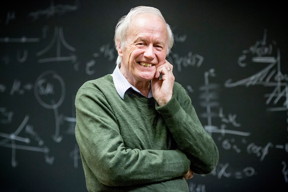 |
| Illinois physics professor and Nobel Laureate Anthony Leggett talks about the 1938 discovery of superfluidity and its significance to low-temperature physics. Photo by L. Brian Stauffer |
Abstract:
2018 marks the 80th anniversary of the landmark physics discovery of superfluidity. News Bureau physical sciences editor Lois Yoksoulian asked University of Illinois physics professor and 2003 Nobel Prize winner Anthony Leggett about the significance of the historic finding.
Superfluidity: what is it and why does it matter?
Champaign, IL | Posted on December 20th, 2018What is superfluidity?
The most obvious definition of superfluidity is the ability of a liquid to flow through narrow channels without apparent friction. However, this is actually only one of a number of interesting properties. For example, if we place a liquid into a bucket and slowly rotate it while cooled into the superfluid phase, the liquid, which initially rotates with the bucket, will appear to come to rest. We call this phenomenon the Hess-Fairbank effect.
Today, superfluidity is something that we can directly observe in helium isotopes and in ultra-cold atomic gases. It is conjectured to occur in extraterrestrial systems, such as neutron stars, and there is circumstantial evidence supporting its existence in other terrestrial systems, such as excitons, which are bound electron-hole pairs found in semiconductors.
How was superfluidity discovered?
Helium-4 was liquefied in 1908, but it was only in 1936 and 1937 that scientists recognized that below the temperature of 2.17 degrees absolute – which we now call the lambda point – it possessed properties different from any other substance known at the time. In particular, the thermal conductivity of the low-temperature phase, now known as He-II, is very large, which suggests a convection mechanism, but with anomalously low viscosity.
In 1938, Pyotr Kapitza in Moscow and John Allen and Don Misener at the University of Cambridge simultaneously performed a direct measurement of the behavior of the viscosity of the helium contained in a thin tube as a function of temperature. Both groups found a drop in He-II, which appeared discontinuously at the lambda point. On the basis of the analogy with superconductivity, Kapitza coined the term superfluidity for this behavior.
What is the relationship between superfluidity and superconductivity?
According to our modern understanding, superconductivity is nothing more than superfluidity occurring in an electrically charged system. Just as a superfluid liquid can flow forever down a narrow capillary without apparent friction, so can a current, once started in a superconducting ring – or at least for a time much longer than the age of the Universe!
The analog of the Hess-Fairbank effect mentioned earlier is a bit less intuitive. The direct analog is that when a magnetic field is applied to the surface of a metal, the normal, non-superconducting state has little effect. However, when the metal is in the superconducting state, it will induce an electric current, or diamagnetism. In a thin ring, this would be the end of the story, but in a bulk sample this current induces its own magnetic field in a direction opposite to the external one, and eventually the latter is screened out of the metal completely. This is the so-called Meissner effect, and leads to spectacular phenomena such as superconducting levitation.
What types of advancements have been made as a result of understanding superfluidity?
The direct uses of superfluid helium are actually rather few. Because of its extremely high thermal conductivity, the superfluid phase of helium-4 is an excellent coolant for high-field magnets, and both isotopes have some applications as detectors of exotic particles. While there are other unique indirect applications of superfluidity, they are most useful in the development of theory and understanding high-temperature superconductivity.
####
For more information, please click here
Contacts:
LOIS YOKSOULIAN
PHYSICAL SCIENCES EDITOR
217-244-2788
Anthony Leggett
Copyright © University of Illinois at Urbana-Champaign
If you have a comment, please Contact us.Issuers of news releases, not 7th Wave, Inc. or Nanotechnology Now, are solely responsible for the accuracy of the content.
Bookmark:


| Related News Press |
News and information
 Quantum computer improves AI predictions April 17th, 2026
Flexible sensor gains sensitivity under pressure April 17th, 2026
A reusable chip for particulate matter sensing April 17th, 2026
Detecting vibrational quantum beating in the predissociation dynamics of SF6 using time-resolved photoelectron spectroscopy April 17th, 2026
Superconductivity
MXene nanomaterials enter a new dimension Multilayer nanomaterial: MXene flakes created at Drexel University show new promise as 1D scrolls January 30th, 2026
Physics
UC Irvine physicists discover method to reverse ‘quantum scrambling’ : The work addresses the problem of information loss in quantum computing system April 17th, 2026
Possible Futures
A fundamentally new therapeutic approach to cystic fibrosis: Nanobody repairs cellular defect April 17th, 2026
UC Irvine physicists discover method to reverse ‘quantum scrambling’ : The work addresses the problem of information loss in quantum computing system April 17th, 2026
Chip Technology
A reusable chip for particulate matter sensing April 17th, 2026
Metasurfaces smooth light to boost magnetic sensing precision January 30th, 2026
Discoveries
Quantum computer improves AI predictions April 17th, 2026
Flexible sensor gains sensitivity under pressure April 17th, 2026
A reusable chip for particulate matter sensing April 17th, 2026
Detecting vibrational quantum beating in the predissociation dynamics of SF6 using time-resolved photoelectron spectroscopy April 17th, 2026
Announcements
A fundamentally new therapeutic approach to cystic fibrosis: Nanobody repairs cellular defect April 17th, 2026
UC Irvine physicists discover method to reverse ‘quantum scrambling’ : The work addresses the problem of information loss in quantum computing system April 17th, 2026
Aerospace/Space
Decoding hydrogen‑bond network of electrolyte for cryogenic durable aqueous zinc‑ion batteries January 30th, 2026
ICFO researchers overcome long-standing bottleneck in single photon detection with twisted 2D materials August 8th, 2025
Onion-like nanoparticles found in aircraft exhaust May 14th, 2025
Grants/Sponsored Research/Awards/Scholarships/Gifts/Contests/Honors/Records
Quantum computer improves AI predictions April 17th, 2026
Detecting vibrational quantum beating in the predissociation dynamics of SF6 using time-resolved photoelectron spectroscopy April 17th, 2026
Metasurfaces smooth light to boost magnetic sensing precision January 30th, 2026
 |
||
 |
||
| The latest news from around the world, FREE | ||
 |
||
|
|
||
| Premium Products | ||
 |
||
|
Only the news you want to read!
Learn More |
||
 |
||
|
Full-service, expert consulting
Learn More |
||
|
|
||